
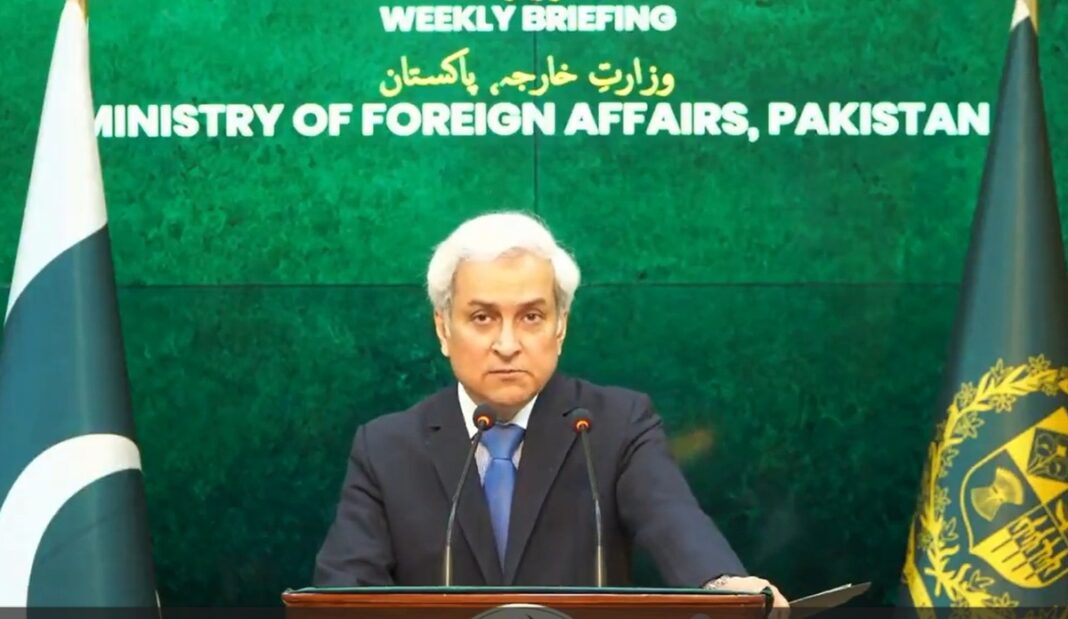
Pakistan has reiterated that dialogue and diplomacy remain the only viable path to resolving the ongoing tensions between Iran and the United States, while reaffirming its role in efforts aimed at restoring regional stability through the Islamabad Memorandum of Understanding (MoU).
During the Foreign Office’s weekly press briefing, the spokesperson said Pakistan remains actively engaged with regional partners to encourage de-escalation and the resumption of technical-level talks between Washington and Tehran. The briefing also covered Pakistan’s diplomatic engagement with Gulf states, developments on Palestine, relations with the United States and the Shanghai Cooperation Organisation (SCO), as well as Islamabad’s response to criticism of its nuclear programme.
Pakistan Reaffirms Support for Iran-US Dialogue
The Foreign Office expressed concern over the renewed instability in the Gulf despite a brief period of relative calm.
According to the spokesperson, Pakistan believes diplomacy remains the only sustainable solution to the crisis and continues to support efforts aimed at maintaining the ceasefire and resuming negotiations between Iran and the United States.
Islamabad said negotiations are continuing to:
- Reduce tensions in the Strait of Hormuz.
- Prevent further regional escalation.
- Restore technical-level talks under the Islamabad MoU.
- Implement understandings reflected in the Pakistan-Qatar Joint Statement.
The spokesperson stressed that Pakistan remains hopeful the current diplomatic efforts will eventually lead to a peaceful settlement.
Islamabad MoU Remains the Foundation for Peace
Responding to questions regarding the future of the Islamabad Memorandum of Understanding, the Foreign Office rejected suggestions that the agreement had become obsolete.
Instead, Pakistan described the Islamabad MoU as the principal framework for future negotiations between Iran and the United States.
According to the spokesperson, both the Islamabad MoU and the Pakistan-Qatar Joint Statement continue to provide the roadmap for technical-level discussions designed to resolve outstanding issues peacefully.
Pakistan Maintains Active Gulf Diplomacy
The briefing highlighted several high-level diplomatic engagements reflecting Pakistan’s continued focus on regional stability.
Among the key developments:
- Prime Minister Shehbaz Sharif held a telephone conversation with Saudi Crown Prince Mohammed bin Salman, with both leaders agreeing to work closely for regional peace and the uninterrupted flow of maritime trade through the Red Sea and the Strait of Hormuz.
- Deputy Prime Minister and Foreign Minister Senator Mohammad Ishaq Dar spoke separately with Saudi Foreign Minister Prince Faisal bin Farhan, discussing regional developments and reaffirming the importance of diplomacy.
- Senator Dar also held talks with Jordanian Foreign Minister Ayman Safadi, focusing on the deteriorating humanitarian situation in Palestine and coordinated diplomatic efforts.
Pakistan-Kuwait Defence Cooperation Expanded
The Foreign Office also highlighted the official visit of Kuwait’s Foreign Minister to Islamabad.
Both countries agreed to expand cooperation in:
- Trade
- Investment
- Energy
- Information technology
- Agriculture
- Education
- Healthcare
Pakistan also welcomed Kuwait’s ratification of the Pakistan-Kuwait Defence Cooperation Agreement, describing it as an important step towards strengthening institutional defence cooperation between the two countries.
Officials clarified that the agreement primarily focuses on peacetime military cooperation, including joint training and defence exchanges, rather than mutual defence obligations during armed conflict.
Pakistan to Host SCO Summit in 2027
The briefing confirmed Pakistan’s growing role within the Shanghai Cooperation Organisation (SCO).
Following participation in the SCO Council of Foreign Ministers meeting, Pakistan reaffirmed its readiness to assume the organisation’s chairmanship for 2026-27 and confirmed that it will host the SCO Summit in 2027.
The Foreign Office stated that invitations would be extended to all SCO member states, including India, in accordance with established organisational procedures.
Pakistan Highlights Improving Relations with the United States
The Foreign Office also pointed to improving bilateral engagement with Washington.
Senator Ishaq Dar recently addressed a delegation of U.S. lawmakers and business leaders, highlighting positive momentum in Pakistan-US relations and expressing Islamabad’s commitment to strengthening cooperation through:
- Parliamentary engagement
- Trade and investment
- Business partnerships
- People-to-people exchanges
Pakistan Rejects Deutsche Welle Documentary on Nuclear Programme
One of the strongest responses during the briefing concerned a recent documentary produced by Deutsche Welle (DW) on Pakistan’s nuclear programme.
The Foreign Office categorically rejected the documentary, describing it as misleading, speculative and based on biased sourcing.
According to the spokesperson, the documentary demonstrated either a misunderstanding or deliberate disregard of the history and rationale behind Pakistan’s nuclear deterrent.
Pakistan also reaffirmed confidence in its:
- Nuclear command and control system.
- Nuclear safety mechanisms.
- Technical safeguards.
- Institutional oversight.
The spokesperson stated that Pakistan’s nuclear security arrangements meet the highest international standards and have been recognised by independent international experts.
Pakistan Condemns Restrictions on Its Media in India
The Foreign Office also criticised India’s decision to block access to several Pakistani social media accounts, including those of PTV Digital.
Islamabad described the move as part of a broader pattern of restricting independent reporting and limiting freedom of expression.
The spokesperson urged the international community and media organisations to take note of what Pakistan characterised as a shrinking space for free speech in India.
Pakistan Reaffirms Position on Jammu and Kashmir
Responding to questions regarding recent statements by Indian officials, the Foreign Office reiterated Pakistan’s longstanding position on Jammu and Kashmir.
Islamabad rejected what it described as attempts to normalise India’s control over the territory and maintained that the dispute should be resolved through a United Nations-administered plebiscite in accordance with relevant UN Security Council resolutions.
The spokesperson also condemned the historical use of pellet guns in Indian Illegally Occupied Jammu and Kashmir, describing the practice as inconsistent with international human rights standards.
Pakistan Defends Counterterrorism Operations
The briefing also addressed questions regarding cross-border security operations involving Afghanistan.
Rejecting allegations contained in a recent UN report, the Foreign Office stated that Pakistan’s military operations are conducted with due diligence and are directed exclusively against terrorist targets.
The spokesperson emphasised that Pakistan remains engaged with the United Nations while continuing efforts to protect its citizens from cross-border terrorism.
Strategic Significance
The latest Foreign Office briefing underscores Pakistan’s effort to position itself as a diplomatic stakeholder in one of the Middle East’s most volatile crises. By advocating dialogue between Iran and the United States while maintaining close ties with Gulf partners, Islamabad is seeking to reinforce its role as a credible regional interlocutor.
At the same time, the government’s firm rejection of criticism surrounding Pakistan’s nuclear programme, its emphasis on expanding defence cooperation with Gulf states and its renewed engagement with major powers through the SCO and the United States reflect a broader foreign policy aimed at balancing regional security, strategic partnerships and economic diplomacy.