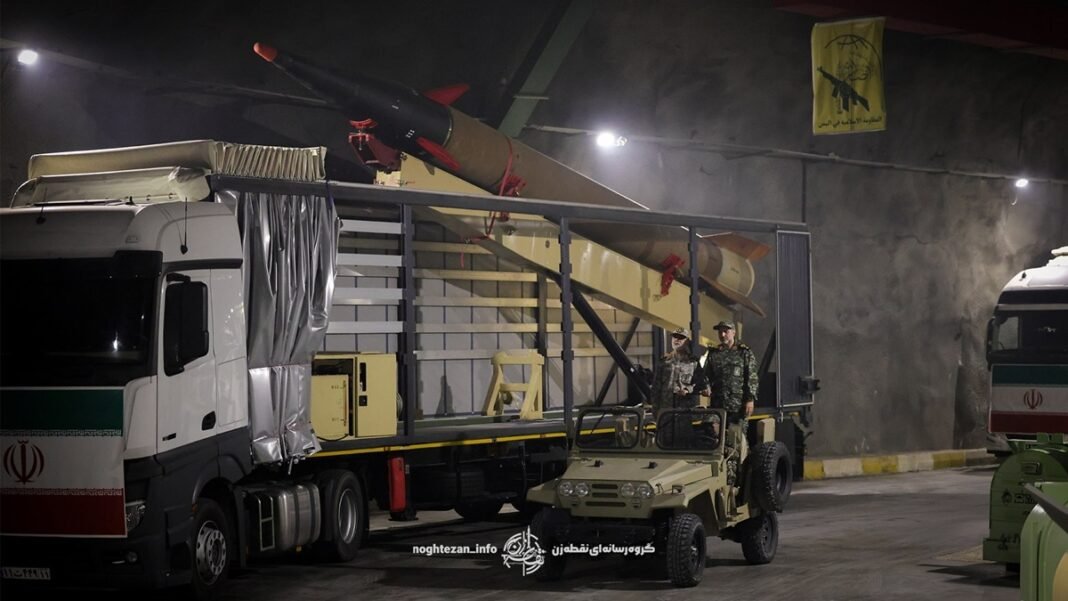
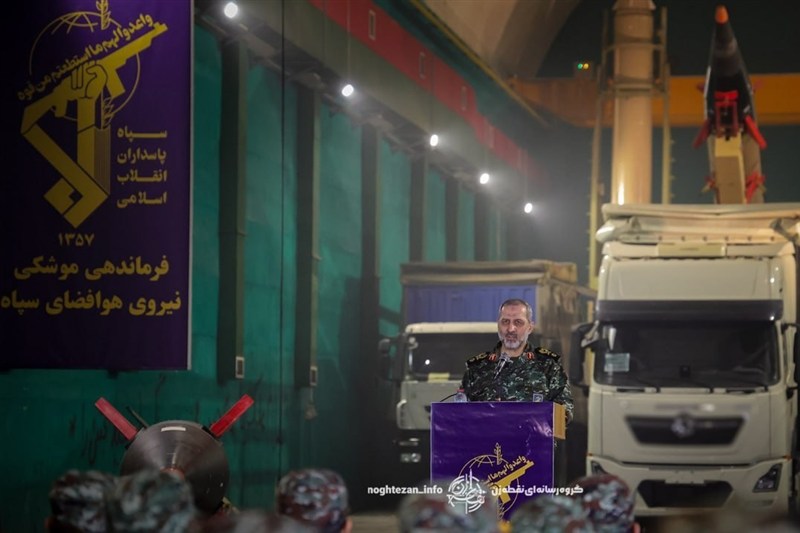
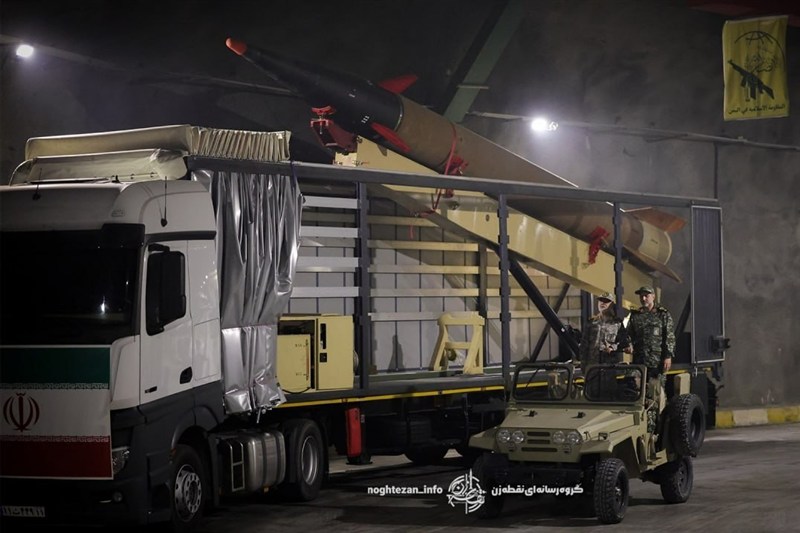
Footage published by Tasnim News Agency on November 10 shows two senior Iranian military commanders touring the underground complex, where rows of missiles, mobile launchers and other military equipment are displayed inside extensive subterranean corridors.
The visit was attended by Major General Ali Abdollahi, Chief of Staff of Iran’s Armed Forces, and Brigadier General Seyyed Majid Mousavi, commander of the IRGC Aerospace Force.
The facility’s precise location has not been disclosed.
Fattah-1 missiles and manoeuvring re-entry vehicles on display
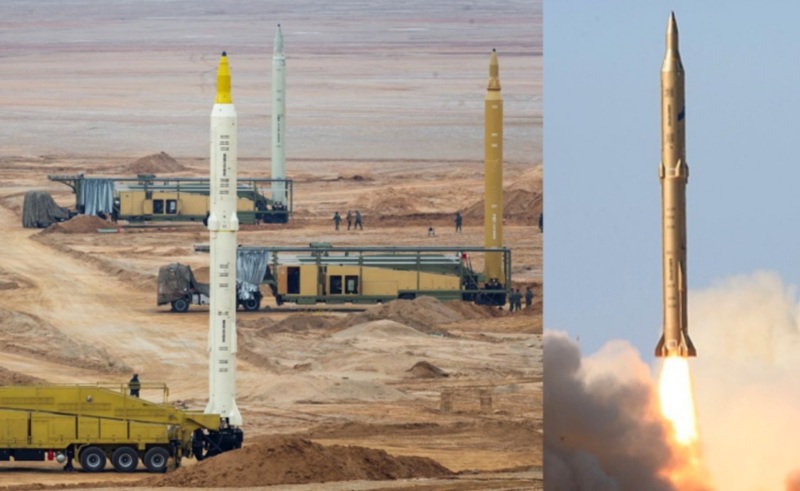
One of the most significant aspects of the footage is the apparent presence of Iran’s Fattah-1 ballistic missile systems.
The underground facility appears to contain multiple missiles alongside separately displayed manoeuvring re-entry vehicles (MaRVs), as well as complete missile configurations fitted with propulsion boosters and warhead sections.
The distinction is important. A conventional ballistic missile follows a largely predictable trajectory after its powered flight, making its projected flight path easier for missile-defence systems to calculate. A manoeuvring re-entry vehicle introduces additional uncertainty by changing its trajectory during the terminal phase of flight.
Iran introduced the Fattah missile in June 2023, describing it as a hypersonic weapon designed to manoeuvre and challenge advanced missile-defence systems.
According to Iranian specifications, the Fattah-1 has an advertised range of approximately 1,400 kilometres and a claimed maximum speed of Mach 13–15. Tehran has also highlighted its secondary propulsion system and manoeuvrable re-entry vehicle as distinguishing features.
These performance figures remain Iranian claims and should not be treated as independently established battlefield performance.
The footage is particularly relevant because it places the missile systems within a broader underground military infrastructure rather than presenting them solely as individual weapons.
Iran shifts missile and drone production underground
The unveiling follows an announcement by IRGC spokesman Brigadier General Hossein Mohebbi on November 7 that the Aerospace Force was moving beyond underground missile storage facilities towards underground production complexes.
Mohebbi said Iran had transferred missile and drone production lines from surface installations to underground locations, describing the emerging facilities as “missile production cities.”
According to the IRGC spokesman, the objective is to ensure that weapons manufacturing can continue even under sustained aerial bombardment.
This represents an important distinction in Iran’s military strategy.
Underground storage facilities protect existing missile inventories, while underground production infrastructure is intended to preserve the ability to manufacture, maintain and replenish weapons after attacks on surface-based industrial facilities.
Mohebbi also argued that Iran’s domestic defence industry, geographical depth and distributed production infrastructure would make it difficult for adversaries to halt its weapons programme through airstrikes.
These are official Iranian claims; the scale, location and actual production capacity of the underground facilities have not been independently established.
Iran lifts its 2,000-kilometre missile-range restriction
The timing of the missile-city unveiling is particularly significant because of a major statement made by the IRGC just days earlier.
On November 7, Brigadier General Hossein Mohebbi announced that Iran’s previously declared self-imposed restriction on ballistic missile range had been lifted.
Iran had long maintained that it voluntarily limited the range of its ballistic missiles to approximately 2,000 kilometres, a distance sufficient to reach Israel and numerous US military installations across the Middle East.
Mohebbi confirmed that the restriction no longer applied, although he did not announce the deployment of a new missile with a range exceeding 2,000 kilometres.
The distinction matters: removing a policy restriction does not automatically demonstrate that a country has developed, tested or deployed a longer-range operational missile.
Nevertheless, the announcement indicates a potentially significant shift in Tehran’s declared missile posture, particularly when considered alongside its renewed emphasis on underground weapons production and missile infrastructure.
The development has raised questions about the geographical scope of Iran’s future missile capabilities and the potential implications for security calculations beyond the Middle East.

Why Iran’s underground missile cities matter
Iran’s underground missile infrastructure has developed over several decades as part of its strategy to compensate for conventional military disadvantages and protect strategic weapons from potential air attacks.
The facilities, commonly referred to as missile cities, are designed to accommodate missile storage, transportation, maintenance and launch-support infrastructure.
Their military significance rests on several factors:
1. Protection against airstrikes
Underground construction can make missile inventories and associated infrastructure more difficult to locate and destroy through conventional aerial attacks, particularly when facilities are built deep beneath mountains or reinforced geological formations.
2. Operational continuity
Multiple underground corridors and access points can help military units maintain access to equipment even when surface infrastructure is damaged.
3. Missile dispersal and survivability
Distributing weapons across multiple locations complicates an adversary’s targeting calculations. Destroying visible launchers or known storage locations does not necessarily eliminate the entire missile force.
4. Sustaining missile production
If Iran’s claims about underground manufacturing facilities are accurate, the strategy could make its missile programme more resilient by protecting not only existing inventories but also the industrial capacity required to replenish them.
5. Maintaining retaliatory capability
For Tehran, preserving the ability to launch retaliatory strikes after absorbing an initial attack is central to its deterrence strategy.
The Center for Strategic and International Studies (CSIS) has previously examined Iran’s underground missile infrastructure, including facilities designed to accommodate ballistic and cruise missiles.
A message directed at Washington and Tel Aviv
The unveiling also carries a significant strategic and political message.
By allowing senior military commanders to tour the underground facility and publicising images of its missile inventory, Iran is signalling that its missile infrastructure remains an important component of its military posture despite previous attacks against Iranian military installations.
The appearance of Ali Abdollahi and Majid Mousavi is particularly noteworthy given their senior positions within Iran’s military command structure.
The two commanders represent the operational and strategic leadership responsible for maintaining Iran’s military readiness and aerospace capabilities.
According to reporting by Iran International, Abdollahi also warned during the visit that any renewed attack against Iran could trigger a response extending beyond the Middle East.
The message coincides with increasingly assertive statements from Iranian military officials about the country’s willingness to expand its retaliatory options.
For Israel, the demonstration reinforces the challenge of neutralising Iran’s missile capabilities through air operations alone. Even extensive strikes against known launch facilities may not guarantee the destruction of weapons concealed in underground complexes.
For the United States, the issue extends beyond the immediate threat to regional military installations. The survivability of Iran’s missile infrastructure has implications for American military planning across the Gulf, the eastern Mediterranean and the wider Middle East.
What the latest footage reveals about Iran’s missile strategy
The latest unveiling should not be interpreted simply as another presentation of Iranian military hardware.
Its significance lies in the combination of three developments: the public display of underground missile infrastructure, the IRGC’s stated transition towards underground weapons production and the removal of its previously declared 2,000-kilometre missile-range restriction.
Together, these developments point towards a strategy focused on preserving missile capabilities, maintaining weapons production and strengthening the credibility of Iran’s retaliatory options.
However, important questions remain unanswered. Tehran has not disclosed the facility’s location, its underground depth, its storage capacity or the number of operational missiles it contains. Nor has it provided independently verifiable evidence of the production capacity it claims to have transferred underground.
The Fattah-1’s actual battlefield performance against modern integrated missile-defence networks also remains a separate question from its advertised specifications.
Nevertheless, the message from Tehran is unmistakable: Iran wants its adversaries to consider not only the missiles it can launch today, but also the underground infrastructure that could allow it to sustain its missile force during a prolonged confrontation.
As tensions with Washington and Tel Aviv continue, Iran’s underground missile cities are likely to remain a central element of the regional military balance.