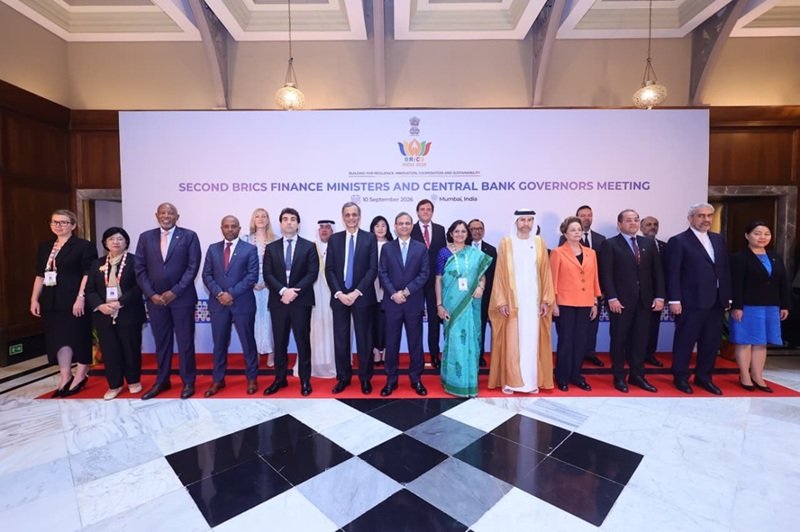
The wars in Iran and Ukraine are putting BRICS under an unusually difficult geopolitical test. The grouping has found common language on dialogue, sovereignty and opposition to unilateral pressure, but the sharply different interests of its members are making a unified position on the two conflicts increasingly difficult.
Putin, Modi, Pezeshkian, Ramaphosa take family photo at BRICS Business Forum pic.twitter.com/Zs10yw1xWQ
— Sputnik (@SputnikInt) September 11, 2026
The BRICS summit opening in New Delhi comes at a particularly uncomfortable moment for the expanded grouping.
For years, BRICS has presented itself as a platform through which major emerging economies can coordinate their positions on global governance, economic pressure and international security. But the wars in Iran and Ukraine are now testing how far that coordination can actually go when the interests of BRICS members collide.
The problem is especially visible in the Middle East.
Iran is itself a BRICS member. So is the United Arab Emirates, while Saudi Arabia remains closely associated with the expanded grouping. The war involving Iran has therefore created a direct internal fault line that did not exist when BRICS was a much smaller organisation.
Ukraine presents a different challenge.
Russia is one of BRICS’ founding members and remains one of its most influential powers. India maintains a close strategic relationship with Moscow but also has expanding ties with the United States and Europe. China has its own strategic partnership with Russia while simultaneously managing a complex relationship with Europe and the West.
The result is a BRICS that can increasingly agree on principles, but finds it much harder to agree on specific geopolitical crises.
That distinction could define the New Delhi summit.
Iran Is the Harder Test for BRICS
The war involving Iran has become the most immediate test of BRICS cohesion.
The grouping failed to produce a joint statement after its foreign ministers met in New Delhi in May because of differences over the conflict. Iran wanted stronger language condemning the US and Israeli military campaign, while the UAE sought language addressing Iranian attacks on Gulf states.
That disagreement goes to the heart of BRICS’ problem.
It is relatively easy for the grouping to oppose unilateral sanctions or call for reform of international institutions.
It is much harder to agree when two BRICS members are directly affected by the same war but hold opposing positions on it.
Ahead of the New Delhi summit, negotiators have again been working to find language acceptable to the different sides. Reports indicate that the central dispute concerns how the BRICS statement should address the West Asia conflict, particularly given the presence of Iran and the UAE.
The outcome will therefore be closely watched.
A strong statement explicitly supporting Iran would risk alienating Gulf members and countries seeking close relations with Washington.
A neutral statement could disappoint Tehran.
And silence would expose the limits of BRICS’ ability to act collectively on one of the biggest conflicts involving one of its own members.

Ukraine Presents a Different Kind of Problem
The Ukraine war creates a different diplomatic equation.
Russia is a direct party to the conflict, but most other BRICS members are not.
India has maintained close economic, energy and defence ties with Russia while repeatedly calling for dialogue and diplomacy to end the war.
That position was reiterated in the latest Modi-Putin discussions.
According to India’s official account of the meeting, Modi said dialogue and diplomacy were the way forward in resolving conflicts and that India was ready to assist peace efforts. The two leaders also discussed the Black Sea conflict and its impact on maritime trade and the safety of Indian seafarers.
This formulation is important.
India is not endorsing Russia’s conduct of the war.
But neither is New Delhi joining Western efforts to isolate Moscow.
Instead, India is trying to maintain a position that allows it to engage Russia while retaining diplomatic space with Ukraine, Europe and the United States.
That makes India potentially useful as a diplomatic bridge—but it also limits how far BRICS can move toward an explicitly pro-Russian position.
Modi-Putin Meeting Shows Where India Is Drawing the Line
The meeting between Modi and Putin on the sidelines of the BRICS summit is particularly significant because it combines close bilateral relations with India’s independent position on Ukraine.
The Indian Foreign Office said the two leaders reviewed cooperation in politics, economics, defence, energy, space, skills and people-to-people relations. They also discussed BRICS and regional and global developments.
The two sides agreed to continue strengthening the India-Russia “Special and Privileged Strategic Partnership.”
Putin also invited Modi to Russia for the next annual India-Russia summit, which Modi accepted.
Yet the Ukraine discussion was framed around diplomacy rather than military alignment.
That is probably the most revealing feature of India’s current BRICS policy.
New Delhi wants strong relations with Moscow, but it does not want BRICS to become a vehicle for endorsing Russia’s war.

Russia Also Sees India as a Potential Diplomatic Channel
Moscow’s response to India’s position is equally important.
Kremlin spokesman Dmitry Peskov has said Russia welcomes India’s peace efforts and that Moscow’s position on resolving the Ukraine conflict through peaceful means corresponds to India’s position to a considerable extent.
That does not mean Moscow and New Delhi have identical positions on the war.
It does, however, create a diplomatic space that Western countries have found difficult to establish with Russia.
India maintains communication with Moscow at the highest level while also maintaining relations with Kyiv and Western capitals.
That gives Modi an unusual position within BRICS.
Putin’s BRICS Message: The Global Economy Is Changing
The speeches at the BRICS Business Forum reinforce another area of convergence.
Putin argued that the world is experiencing profound structural changes and that new centres of economic growth are becoming increasingly important. He highlighted BRICS’ population and economic weight as evidence of this shift.
Iranian President Masoud Pezeshkian went further on the financial side, calling for greater use of national currencies in trade and stronger BRICS financial mechanisms to reduce vulnerability to political shocks.
He also argued that the New Development Bank should play a larger role in infrastructure and energy financing.
Brazilian Foreign Minister Mauro Vieira similarly warned against protectionism, economic coercion and unilateral sanctions.
These positions reveal where BRICS currently has its greatest political overlap.
The strongest common ground is not necessarily on wars. It is on the international economic system surrounding those wars.
The Emerging BRICS Position on the Conflicts
Taken together, the speeches and diplomatic activity suggest that a broad BRICS position is emerging around several principles:
- conflicts should be addressed through dialogue and diplomacy;
- sovereignty and territorial integrity should be respected;
- civilian populations should be protected;
- maritime trade and freedom of navigation should be maintained;
- unilateral sanctions and economic coercion are viewed with suspicion;
- developing countries should have greater influence in global decision-making;
- economic dependence should not automatically translate into political vulnerability.
These principles are broad enough to accommodate very different national positions.
That may be deliberate.
BRICS does not need to agree on every conflict to remain useful to its members.
Instead, it can seek consensus around the rules and principles that members believe should govern the international system.

But Iran Exposes the Limits of That Strategy
The Iran war makes even that approach difficult.
Iran wants BRICS to acknowledge what Tehran regards as an externally imposed war and condemn the actions of the United States and Israel.
The UAE, however, has its own security concerns following Iranian attacks and cannot easily support language that appears to endorse Tehran’s position.
Saudi Arabia adds another complication.
China and Russia have close strategic relations with Iran, but neither necessarily wants BRICS to become directly involved in the conflict in a way that increases regional instability.
India faces an even more complicated equation.
New Delhi has longstanding ties with Iran, important interests in Gulf states, close energy relationships with Russia and increasingly important strategic and economic relations with the United States.
For India, therefore, keeping BRICS together may be more important than producing the strongest possible statement on Iran.
Ukraine Shows the Other Side of the BRICS Equation

Ukraine is different because there is no equivalent intra-BRICS war between member states.
But Russia’s membership creates a fundamental challenge.
If BRICS strongly condemns Moscow, it risks undermining one of its most powerful members.
If it explicitly endorses Russia’s position, it risks alienating India, Brazil and other members that do not want the organisation transformed into a Russian-led geopolitical platform.
The most practical middle ground is therefore the language India has repeatedly promoted:
dialogue, diplomacy, peace efforts and respect for sovereignty.
That language does not solve the war.
But it allows BRICS to remain politically functional.
Why India May Be the Key Player
The wars in Iran and Ukraine have placed India at the centre of BRICS diplomacy.
New Delhi has relationships with almost every side of the major geopolitical disputes surrounding the summit.
It has a strategic partnership with Russia.
It has growing ties with the United States.
It maintains relations with Iran and the Gulf states.
It has been working to stabilise relations with China.
And it has increasingly presented itself as a country willing to facilitate dialogue rather than choose permanently between competing blocs.
That makes India’s BRICS presidency unusually important.
India’s objective is unlikely to be the creation of a common foreign policy.
It is more likely to be keeping the enlarged grouping functional despite major disagreements among its members.
BRICS Expansion Has Created Both Strength and Weakness
The Iran crisis demonstrates the paradox of BRICS expansion.
Adding major energy producers, Asian economies and Middle Eastern states has increased the group’s economic and geopolitical weight.
But it has also imported new rivalries.
Iran and the UAE have conflicting interests.
India and China remain strategic competitors.
Egypt and Ethiopia have their own regional disagreements.
Saudi Arabia’s relationship with the grouping remains complicated.
The larger BRICS becomes, the more difficult it becomes to achieve consensus on contentious geopolitical questions.
Yet the same diversity also gives the organisation greater diplomatic reach.
That is the paradox India is now trying to manage.
Could BRICS Play a Role in the Ukraine Peace Process?
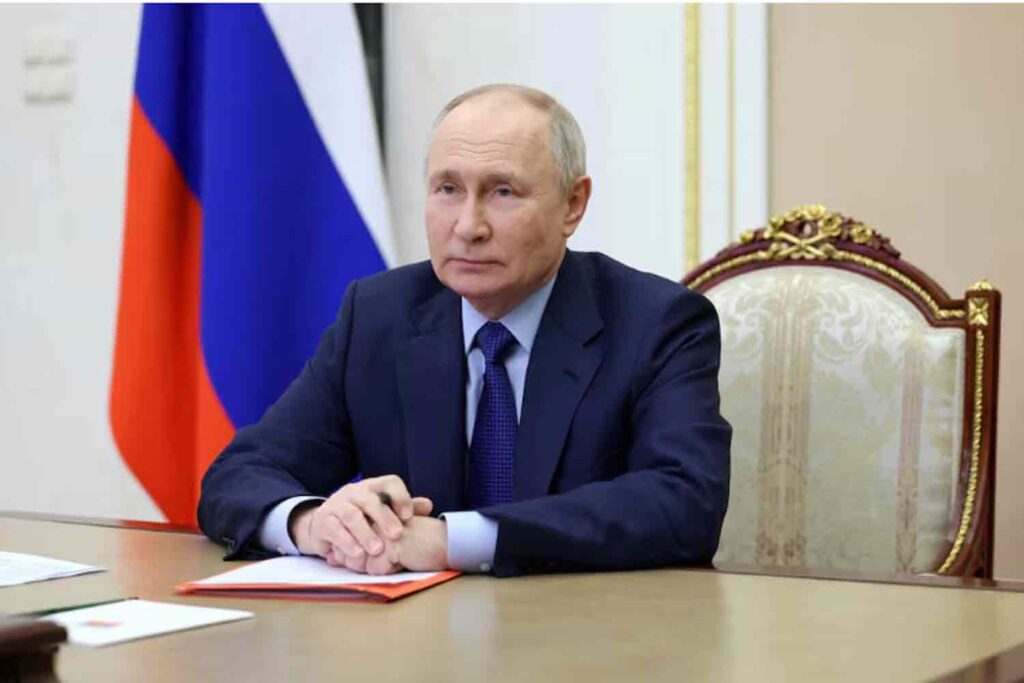
This is one area where a limited geopolitical opening may be possible.
BRICS as a collective organisation is unlikely to become the main mediator between Russia and Ukraine.
There is too much disagreement within the grouping.
But individual BRICS members could play important roles.
India is the obvious example.
China has maintained communication with Moscow and has previously presented its own proposals concerning the Ukraine conflict.
Brazil has also attempted to promote diplomatic approaches.
These countries could potentially support parallel diplomatic channels without requiring BRICS to adopt a single peace plan.
The more realistic possibility is therefore BRICS countries acting individually but using the grouping as a political environment for dialogue.
Could BRICS Influence the Iran Conflict?
Here the possibilities are more limited.
The first objective may simply be preventing the Iran conflict from destroying BRICS consensus.
A joint statement calling for an immediate reduction in tensions, protection of civilians, respect for sovereignty and secure maritime trade would allow the grouping to demonstrate relevance without taking a position on every disputed question.
The second possibility is diplomatic engagement by individual members.
India, China and Russia all have relationships with Iran that could potentially be used for communication.
But none of them can single-handedly resolve the conflict.
And BRICS lacks the institutional mechanisms of a formal security alliance.
The Real Test Is Not Whether BRICS Can End These Wars
It is unrealistic to expect BRICS to resolve either Ukraine or Iran at the New Delhi summit.
The more meaningful question is whether it can remain politically coherent while its members disagree about those wars.
That is a much tougher test.
If the leaders can produce a joint statement that recognises the different positions but still establishes basic principles—dialogue, diplomacy, sovereignty, civilian protection and open maritime trade—it would demonstrate a degree of political resilience.
If they cannot, the failure would reinforce the argument that BRICS is primarily an economic and diplomatic forum rather than an emerging geopolitical bloc.

What to Watch at the New Delhi Summit
Four developments will be particularly important.
1. The wording on Iran
Will BRICS condemn the military campaign against Iran?
Will it mention Iranian attacks on Gulf states?
Or will it settle for general language on sovereignty, civilian protection and diplomacy?
The wording will reveal the limits of consensus.
2. The wording on Ukraine
Will Russia’s war be mentioned directly?
Will the statement use broader language about conflicts and negotiations?
India is likely to prefer language that keeps the door open to diplomacy without directly confronting Moscow.
3. Modi’s diplomacy with Putin and other leaders
The Modi-Putin meeting demonstrates that India is maintaining its strategic relationship with Moscow while continuing to push a diplomatic approach to Ukraine.
A subsequent Modi-Xi engagement could also matter because the India-China relationship remains one of the central strategic variables inside BRICS. Current reporting indicates that both bilateral relationships are expected to feature prominently around the summit.
4. Whether BRICS can actually issue a joint declaration
This may be the simplest measure of success.
After the failure to produce a joint foreign ministers’ statement in May, another breakdown would be politically damaging.
A consensus statement, even if carefully worded, would demonstrate that the enlarged BRICS can absorb major disagreements without becoming paralysed.
No New World Order Yet—But a New Diplomatic Reality Is Emerging
It would be premature to describe BRICS as an alternative world order.
The grouping lacks the political unity, institutional integration and common security structure required to operate as a unified geopolitical bloc.
But something important is changing.
The Iran and Ukraine wars are forcing BRICS members to confront questions that previously existed largely at the level of economic cooperation: What happens when members have conflicting security interests? Can a group this diverse maintain a common diplomatic voice? And can emerging powers provide diplomatic alternatives without becoming another rigid geopolitical bloc?
The answers are still unclear.
What is becoming clearer is that BRICS is no longer simply a discussion forum about trade and development.
Its members increasingly expect it to respond to major international crises.
The New Delhi summit is therefore less a test of whether BRICS can create a new world order than a test of whether an increasingly influential but internally diverse group can develop a workable common position on the wars shaping today’s international politics.
On Ukraine, there appears to be space around dialogue and diplomacy.
On Iran, the divisions are much sharper.
And that contrast may ultimately tell us more about the future of BRICS than its economic statistics ever could.