Gulf Cooperation Council (GCC) defence ministers have approved the establishment of a forward military command headquarters in Kuwait, marking a significant development in the bloc’s efforts to strengthen collective defence capabilities amid escalating regional security challenges and the continuing fallout from the US-Israel war with Iran.
The decision, announced on November 10, 2026, also includes the allocation of appropriate military forces to the new headquarters, indicating that the initiative is intended to move beyond diplomatic coordination towards a more structured military presence.
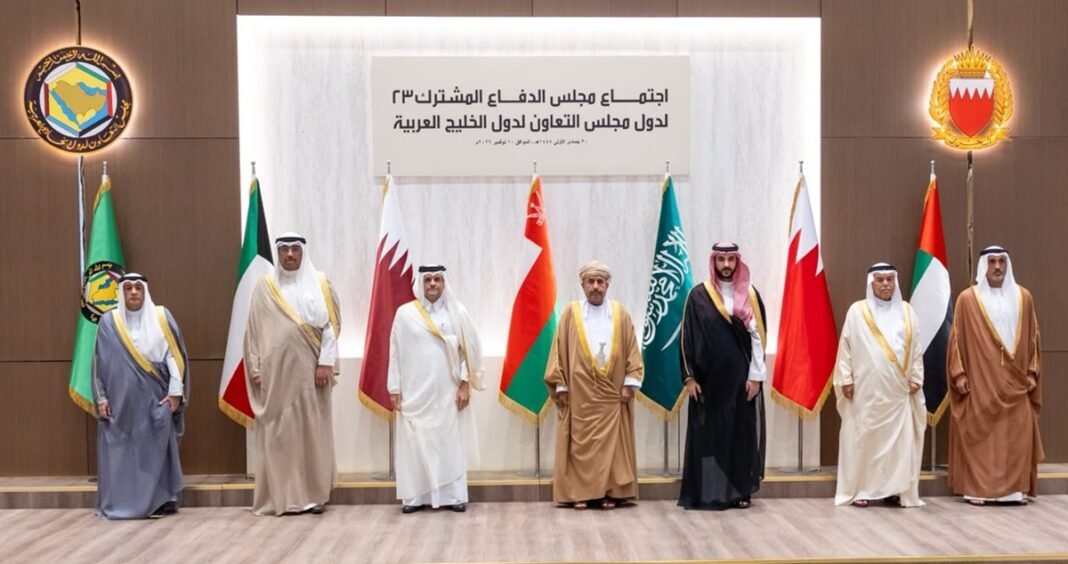
The approval was granted during the 23rd session of the GCC Joint Defence Council in Manama, Bahrain, attended by defence ministers from all six member states: Saudi Arabia, the United Arab Emirates, Kuwait, Bahrain, Qatar and Oman.
GCC Secretary-General Jasem Mohamed Albudaiwi announced the decision, describing closer military cooperation as essential to protecting the sovereignty, security and territorial integrity of member states.
The announcement comes at a particularly sensitive time for the Gulf, where Iranian missile and drone attacks, Houthi operations, maritime disruptions and threats to critical energy infrastructure have exposed the security vulnerabilities of the region.
The establishment of a forward command in Kuwait could provide the GCC with an additional mechanism for coordinating military responses, improving operational readiness and managing security threats across the northern Gulf.
Kuwait to Host GCC’s Forward Military Command
Under the newly approved arrangement, Kuwait will host an advanced headquarters of the GCC Unified Military Command, with appropriate forces assigned to support its operations.
The decision was taken during the 23rd meeting of the Joint Defence Council, chaired by Bahrain’s Minister of Defence Affairs, Lieutenant General Abdullah bin Hassan Al Nuaimi.
According to the GCC announcement, the initiative forms part of a wider effort to expand military cooperation and advance defence integration among member states.
However, several operational details remain undisclosed.
These include:
- The exact location and infrastructure of the new headquarters.
- The number of military personnel and units to be assigned.
- Whether the deployment will include land, air defence or naval components.
- The command-and-control arrangements linking the Kuwait headquarters with national military establishments.
- The operational timetable and readiness targets.
The absence of these details means the announcement should not yet be interpreted as the creation of a fully integrated Gulf combat force.
Nevertheless, assigning military units to a forward headquarters represents an important institutional step towards more permanent joint defence coordination.
The development also gives Kuwait a greater role in the GCC’s regional military planning, particularly because of its geographical position at the northern end of the Persian Gulf.
Why Kuwait? The Strategic Importance of the Northern Gulf
Kuwait’s selection is significant because of its geographical position between Iraq, Saudi Arabia and the northern Gulf, with Iran situated across the Gulf waters.
This location places the country within a sensitive regional security environment involving missile threats, drone operations, maritime routes and cross-border security concerns.
A forward military headquarters in Kuwait could strengthen coordination in several areas:
Northern Gulf security: The facility could improve military coordination concerning developments around Kuwait, Iraq and the northern Gulf.
Missile and drone threats: A more permanent command structure could facilitate faster communication between national defence establishments when responding to aerial threats.
Maritime security: Kuwait’s location provides strategic relevance to monitoring developments affecting commercial shipping and energy transportation through the Gulf.
Military readiness: Assigning forces to a forward headquarters could reduce coordination delays and support joint planning during regional emergencies.
Regional crisis management: The facility could provide a central point for coordinating responses to threats affecting multiple GCC countries simultaneously.
The operational value will ultimately depend on the forces assigned, the authority granted to the headquarters and the degree of integration between the six national military systems.
Iran War Exposes Gulf Security Vulnerabilities
The decision comes against the background of the US-Israel war with Iran, which began on February 28, 2026, and triggered a wider regional security crisis.
Gulf countries, several of which host major American military installations, have faced repeated Iranian missile and drone attacks since the conflict began.
Tehran has described its retaliatory operations as targeting American military assets and facilities associated with the US military presence in the region. However, attacks have also affected civilian areas and critical infrastructure, according to Gulf government statements and international reporting.
The resulting security environment has placed additional pressure on Gulf defence establishments.
The attacks have highlighted the vulnerability of:
- Military installations and airfields.
- Airports and civilian aviation infrastructure.
- Oil and gas production facilities.
- Electricity and water infrastructure.
- Commercial ports and maritime transportation.
- Strategic logistics and supply routes.
For the GCC, the challenge is no longer limited to protecting individual national territories. Missile and drone operations can create simultaneous security problems across several countries, requiring rapid information sharing and coordinated responses.
This makes the establishment of a forward military command particularly relevant.
GCC Secretary-General Albudaiwi specifically praised the military cooperation demonstrated by member states in responding to Iranian attacks and described Gulf security as a shared responsibility.
The organisation also condemned attacks attributed to Yemen’s Houthi movement against Saudi Arabia, including incidents involving sensitive sites.
These statements underline the broader security environment behind the Kuwait headquarters decision.
A New Phase in GCC Military Integration
The Kuwait headquarters is not the creation of an entirely new military organisation. It will operate within the existing framework of the GCC Unified Military Command.
The GCC established the Unified Military Command during its 34th summit in Kuwait in December 2013, with the objective of strengthening collective defence and coordinating military operations among member states.
Its permanent headquarters in Riyadh was inaugurated on November 22, 2021, under the patronage of Saudi Crown Prince Mohammed bin Salman.
The command was designed to improve coordination between the armed forces of the six GCC countries and strengthen their ability to respond to shared security threats.
The GCC also maintains the Peninsula Shield Force, a collective military formation established in the 1980s to support the defence of member states.
The latest decision adds a forward headquarters in Kuwait to this existing structure.
This distinction is important: Riyadh remains the location of the existing Unified Military Command headquarters, while Kuwait is expected to host an additional advanced command facility.
The development suggests an effort to distribute operational coordination more effectively across the region rather than relying exclusively on a central headquarters.
It also reflects the GCC leadership’s growing emphasis on military integration following the regional security shocks of 2026.
Will the New Command Integrate Gulf Air Defence Systems?
One of the most important questions surrounding the new headquarters concerns the integration of air and missile defence capabilities.
The recent regional conflict has demonstrated how missile and drone threats can challenge national defence systems operating independently.
GCC countries possess a combination of advanced American and European defence systems, including Patriot and THAAD missile defence capabilities, as well as different radar, surveillance and air-defence platforms.
However, the effectiveness of a collective defence arrangement depends not simply on purchasing advanced weapons but on ensuring that different systems can communicate and operate together.
A more integrated GCC command structure could potentially improve:
- Shared radar and early-warning information.
- Coordination between national air-defence command centres.
- Identification and tracking of incoming missiles and drones.
- Exchange of intelligence on regional aerial threats.
- Coordination of interceptor deployment and defensive responses.
- Joint military planning during simultaneous attacks.
The new headquarters could provide an institutional framework for improving these functions.
However, the GCC has not announced that the Kuwait facility will directly control all six countries’ air-defence systems.
Nor has it disclosed whether the new command will receive authority to coordinate interceptor allocation or cross-border military engagements.
Those questions will be important indicators of how far Gulf defence integration actually progresses.
US Military Bases in the Gulf: Complementing Washington or Building Strategic Autonomy?
The decision also raises an important question about the future of American military involvement in Gulf security.
The United States maintains an extensive military presence across the region.
Its installations and military facilities in countries such as Bahrain, Qatar, Kuwait, Saudi Arabia and the UAE have played an important role in regional security arrangements.
These include the US Navy’s Fifth Fleet headquarters in Bahrain, Al Udeid Air Base in Qatar and Camp Arifjan in Kuwait.
The American military presence has traditionally provided Gulf governments with access to advanced intelligence, air defence capabilities, logistical support and military deterrence.
However, the recent conflict has also highlighted the complicated position of Gulf states.
While maintaining strategic partnerships with Washington, these countries have faced security consequences arising from a wider military confrontation involving the United States, Israel and Iran.
This has strengthened the rationale for developing greater indigenous and collective defence capabilities.
The new Kuwait command could therefore serve two complementary purposes.
First, it could improve the GCC’s ability to coordinate its own armed forces rather than relying entirely on separate national command structures.
Second, it could provide a more organised regional framework for cooperation with existing international security partners.
The announcement does not establish that Gulf governments are abandoning their military relationships with Washington.
Rather, it indicates that the GCC is seeking to strengthen its own collective defence arrangements alongside existing partnerships.
The distinction between dependence on external security guarantees and the development of independent regional capabilities is likely to become increasingly important.
Strait of Hormuz and Energy Security: A Major Strategic Concern
The security of the Strait of Hormuz is another major factor behind the GCC’s decision.
The waterway remains one of the world’s most important energy transportation routes, connecting major Gulf oil and gas producers with international markets.
Any prolonged disruption can affect global oil prices, shipping insurance, supply chains and energy security.
According to figures cited by the US Energy Information Administration, oil flows through the Strait of Hormuz averaged approximately 4.9 million barrels per day in the second quarter of 2026, compared with around 21 million barrels per day a year earlier.
The reduction illustrates the scale of the disruption affecting the region’s energy transportation system.
Gulf countries have also been exploring alternative transportation arrangements to reduce dependence on the Strait.
Saudi Arabia’s East-West pipeline, which transports crude oil towards the Red Sea port of Yanbu, has become particularly important in this context.
Reports on November 10 indicated that the pipeline infrastructure had also faced an attack in the Madinah region, although Saudi authorities said operations continued after a limited fire was extinguished.
The GCC’s decision to establish a forward military headquarters in Kuwait must therefore be understood within a wider security environment involving energy infrastructure, maritime transportation and the protection of critical economic assets.
A more integrated military command could help coordinate regional responses to threats affecting these interconnected systems.
Nevertheless, the new headquarters alone cannot guarantee the security of the Strait of Hormuz or restore normal maritime traffic.
That would require a combination of naval capabilities, air surveillance, intelligence sharing, diplomatic arrangements and effective crisis management.
Houthi Threat Adds Another Dimension to Gulf Defence Planning
The security challenge facing the GCC is not limited to Iran.
The Houthi movement in Yemen remains another important factor in the regional military equation.
Houthi missile and drone capabilities have previously targeted Saudi territory, energy infrastructure and strategic installations.
The threat has demonstrated how relatively low-cost unmanned systems and missiles can create significant defensive and economic challenges for countries with advanced military infrastructure.
The GCC has therefore maintained concerns over the possibility of renewed attacks originating from Yemen.
Secretary-General Albudaiwi specifically condemned Houthi attacks against Saudi Arabia during his November 10 announcement and reaffirmed the bloc’s solidarity with the Kingdom.
This suggests that the new military headquarters is intended to address a wider range of regional threats rather than being exclusively designed around the US-Iran confrontation.
The inclusion of missile, drone, maritime and cross-border security concerns in future joint planning could shape the operational responsibilities of the Kuwait facility.
What Does the Development Mean for Pakistan?
The establishment of a forward GCC military headquarters in Kuwait also carries implications for Pakistan.
Pakistan maintains longstanding defence relationships with Saudi Arabia, the UAE, Qatar, Bahrain and other Gulf countries.
Its military cooperation with Saudi Arabia has historically included training, defence exchanges and security arrangements.
The strategic importance of this relationship increased further following the Pakistan-Saudi mutual defence agreement signed in 2025.
For Islamabad, the emerging GCC military structure could create additional opportunities for defence cooperation in areas such as:
- Military training and professional exchanges.
- Counter-drone and air-defence cooperation.
- Intelligence sharing and security coordination.
- Maritime security and protection of commercial shipping.
- Defence technology and military logistics.
Pakistan’s experience in regional military cooperation and its established defence relationships with Gulf countries could become relevant as the GCC expands its collective military capabilities.
However, the new Kuwait headquarters is a GCC initiative, and there has been no announcement that Pakistan will be formally integrated into its command structure.
For Pakistan, the wider regional development also has an economic dimension.
Any prolonged disruption to Gulf energy supplies or maritime transportation could affect Pakistan’s fuel imports, energy costs and economic stability.
A more coordinated regional defence arrangement could contribute to improving security, but the broader situation will continue to depend on diplomatic developments between Iran, the United States and Gulf governments.

What Comes Next for the GCC Military Command?
The most important test of the new headquarters will be its actual operational responsibilities.
The announcement establishes political approval for the facility and the allocation of forces, but the GCC has not yet published a detailed deployment plan.
Several developments will be worth monitoring:
- Force allocation: Whether the six member states assign permanent military units or rotating personnel to the Kuwait headquarters.
- Air-defence integration: Whether the new facility receives a formal role in coordinating radar networks, missile warning systems and counter-drone operations.
- Joint command arrangements: Whether it operates with delegated operational authority or primarily serves as a coordination and planning centre.
- Maritime security: Whether naval coordination and protection of shipping routes become part of its responsibilities.
- Relations with the United States: Whether the GCC expands its independent military coordination while continuing to work with American defence structures.
- Regional diplomacy: Whether the new military framework is accompanied by efforts to reduce tensions with Iran and prevent further attacks on Gulf infrastructure.
These developments will help determine whether the Kuwait headquarters becomes a permanent operational component of Gulf collective defence or remains primarily an advanced coordination facility.
Conclusion: Gulf States Move Towards a More Integrated Defence Structure
The approval of a forward military command in Kuwait represents a significant development in the evolution of Gulf defence cooperation.
The decision reflects growing recognition among GCC governments that regional security threats increasingly cross national borders and require coordinated military responses.
The US-Israel war with Iran, missile and drone attacks, threats to energy infrastructure and disruptions to maritime transportation have all contributed to the urgency of strengthening collective defence arrangements.
For Kuwait, hosting the forward headquarters will increase its institutional role in regional military coordination.
For Saudi Arabia, the UAE, Bahrain, Qatar and Oman, the initiative provides another mechanism for improving cooperation between their armed forces.
The development does not mean that the GCC is abandoning its security partnerships with the United States, nor does it establish that a unified Gulf combat force has already been created.
Its longer-term significance will depend on whether the six countries can translate political commitments into interoperable military capabilities, shared intelligence and effective command arrangements.
The establishment of the Kuwait headquarters marks another step in the GCC’s effort to shape its own regional security architecture at a time when the Gulf is confronting one of its most complex security environments in decades.