


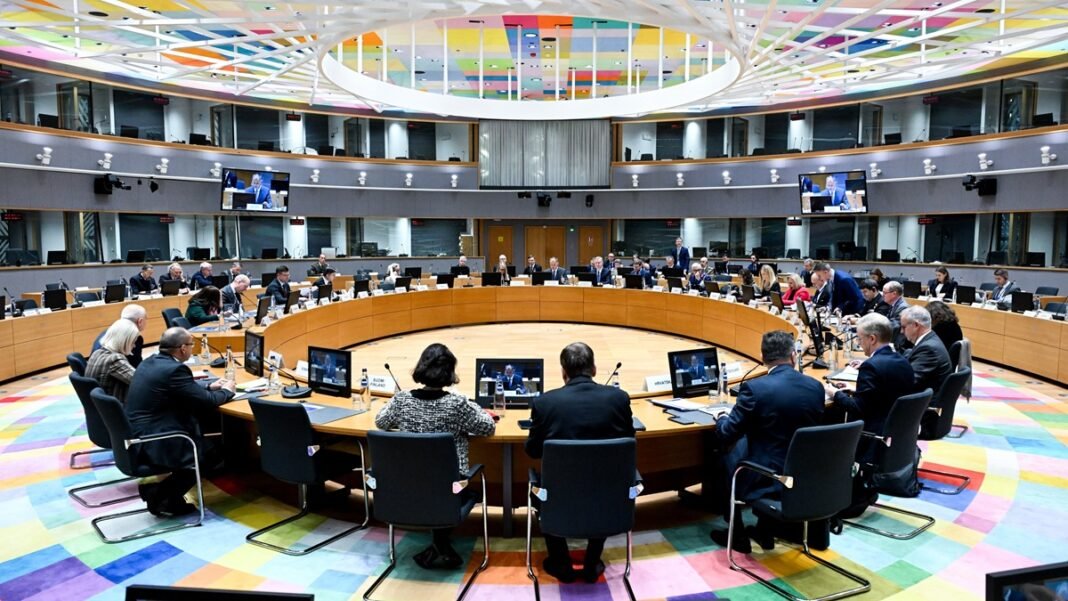
European defence ministers have convened in Brussels on November 17 to discuss the future of European security, military assistance for Ukraine, defence cooperation with the United States and strategic challenges arising from China’s growing influence.
The meeting, chaired by European Union foreign policy chief Kaja Kallas, comes as European governments face increasing pressure to strengthen their military capabilities, reduce strategic dependencies and prepare for a potentially prolonged confrontation with Russia.
The Brussels gathering is particularly significant because it brings together discussions on Ukraine’s immediate military requirements and Europe’s longer-term defence readiness. It also takes place just two days before a major meeting of the Coalition of the Willing in Berlin, where leaders are expected to examine security guarantees for Ukraine and diplomatic efforts to end the war.

Ukraine’s Air Defence and Military Integration Top EU Agenda
Support for Ukraine remains one of the central issues confronting European defence ministers.
According to the European Council’s agenda, ministers are discussing additional support for Ukraine, with particular emphasis on air defence capabilities and integrating Ukraine into Europe’s defence technological and industrial base.
Ukrainian Defence Minister Yevhenii Khmara has been invited to participate in the relevant discussions, providing an opportunity for Kyiv to communicate its military requirements directly to European governments.
The focus on air defence reflects Ukraine’s continuing need to protect its cities, military infrastructure and critical energy facilities against Russian missile and drone attacks.
Beyond immediate military assistance, European governments are also looking at ways to deepen cooperation between Ukrainian and European defence industries. Ukraine’s battlefield experience, particularly in drone warfare, electronic warfare and air defence, has become an increasingly important source of military lessons for European armed forces.
Closer industrial cooperation could include joint production, technology development and the integration of Ukrainian defence companies into European supply chains.
The EU’s objective is not simply to provide weapons to Ukraine but also to strengthen its long-term military capacity and establish a more sustainable defence partnership.

EU-China Relations Become Part of Europe’s Security Debate
Another important issue on the Brussels agenda is the security and defence dimension of EU-China relations.
European ministers are examining strategic vulnerabilities arising from critical dependencies, defence supply chains and China’s position in the broader international security environment.
The discussion reflects growing European concerns about the security implications of dependence on external suppliers for strategically important materials, technologies and industrial components.
China’s relationship with Russia is also an important consideration in European security calculations, particularly as European governments seek to prevent Moscow from strengthening its military capabilities through external assistance.
The debate is therefore broader than the Ukraine conflict. It concerns Europe’s ability to maintain independent defence capabilities, protect critical infrastructure and secure reliable access to essential technologies and industrial supplies.
Transatlantic Security and NATO Coordination
The Brussels meeting also includes discussions on transatlantic security and defence, with US Under Secretary of War for Policy Elbridge Colby participating in the exchange with European defence ministers.
The discussions are taking place amid continuing debate over the distribution of defence responsibilities between Europe and the United States.
European governments increasingly recognise the need to strengthen their own military capabilities while maintaining NATO as the principal framework for collective defence.
The challenge is to develop a stronger European defence industrial and military capacity without creating unnecessary divisions within the transatlantic alliance.
For Washington, European defence investment and greater burden-sharing remain important elements of the debate over NATO’s future.
For European capitals, the issue is equally strategic: they need to ensure that the continent can respond effectively to security threats even if American military attention and resources are increasingly directed towards other regions.
Merz and Stubb Prepare for Berlin’s Coalition of the Willing Summit
While defence ministers are meeting in Brussels, German Chancellor Friedrich Merz is hosting Finnish President Alexander Stubb in Berlin on November 17.
The discussions are expected to focus on European security, defence cooperation and Russia’s war against Ukraine.
Finland’s participation carries particular strategic importance because of its geographical position along Russia’s northwestern frontier and its central role in Northern European security.
Finland joined NATO in April 2023, fundamentally changing the alliance’s strategic geography and strengthening its military presence along the northern flank.
Stubb has consistently advocated a strong European role in supporting Ukraine and maintaining pressure on Russia.
His Berlin visit also comes ahead of the November 19 Coalition of the Willing summit, which Merz will host alongside French President Emmanuel Macron and British Prime Minister Andy Burnham.
The summit will be held under the theme United for Peace in Ukraine and European Security.
According to the German government, the discussions will focus on coordinating diplomatic initiatives, establishing security guarantees for Ukraine after the war and maintaining international support for Kyiv.
Finnish President Stubb is among the leaders expected to participate.
Coalition of the Willing: Preparing Security Guarantees for Ukraine

The Coalition of the Willing has developed into an important political and military framework for coordinating international support for Ukraine.
According to France’s Foreign Ministry, the coalition brings together 36 countries committed to supporting Ukraine over the long term.
Its work extends beyond the delivery of weapons and financial assistance. It also involves discussions on how Ukraine could be protected against another Russian military offensive if a ceasefire or peace agreement is reached.
The security framework developed by coalition members includes five major elements:
- Participation in a US-led ceasefire monitoring and verification mechanism.
- Long-term financial, military and capability support for Ukraine’s armed forces.
- Preparation of a multinational reassurance force that could be deployed in Ukraine following a credible cessation of hostilities, at Kyiv’s request.
- Commitments to support Ukraine in the event of another Russian attack.
- Deeper long-term defence cooperation between Ukraine and participating countries.
An important development is the preparation of the Multinational Force for Ukraine (MNF-U).
France’s Foreign Ministry says that Exercise Koalicija 26.2 is taking place from November 2 to November 24, with key activities running from November 9 to November 22.
The exercise involves approximately 2,800 military personnel from 13 countries contributing to the multinational force.
The preparations are designed to test military coordination, logistics, force protection and the arrangements required to support Ukraine if the political and security conditions permit such a deployment.
The proposed multinational force is intended as a reassurance and deterrence mechanism rather than an automatic deployment during ongoing hostilities.
Europe Faces a Larger Strategic Question
The developments in Brussels and Berlin point towards a broader transformation in European security policy.
For years, European security relied heavily on NATO’s collective defence framework and American military capabilities. Russia’s invasion of Ukraine has accelerated efforts to strengthen Europe’s own defence industrial base, improve military readiness and coordinate long-term strategic planning.
However, several difficult questions remain unresolved.
European governments must determine how much additional military assistance Ukraine requires, who will finance its long-term defence, and whether participating countries will be prepared to commit troops to a multinational force after a ceasefire.
The relationship between European defence autonomy and NATO’s continued central role also remains an important issue.
The November 19 summit in Berlin could provide further clarity on these questions, particularly regarding security guarantees and the practical commitments participating countries are prepared to make.
Ultimately, Europe’s challenge is no longer limited to helping Ukraine withstand Russian military pressure. It is also about developing a credible and sustainable security architecture capable of protecting European interests in an increasingly uncertain international environment.
The central question is whether Europe can translate its growing political commitment to Ukraine into a unified military strategy, credible security guarantees and an independent defence capacity while preserving its transatlantic partnership with the United States.


