
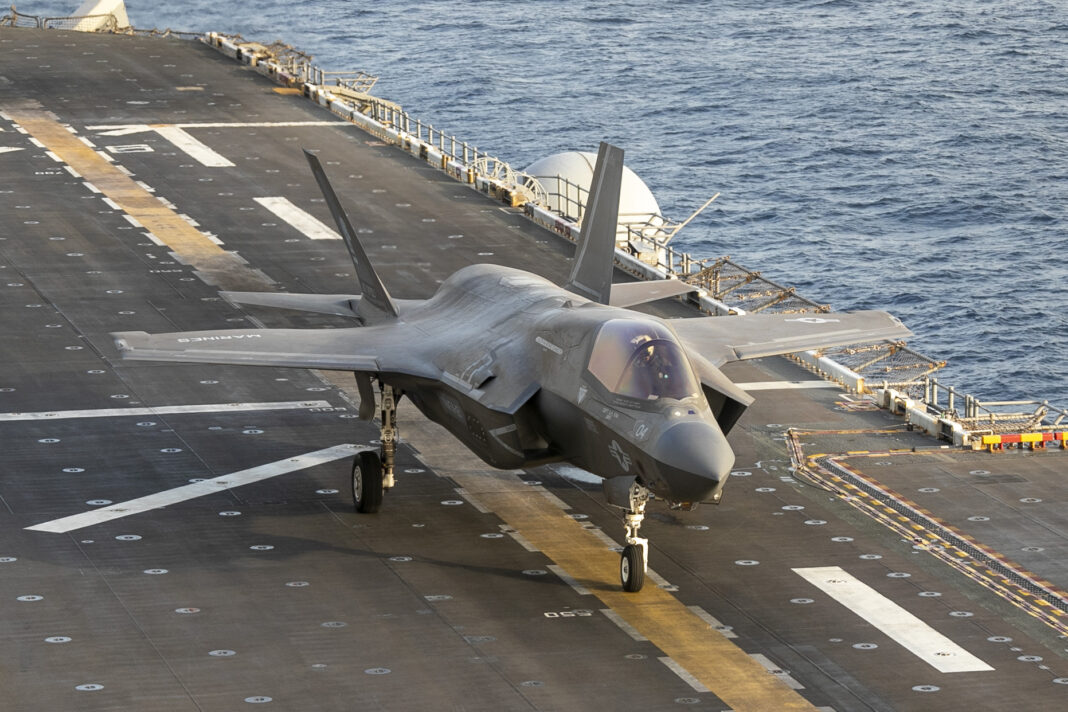
Lockheed Martin has announced a significant development in US naval aviation training after four F-35 full-mission simulators at Naval Air Station Lemoore successfully demonstrated real-time connectivity with six airborne F/A-18 fighter aircraft.
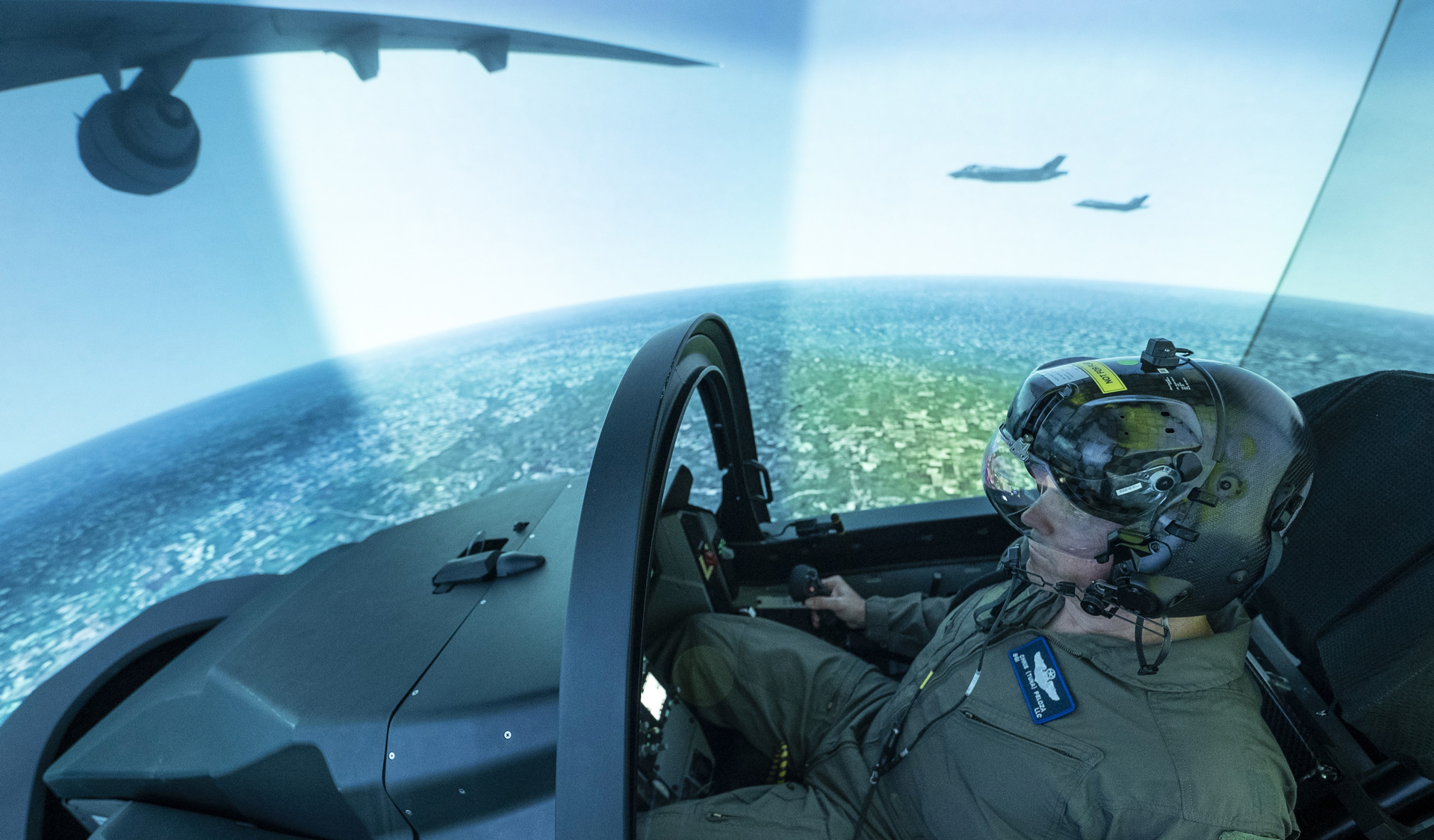
The demonstration, announced on November 17, 2026, represents an important step towards integrating live aircraft, virtual simulators and computer-generated adversaries into a common training environment.
The exercise used the US Navy’s Continuous Training Environment (NCTE) and Link-Inject-to-Live (LITL) ground station systems to connect aircraft operating in the air with pilots training inside ground-based F-35 simulators.
The development is significant because it allows pilots flying real aircraft and those operating simulators to participate in coordinated mission scenarios, creating a more complex and realistic training environment without requiring every participating aircraft to be physically airborne.
According to Lockheed Martin, the demonstration involved four F-35 full-mission simulators and six F/A-18 aircraft, bringing ten live and simulated training platforms together.
The company described the achievement as a joint-training first.
How the F-35 and F/A-18 Integrated Training System Works

The key feature of the demonstration is its ability to connect different training environments in real time.
Traditionally, pilots train through a combination of actual flight exercises, ground-based simulators and computer-generated scenarios. However, integrating these separate environments into a common operational picture presents technical challenges.
The new demonstration addresses this challenge by linking F-35 full-mission simulators on the ground with F/A-18 aircraft operating in the air.
Through the Navy’s Continuous Training Environment and Link-Inject-to-Live architecture, simulated tactical information and virtual adversaries can become part of a shared training scenario.
This allows pilots to rehearse missions involving a combination of actual aircraft and simulated forces.
For example, an F/A-18 pilot flying an actual sortie can participate in a training scenario involving virtual aircraft, simulated threats and F-35 pilots operating from ground-based simulators.
The result is a more complex training environment without the expense and logistical requirements of putting every participating aircraft into the air.
Importantly, the demonstration establishes a training connectivity milestone. It does not mean that the ground-based simulators have become airborne aircraft or that the system has demonstrated a new operational combat capability.
What Is the Navy’s Continuous Training Environment?
The US Navy’s Continuous Training Environment is a distributed training architecture designed to connect live aircraft, virtual simulators and computer-generated forces.
It forms part of the broader Live, Virtual and Constructive (LVC) training concept.
The three elements have different functions:
- Live training: Actual military aircraft and personnel participate in physical training exercises.
- Virtual training: Pilots operate high-fidelity simulators that replicate aircraft cockpits, flight characteristics and mission environments.
- Constructive training: Computer-generated forces and simulated threats create additional participants and battlefield conditions.
By combining these elements, the Navy can create large-scale exercises that would otherwise require substantially more aircraft, personnel, fuel and operational resources.
The architecture can also introduce complex threat scenarios, allowing pilots to practise decision-making against multiple simulated adversaries.
The Navy has previously demonstrated the operational value of this approach.
In May 2023, Naval Air Systems Command reported that its Link-Inject-to-Live training capability could introduce high-fidelity simulated air-to-air and surface-to-air threats into F/A-18E/F Super Hornet and EA-18G Growler weapon systems.
The technology was designed to improve training realism while reducing the need for dedicated adversary aircraft and associated flight hours.
The November 2026 demonstration extends this training concept by connecting F-35 full-mission simulators with airborne F/A-18 aircraft.

Why Connecting F-35 and F/A-18 Aircraft Matters
The integration has particular importance because the F-35 and F/A-18 represent different generations of US military aviation.
The F-35 Lightning II is a fifth-generation stealth multirole fighter designed around advanced sensors, information fusion, electronic warfare and network-enabled operations.
The F/A-18E/F Super Hornet is a carrier-based multirole fighter that remains a major component of US Navy carrier air wings.
Both aircraft contribute to naval aviation, but their operational capabilities and technological architectures differ.
Training them together creates opportunities to rehearse coordinated missions involving different aircraft capabilities.
The integration could help pilots practise:
- Coordinated air operations involving fifth-generation and fourth-generation fighters.
- Tactical communication and information exchange.
- Responses to complex simulated air and surface threats.
- Mission planning and decision-making under pressure.
- Coordination between live aircraft and virtual participants.
The ability to include simulated adversaries also allows training planners to create scenarios involving larger numbers of threats than would be practical using only real aircraft.
For the US Navy, this is particularly relevant as future air operations are expected to involve increasingly complex combinations of manned aircraft, unmanned systems, electronic warfare and networked sensors.
Virtual Adversaries Could Transform US Navy Air Combat Training
One of the most important aspects of the new capability is the ability to incorporate virtual adversaries into realistic training missions.
Modern air combat requires pilots to process large amounts of information while operating under severe time pressure.
They must identify potential threats, coordinate with other aircraft, manage their sensors and make decisions in rapidly changing tactical environments.
Traditional flight training can reproduce some of these conditions, but the number of aircraft and threats available for an exercise is limited by cost, maintenance, fuel and operational availability.
Virtual adversaries offer a way to expand the complexity of training scenarios.
Pilots can encounter simulated hostile aircraft and other threats while flying alongside actual and simulated friendly aircraft.
This makes it possible to practise larger and more demanding engagements without deploying an equivalent number of real aircraft.
It also provides greater flexibility for repeating scenarios, examining pilot decisions and identifying weaknesses during post-mission assessments.
The combination of high-fidelity simulation and actual flight training is particularly valuable because simulator-based mission rehearsal cannot completely reproduce the physical demands of high-G manoeuvres, cockpit workload and real-world flight conditions.
The integrated approach seeks to combine the advantages of both environments.
Lockheed Martin: Integrated Training Will Improve Pilot Readiness
Ken Garrett, Lockheed Martin’s vice president of F-35 Training and Logistics, highlighted the importance of combining live aircraft, advanced simulators and virtual adversaries.
“When we connect live aircraft, high-fidelity simulators and virtual adversaries, we can build more realistic scenarios, test decision-making under pressure and get pilots better prepared for the moment it matters,” Garrett said.
His remarks underline the company’s broader approach to military training: preparing pilots for complex missions through increasingly connected and realistic simulation environments.
Lockheed Martin has been expanding its distributed training capabilities, allowing F-35 pilots at different locations to participate in common mission rehearsals.
In September 2026, the company announced another training milestone involving 16 F-35 full-mission simulators across four locations: Marine Corps Air Stations Yuma, Miramar and Iwakuni, and Naval Air Station Lemoore.
That exercise also incorporated F/A-18 simulators and an E-2D Hawkeye airborne command-and-control trainer based at Naval Air Station Oceana.
The two-hour exercise simulated a multidomain mission involving air, surface and cyber elements.
The September demonstration and the latest November achievement point towards a broader effort to develop distributed training networks capable of connecting aircraft and simulators across different military installations.
The F-35 Training Network Is Becoming a Strategic Military Asset
The latest development reflects a wider transformation in military aviation.
As advanced fighters become increasingly dependent on sophisticated sensors, data processing and network connectivity, pilot training must evolve beyond traditional dogfighting and individual aircraft proficiency.
Future air operations are likely to involve coordinated missions in which fighters, airborne early-warning aircraft, electronic warfare platforms, unmanned systems and ground-based command networks operate together.
Preparing pilots for these environments requires more than conventional flight hours.
Integrated simulation provides an opportunity to rehearse complex operational scenarios before pilots encounter comparable situations in real-world missions.
It also allows military planners to introduce sophisticated adversary capabilities, including simulated electronic warfare and air-defence threats, without exposing actual aircraft to unnecessary risks.
For the US Navy, the ability to connect F-35 simulators with airborne F/A-18 fighters could therefore improve the preparation of mixed-generation carrier aviation forces.
However, the actual operational value will depend on the reliability, fidelity and security of the network, as well as its ability to support increasingly complex training scenarios.
US Military Training Moves Towards Live-Virtual-Constructive Warfare
The November 17 demonstration is part of a larger shift towards Live, Virtual and Constructive training across the US military.
The US Navy has already invested in systems that allow real aircraft to interact with simulated threats.
Meanwhile, the US Air Force and other military services are also expanding distributed simulation capabilities to prepare pilots for complex, multi-platform missions.
In July 2026, the US Air Force’s 13th Fighter Squadron used F-35 FENIX simulators during Exercise Valiant Shield 2026 at Misawa Air Base in Japan.
The exercise connected simulators at Misawa with a training environment in Guam, allowing pilots to participate in distributed live, virtual and constructive scenarios across the Pacific.
Together, these developments demonstrate that military simulation is evolving from an individual pilot-training tool into an interconnected component of broader force preparation.
The objective is to create training environments in which aircraft, pilots and simulated threats can interact across different locations and platforms.
For the US military, this approach could improve readiness while reducing the cost and logistical burden associated with conducting every training scenario using actual aircraft.
What This Means for Future Air Warfare
The ability to integrate live fighters with ground-based simulators is not itself a new weapon or a direct increase in the combat performance of the F-35.
Its significance lies in improving how pilots prepare for complex missions.
As air warfare becomes increasingly dependent on information superiority, electronic warfare, network integration and coordinated operations, the quality of pilot training will remain a critical factor.
The latest Lockheed Martin demonstration suggests that the US Navy is moving towards a more interconnected training architecture in which actual aircraft and simulated platforms can operate within the same mission environment.
The next challenge will be expanding such connectivity across additional aircraft types, military installations and training networks.
The larger question is whether integrated live-virtual-constructive training will become the foundation of future air combat preparation, allowing military forces to rehearse increasingly complex battles without having to put every aircraft in the sky.