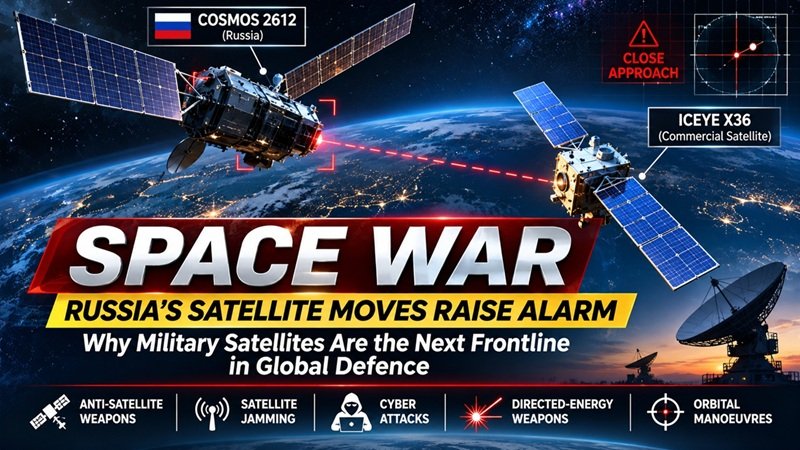
Russia’s close approach to a Western commercial satellite has raised fresh concerns about orbital warfare. As military powers develop anti-satellite weapons, electronic warfare and cyber capabilities, space is emerging as a critical new battlefield.

The next major military confrontation may not begin with fighter jets crossing a border or warships entering disputed waters. It could begin thousands of kilometres above Earth, where military and commercial satellites increasingly support intelligence gathering, communications, navigation and battlefield operations.
A recent Russian military satellite manoeuvre has highlighted the growing risks facing this infrastructure.
According to Reuters, Russia’s Cosmos 2612 satellite approached a Western commercial satellite operated by Finnish company ICEYE during October. The spacecraft, known as X36, provides radar imagery used by Western governments and militaries, including Ukraine.
US Under Secretary of State Thomas DiNanno described the Russian manoeuvres as “consistent with on-orbit weapons operations.”
A military space specialist subsequently suggested that the encounter could have been an attack rehearsal. However, other experts cautioned that the satellite’s precise intentions could not be established from publicly available orbital data alone.
The incident has nevertheless intensified concerns about the vulnerability of commercial satellites and the possibility that future military confrontations could extend into orbit.
What Is Space War?
Space war, commonly described as space warfare or orbital warfare, refers to military operations conducted in, through or against outer space.
It involves protecting military satellites, disrupting an adversary’s space-based capabilities and potentially attacking spacecraft or the infrastructure supporting them.
Unlike conventional warfare, space conflict does not necessarily involve explosions, visible destruction or physical combat between military forces.
A satellite can be rendered ineffective through electronic interference, cyberattacks or the disruption of its communications without physically destroying it.
Space warfare can therefore involve several different forms of military action:
- Disrupting satellite communications.
- Interfering with GPS and other navigation systems.
- Blinding satellite sensors with directed-energy weapons.
- Hacking satellite networks and ground infrastructure.
- Launching anti-satellite missiles.
- Using manoeuvring spacecraft to approach, inspect or potentially damage another satellite.
The US Space Force identifies cyberattacks, electronic warfare, directed-energy weapons, kinetic attacks and orbital operations among the major threats to space systems.
Space is not a completely new military domain. Satellites have supported military operations for decades.
What has changed is the growing dependence of modern armed forces on space-based technology and the increasing ability of competitors to disrupt these systems.
NATO formally recognised space as an operational domain in 2019, alongside land, air, maritime and cyberspace.
Why Satellites Have Become Military Targets
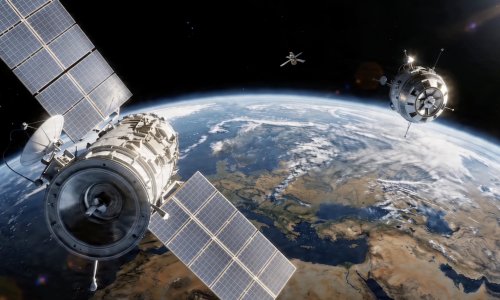
Modern military operations depend heavily on information generated and transmitted through space.
Satellites provide capabilities that are difficult to replace through conventional military infrastructure.
1. Intelligence, surveillance and reconnaissance
Military satellites monitor troop movements, military installations, missile deployments, naval activity and battlefield developments.
Synthetic aperture radar satellites, such as those operated by ICEYE, can produce imagery even through cloud cover and during nighttime conditions.
This makes satellite intelligence particularly valuable during military operations.
The Russia-Ukraine war has demonstrated the importance of commercial satellite imagery and private space companies in supporting national security.
A military that loses access to reliable satellite intelligence may struggle to identify targets, assess enemy movements and coordinate operations.
2. Satellite communications
Military satellites provide communications links between aircraft, naval vessels, ground forces and command centres.
These systems are particularly important for forces operating across large geographical distances.
A disruption to satellite communications could complicate command-and-control operations, reduce coordination and limit the effectiveness of military units.
3. Navigation and precision targeting
Global navigation satellite systems support military navigation, precision-guided weapons, aircraft operations and logistics.
GPS is widely used, while other systems include Russia’s GLONASS, China’s BeiDou and Europe’s Galileo.
Interfering with satellite navigation can affect military operations as well as civilian transportation, shipping, aviation and emergency services.
4. Missile warning and early detection
Space-based sensors can help detect missile launches and provide early-warning information.
These capabilities are critical for strategic defence, particularly against ballistic missile threats.
A disruption to early-warning systems could reduce decision-making time during a crisis.
Russia’s Cosmos 2612 Manoeuvre: Why the Incident Matters
The October encounter between Cosmos 2612 and ICEYE’s X36 satellite has become a significant case study in emerging space security challenges.
According to Reuters, Cosmos 2612 approached X36 within approximately one kilometre, with some analysts estimating that the distance may have been only a few hundred metres.
The Russian satellite subsequently moved away.
Two related Russian spacecraft are now reportedly moving towards the orbital path of another ICEYE satellite, X37.
The concern is not simply that one spacecraft approached another.
The more important issue is the potential military application of precise orbital manoeuvring.
A satellite capable of approaching another spacecraft could potentially conduct close inspection, interfere with its operations or position itself for a hostile action, depending on its technical capabilities.
However, such manoeuvres can also have legitimate purposes, including inspection, servicing and orbital maintenance.
The distinction between peaceful operations and hostile activity is therefore becoming increasingly difficult to establish.
The Center for Strategic and International Studies (CSIS) has warned that Russia’s manoeuvres near Western satellites raise questions about whether close-proximity operations could be used to deploy kinetic or non-kinetic counterspace capabilities.
Five Major Weapons and Capabilities in Space Warfare
Space warfare is not limited to anti-satellite missiles. Military planners are developing different methods to disrupt or destroy space-based infrastructure.
1. Anti-satellite missiles
Anti-satellite weapons, commonly known as ASATs, are designed to destroy or disable satellites.
They can be launched from Earth or potentially deployed through other platforms.
In November 2021, Russia conducted a direct-ascent anti-satellite test against a defunct satellite, generating more than 1,500 trackable debris fragments.
The debris threatened other spacecraft, including the International Space Station.
The incident demonstrated how destroying one satellite can create risks for numerous unrelated space operators.
2. Electronic warfare and satellite jamming
Electronic warfare is one of the most practical ways to disrupt satellite services without destroying the spacecraft.
Jamming involves transmitting interference that prevents a satellite receiver from processing legitimate signals.
Spoofing involves transmitting false signals that can mislead a receiver about its location, timing or other information.
These capabilities can interfere with navigation, communications and military coordination.
Unlike a physical attack, electronic interference may be temporary and difficult to attribute immediately.
3. Cyberattacks against satellites
Satellites are connected to ground stations, control networks, software systems and communication terminals.
Cyberattacks against any part of this infrastructure could disrupt space-based services.
Potential targets include:
- Satellite control systems.
- Ground-based communication stations.
- Software and operating systems.
- Satellite internet terminals.
- Data-processing networks.
A successful cyberattack may compromise satellite operations without requiring an attacker to physically reach the spacecraft.
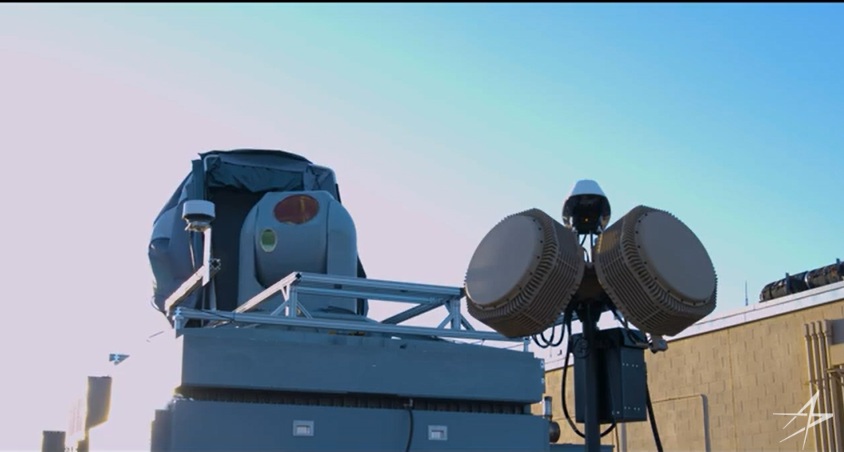
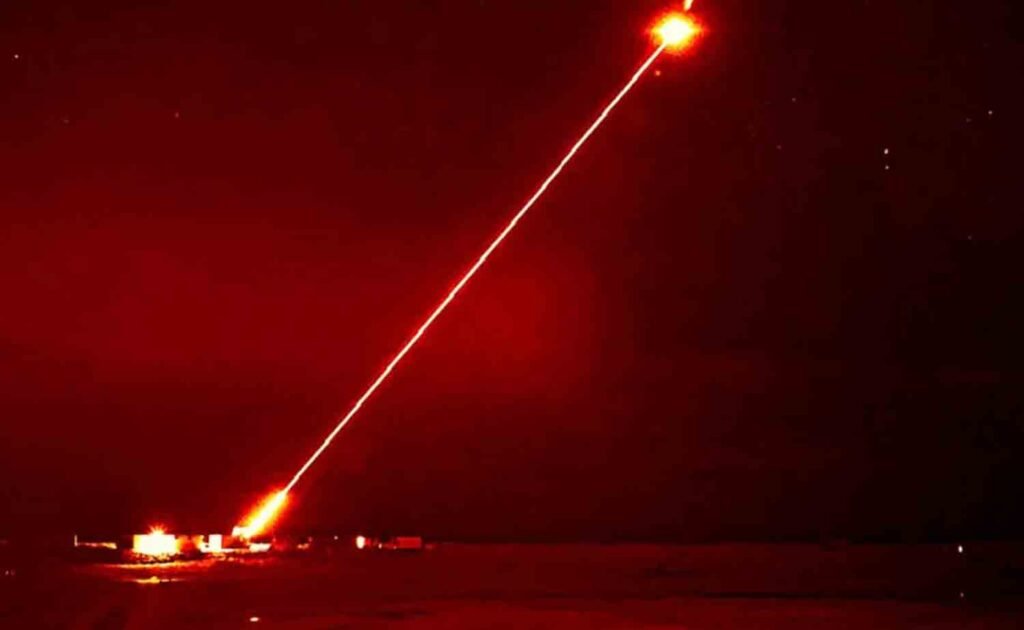
4. Directed-energy weapons
Directed-energy weapons use concentrated energy to damage or interfere with satellite systems.
Laser weapons may be capable of blinding optical sensors or degrading their performance.
High-powered microwave systems could potentially disrupt electronic components.
These capabilities are particularly concerning because some effects may occur without creating the debris associated with destroying a satellite.
5. Orbital attack and inspection satellites
Satellites equipped with manoeuvring capabilities can approach other spacecraft.
Such operations are known as rendezvous and proximity operations.
They can support legitimate activities such as inspection, servicing and debris removal.
However, the same capabilities could potentially be used to interfere with or damage another satellite.
The Cosmos 2612 incident illustrates why military planners are increasingly concerned about spacecraft that can manoeuvre close to foreign satellites.
The Commercial Satellite Problem: Military Targets With Civilian Consequences
One of the most significant developments in modern warfare is the increasing military importance of commercial space companies.
Private companies now provide satellite communications, radar imagery, intelligence products and other services previously associated primarily with national space programmes.
This creates a difficult security challenge.
Commercial satellites may support civilian activities while simultaneously providing services to military forces.
The same satellite network could be used for agriculture, disaster management, infrastructure monitoring and military intelligence.
Consequently, disrupting commercial space infrastructure could have consequences extending far beyond the battlefield.
The International Committee of the Red Cross has warned that attacks against space systems may affect civilian infrastructure and essential services, including communications, energy, transportation and humanitarian operations.
The growing reliance on commercial satellites also creates uncertainty over what constitutes a legitimate military target during armed conflict.
This issue will become increasingly important as governments integrate private satellite networks into their defence systems.
US, Russia and China: The Emerging Space Security Competition
The United States, Russia and China are among the major powers developing capabilities to protect their own satellites and potentially disrupt those of adversaries.
United States
The US Space Force was established to strengthen American military capabilities in space.
Washington is increasingly focused on protecting satellite networks, improving space surveillance and ensuring that American forces can continue operating if space-based services are disrupted.
The United States has also acknowledged deploying on-orbit space-control weapons, although publicly available information about their exact capabilities remains limited.
Russia
Russia has demonstrated anti-satellite capabilities and continues to develop systems intended to challenge Western military advantages in space.
Moscow has also warned that commercial satellites supporting Ukraine could become legitimate targets for retaliation.
The Cosmos 2612 incident has increased concern that Russia could use orbital manoeuvring to threaten Western commercial space infrastructure.
However, the specific purpose of the recent encounter remains unconfirmed.
China
China has invested heavily in space infrastructure, satellite navigation, communications and military space capabilities.
Its BeiDou navigation system provides an alternative to GPS, while its growing satellite networks support communications, intelligence and military operations.
The US Space Force identifies China as a major competitor in the development of space and counterspace capabilities.
The broader competition is increasingly focused on whether military forces can continue operating effectively in an environment where access to space may be contested.

Is Space War Already Happening?
The answer depends on how space warfare is defined.
Military operations already involve electronic interference, cyber activity, satellite surveillance and other forms of competition in space.
However, the Cosmos 2612 incident does not establish that a direct war between satellites has begun.
The more accurate assessment is that space is becoming an increasingly contested military domain, with growing risks of escalation during conventional conflicts.
The distinction matters because the destruction of a satellite could have consequences far beyond the immediate military objective.
A satellite attack could affect civilian infrastructure, disrupt communications and create orbital debris that threatens spacecraft belonging to countries not involved in the conflict.
This makes space warfare potentially more unpredictable than conventional military operations.
International Law: Is War in Space Legal?
Outer space is governed by several international legal frameworks.
The 1967 Outer Space Treaty prohibits placing nuclear weapons and other weapons of mass destruction in orbit around Earth.
However, it does not comprehensively prohibit every form of conventional space weapon or military activity involving satellites.
This creates significant challenges for international security.
The treaty also establishes that outer space should be used for the benefit of all countries and prevents national sovereignty claims over celestial bodies.
The United Nations has identified the Outer Space Treaty as the foundation of international space law.
International humanitarian law also applies to military operations involving space systems during armed conflicts.
The ICRC emphasises that military operations in space are subject to legal principles including distinction, proportionality and precautions to protect civilians.
This means that an attack against a satellite cannot be assessed solely by considering its military function.
The potential consequences for civilian infrastructure and the creation of dangerous debris must also be considered.
What Space Warfare Means for Pakistan
For Pakistan, space security is becoming an increasingly important national defence consideration.
The country’s military, communications, navigation and economic infrastructure operates within a global environment increasingly dependent on satellite services.
Pakistan’s space programme, including the Pakistan Space and Upper Atmosphere Research Commission (SUPARCO), provides a foundation for developing national capabilities in satellite technology and space applications.
The growing militarisation of space highlights several strategic priorities for Pakistan:
- Strengthening satellite communications and space-based infrastructure.
- Developing greater awareness of satellite vulnerabilities.
- Improving resilience against electronic interference and cyberattacks.
- Expanding cooperation with international space partners.
- Protecting critical civilian and military services dependent on satellite technology.
Pakistan does not need to match the largest space powers in every capability to improve its national security.
Resilience, secure communications, reliable access to satellite services and international cooperation could be particularly important for a country with limited resources compared with major space powers.
The emerging space competition also reinforces the importance of technological cooperation with China and other international partners.
For Pakistan, the strategic objective should be to ensure that disruption in space does not translate into a critical vulnerability on the ground.
The Future of Warfare May Depend on Space
The Cosmos 2612 incident is a reminder that the next generation of military competition may extend far beyond traditional battlefields.
Satellites have become essential to modern military operations, making them attractive targets for adversaries seeking to weaken an opponent without directly attacking its territory.
The growing development of anti-satellite weapons, electronic warfare, cyber capabilities and manoeuvring spacecraft is changing the strategic environment.
At the same time, the destruction or disruption of satellites could create consequences for civilian populations, commercial infrastructure and countries uninvolved in a conflict.
The challenge for military planners is therefore not simply to develop weapons capable of operating in space.
It is to protect critical space infrastructure, maintain reliable access to satellite services and prevent military competition from escalating into a conflict that could affect the entire world.
The next major defence challenge may not be who controls the skies, but who can protect—and deny access to—the satellites on which modern warfare increasingly depends.