Pakistan’s military spokesperson says the Makkah Joint Defence Agreement is built around collective deterrence as Saudi Arabia faces renewed Houthi missile and drone pressure
The reported downing of a Saudi F-15 fighter jet over Yemen has emerged at a particularly sensitive moment for Gulf security, with Saudi Arabia facing intensified Houthi attacks while Pakistan, Saudi Arabia and Türkiye move to operationalise their new Makkah Joint Defence Agreement.
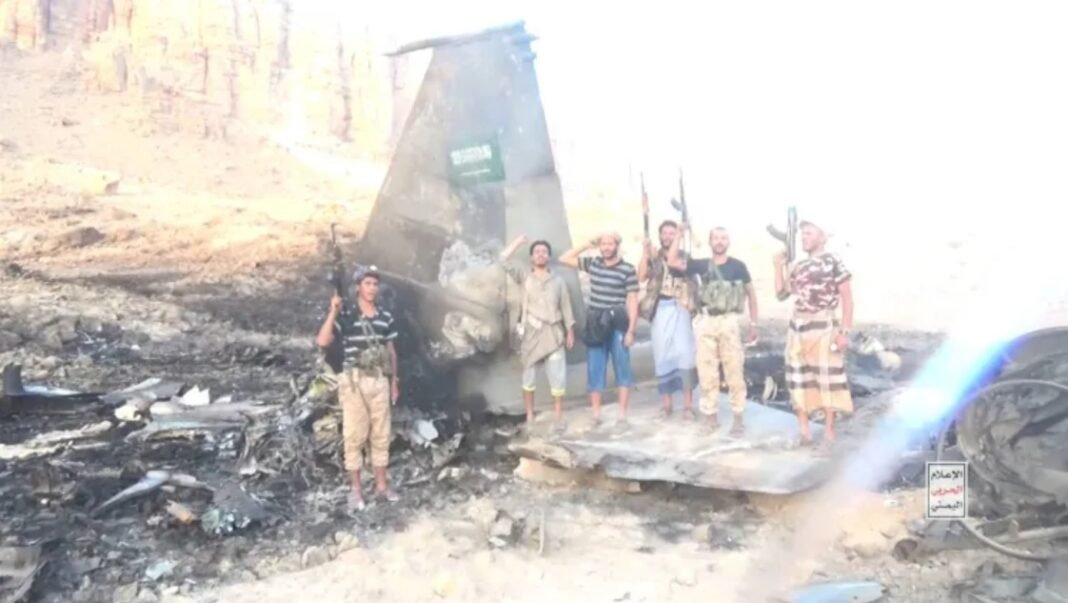
Yemen’s Houthi movement said it had shot down a Saudi F-15 over Marib using a locally manufactured missile. The claim has since been reported by multiple international and defence publications, but Saudi authorities have not publicly confirmed the loss and the incident has not been independently verified.
The timing gives the reported incident significance beyond the fate of a single aircraft. It comes as questions over Saudi air-defence resilience are growing alongside a wider escalation around the Red Sea, Bab al-Mandab and Saudi territory.
At the same time, Pakistan’s military leadership has publicly clarified how Islamabad views the newly created security framework with Riyadh and Ankara.

DG ISPR explains the Makkah Defence Agreement
In an interview with Al Arabiya English, Inter-Services Public Relations Director General Lieutenant General Ahmed Sharif Chaudhry described the Makkah Joint Defence Agreement as defensive in nature and based on collective deterrence.
Al Arabiya English presenter Tom Burges Watson interviews DG ISPR Lieutenant General Ahmed Sharif Chaudhry,
Highlights from the interview#Pakistan #Iran #India #SaudiArabia #ISPR pic.twitter.com/mEx5GMNNAg
— Pakistan Armed Forces News 🇵🇰 (@PakistanFauj) September 15, 2026
He said the agreement has no regional or offensive ambitions and is intended to complement, rather than compete with, the existing relationships and alliances of its three members.
Crucially, when asked how Pakistan would respond if another member came under attack, the DG ISPR said the operational details had not been made public.
He explained that the “how” of implementing a defence commitment is part of operational and security planning and would be determined by Pakistan, Saudi Arabia and Türkiye.
That distinction matters as Saudi Arabia comes under renewed military pressure.
The Makkah Joint Defence Agreement, signed in August, states that an armed attack against one of the three countries will be regarded as an attack against all. Pakistan’s Foreign Office has separately described the agreement as defensive and linked it to collective deterrence and the right of individual and collective self-defence under Article 51 of the UN Charter.
Houthi claim puts Saudi F-15 fleet under scrutiny
The immediate military story remains the Houthi assertion that a Saudi F-15 was destroyed over Marib.
Houthi military spokesman Yahya Saree said the aircraft was conducting what he described as hostile operations in support of Saudi-backed forces and claimed it was brought down using a locally produced missile. Another report described the weapon as a locally manufactured surface-to-air missile, while the Houthi statement reported by AFP and other outlets described it as an air-to-air missile. The precise weapon type therefore remains unclear from the publicly available accounts.
That distinction is important.
A successful engagement by a ground-based air-defence system would raise one set of questions about Saudi operating altitudes, routes, electronic warfare and suppression of enemy air defences. An air-to-air engagement would point toward a very different capability.
At present, the available reporting does not establish the engagement geometry or provide enough independently verified evidence to settle that issue.
The imagery circulated by the Houthis adds visual weight to the claim, but visual material alone does not establish when, where or under what circumstances the aircraft was lost. The original assessment also noted the absence of independently verified geolocation, satellite confirmation, flight-tracking evidence or a third-party examination of the wreckage.
Why an F-15 loss would matter
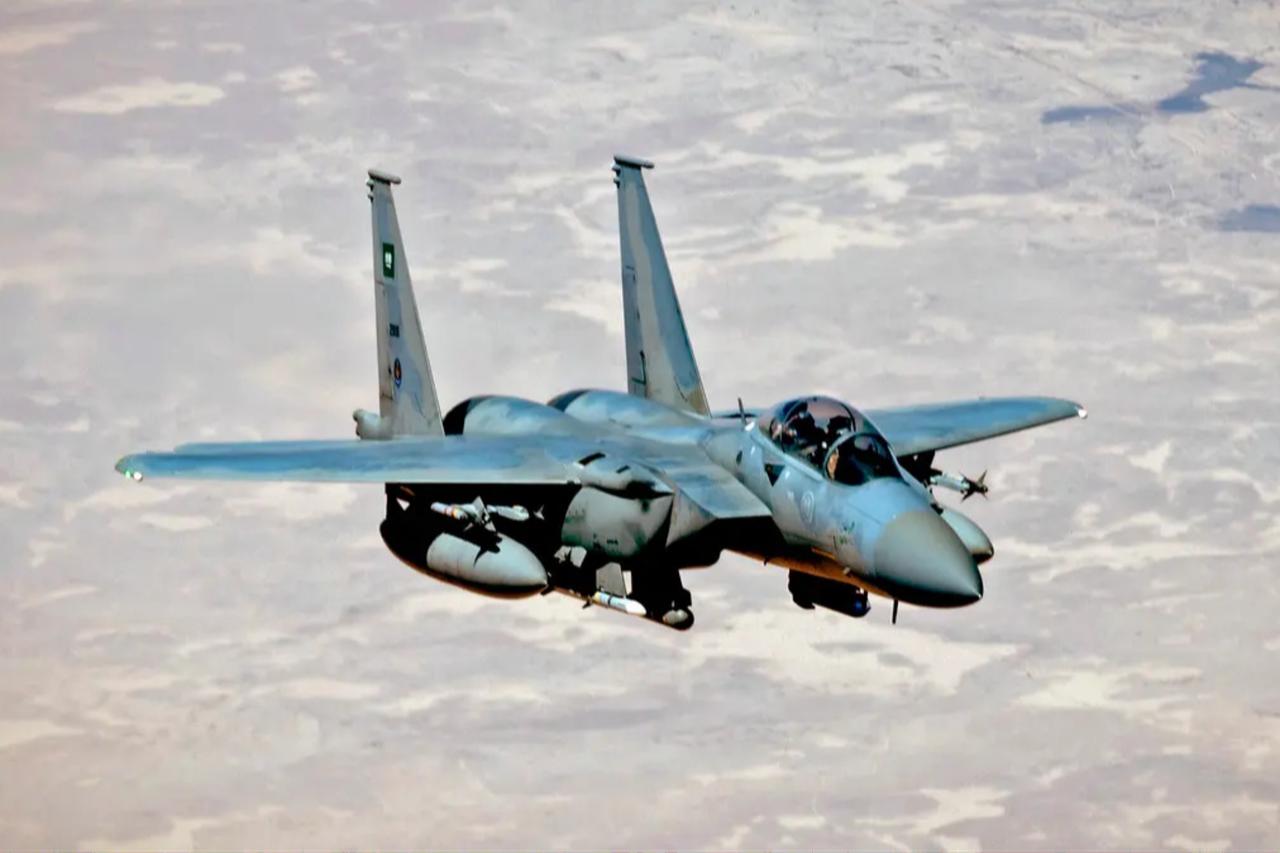
Saudi Arabia’s F-15 fleet has long formed a major component of its combat aviation capability. A confirmed combat loss would therefore be more significant than the loss of an individual aircraft.
It would raise questions about how Saudi aircraft are operating over contested areas, the effectiveness of Houthi detection and targeting systems, the degree of electronic warfare support available to Saudi formations and the risks associated with repeated strike missions over Yemen.
But one aircraft loss would not, by itself, demonstrate the collapse of Saudi air superiority.
Modern air campaigns are shaped by the wider system: airborne early warning, electronic warfare, intelligence, surveillance and reconnaissance, tanker support, stand-off weapons, fighter escorts, air-defence suppression and the ability to sustain sortie rates.
The important issue would therefore be whether the reported engagement represents an isolated tactical success or evidence of a more repeatable Houthi capability.
That remains unanswered.
Saudi Arabia has not confirmed the reported loss
The absence of Saudi confirmation is central to the story.
Current reporting says Saudi authorities have not confirmed that an F-15 was lost over Marib. The Associated Press likewise reported that the Houthi claim could not be independently verified.
That does not prove the Houthi account false. Nor does the publication of footage and reports by several outlets independently establish the shootdown as confirmed.
The strongest evidence would include independently geolocated wreckage, identifiable aircraft components or serial information, satellite imagery, credible flight data, imagery of the aircrew or an official Saudi acknowledgment.
Until such evidence emerges, the most accurate description is that the Houthis claim to have shot down a Saudi F-15 and the claim is being reported by multiple outlets, but the loss remains unconfirmed by Saudi Arabia.
The wider Saudi-Houthi confrontation is expanding
The F-15 claim comes amid a much broader escalation.
Saudi Arabia has faced renewed Houthi missile and drone attacks, including an incident involving a drone that Saudi authorities said was intercepted south of Makkah. The Houthis have denied targeting the holy city while acknowledging attacks against Saudi military and energy-related targets.
The developments are occurring alongside heightened fighting in Yemen and growing concern around the Red Sea and Bab al-Mandab.
Recent reporting has described Houthi military advances along Yemen’s Red Sea coast and increasing pressure around the strategic maritime corridor. The waterway is particularly important because it connects the Red Sea with the Gulf of Aden and provides a major route toward the Suez Canal.
For Saudi Arabia, the issue is not simply the protection of military aircraft.
The security of energy infrastructure, maritime routes, ports and western Saudi territory has become part of the same strategic problem.
Makkah pact faces a very different security environment
This is where the Makkah agreement becomes particularly relevant.
When Pakistan, Saudi Arabia and Türkiye signed the agreement, the stated objective was collective defence and deterrence. Pakistan’s Foreign Office said the accord was not directed against any country and was intended to strengthen the three states’ capacity to respond to external aggression.
Now, however, Saudi Arabia is confronting a more complicated threat environment involving missiles, drones, maritime pressure and attacks originating from multiple directions.
The DG ISPR’s latest comments are therefore significant because they provide a clearer Pakistani description of what the pact does — and what remains deliberately outside the public domain.
Pakistan is saying that the agreement establishes a collective-deterrence framework, while the practical military response to a specific contingency will be decided by the three governments.
That leaves considerable room between the existence of a mutual-defence commitment and any particular military response.
Pakistan’s position is becoming increasingly relevant
Islamabad has already publicly expressed support for Saudi Arabia following the reported incident involving the attempted drone attack near Makkah. Prime Minister Shehbaz Sharif condemned the incident and reaffirmed Pakistan’s support for Saudi sovereignty and the security of the Two Holy Mosques.
But political solidarity and a formal defence commitment are not identical to an announcement of military deployment.
The DG ISPR’s comments reinforce that distinction.
For Pakistan, this is particularly important because the country maintains relations with Saudi Arabia, Türkiye, Iran, China and other regional and international actors. The Makkah agreement has been presented by Islamabad as a defensive arrangement rather than a mechanism for confrontation with another state.
That makes the current Saudi-Houthi escalation an early test of how the new security architecture will function in practice — even though no public statement has established that the reported F-15 incident has triggered any Pakistani military action.
A changing Gulf security picture
The reported F-15 shootdown, the attacks involving Saudi territory, the growing pressure around Bab al-Mandab and the creation of the Makkah defence framework are separate developments, but they are unfolding within the same increasingly complicated regional security environment.
For Saudi Arabia, the immediate challenge is maintaining air and missile defence while continuing military operations in Yemen.
For Pakistan and Türkiye, the challenge is defining how collective deterrence under the Makkah agreement operates without turning the new arrangement into an instrument of wider regional confrontation.
And for the Houthis, any verified ability to threaten advanced Saudi combat aircraft would add another dimension to their military campaign.
For now, however, the central fact remains unresolved: the Houthis say they shot down a Saudi F-15 over Marib, but Saudi Arabia has not confirmed the loss and independent verification is still lacking.
What is already clear is that the claim has arrived at a moment when Gulf security arrangements are being tested by a rapidly changing threat environment — making the Makkah Defence Agreement more consequential as a framework for deterrence, even before its operational mechanisms are publicly revealed.