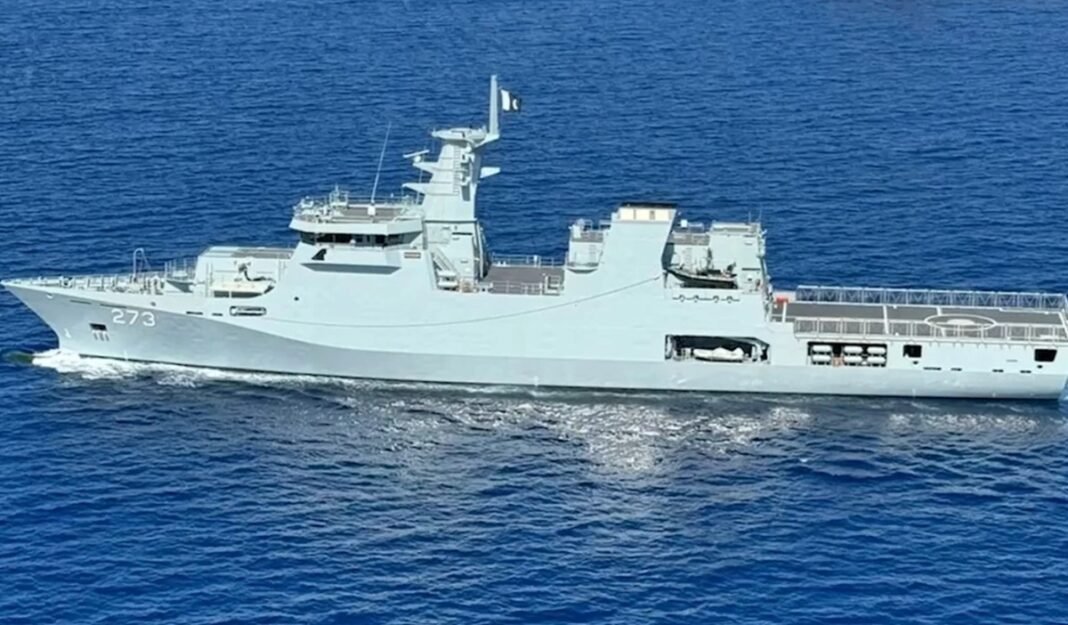
The maritime confrontation between Pakistan and India on September 15 has raised a question that goes beyond the reported contact between two warships: what was an Indian Navy frontline destroyer doing in the vicinity of Pakistan Navy’s Sea Spark 2026 exercise in the North Arabian Sea?
India says INS Kolkata was conducting a routine surveillance mission when it encountered Pakistan Navy’s PNS Hunain in international waters.
The Pakistani side has a different account of the encounter, according to information circulating from Pakistan’s side, with PNS Hunain described as responding to the Indian warship’s manoeuvring while Pakistan Navy’s major Sea Spark exercise was underway.
The incident has now developed into a diplomatic dispute, with New Delhi summoning Pakistan’s chargé d’affaires and lodging a formal protest.
But the Indian description of the mission as “routine surveillance” is itself significant.
Surveillance means the Indian warship was actively observing the maritime environment.
The central issue is therefore not merely whether two ships came dangerously close. It is also whether INS Kolkata was monitoring activity associated with Pakistan Navy’s Sea Spark exercise, and whether that activity contributed to the encounter.
Vishwaguru Blue Water Navy got mogged by PNS Hunain. pic.twitter.com/tQyaDLJz3F
— Mohsin Ali (@Mohsin_o2) September 16, 2026
INS Kolkata and the Sea Spark Question
Pakistan Navy’s Sea Spark 2026 is being conducted from September 1 to September 16 and involves a large-scale evaluation of naval operational readiness.
The exercise comes amid heightened maritime activity in the Arabian Sea, where Pakistan and India maintain significant naval deployments.
India’s own account says INS Kolkata was operating on a surveillance mission in the North Arabian Sea when it encountered PNS Hunain.
That description deserves closer examination.
A surveillance mission does not automatically mean espionage. Naval forces routinely conduct surveillance in international waters, monitor shipping and observe the activities of other military forces.
But when a major Indian Navy combatant is operating near an ongoing Pakistani naval exercise, the distinction between routine surveillance and intelligence collection becomes strategically important.
The available public information does not establish precisely what INS Kolkata was collecting or whether it was specifically tasked to monitor Sea Spark.
That is an important unresolved question.
Why Was an Indian Destroyer There?

The Indian Navy has substantial reasons to maintain a presence in the Arabian Sea.
The area contains major commercial shipping routes and is strategically important to both countries.
But the timing of the encounter is difficult to separate from Pakistan Navy’s Sea Spark exercise.
Pakistan had publicly announced the exercise, meaning its existence was not secret.
A foreign navy observing a publicly announced exercise from international waters is not, by itself, prohibited.
The more important question is how close the observing vessel came to the exercising force and how it manoeuvred while doing so.
That is where the two narratives diverge.
India says PNS Hunain approached its ship at high speed and manoeuvred unsafely.
The Pakistani account circulating around the incident says the Indian warship’s conduct prompted an immediate response by PNS Hunain.
Without navigational records or an independent investigation, responsibility for the precise sequence cannot yet be conclusively established.
India’s Own Word — “Surveillance”
Indian reporting repeatedly describes INS Kolkata as being on a “routine surveillance mission.”
That wording is worth highlighting.
If the Indian warship was conducting surveillance, it means its mission involved observing maritime activity.
That does not automatically establish that India was “spying” on Sea Spark.
However, it makes it reasonable to ask whether the Pakistani naval exercise was among the activities being monitored.
For Pakistan, this is particularly relevant because Sea Spark involves operational movements, maritime patrols and the deployment of multiple naval assets.
Military exercises provide valuable information about:
- deployment patterns;
- command-and-control procedures;
- fleet movements;
- communications;
- maritime patrol activity;
- reaction times;
- operating areas;
- coordination between different naval platforms.
This is precisely why major military exercises are often watched closely by foreign intelligence services.
PNS Hunain Was Not a Random Patrol Vessel

The Indian narrative has focused heavily on PNS Hunain.
But the Pakistani vessel has its own operational significance.
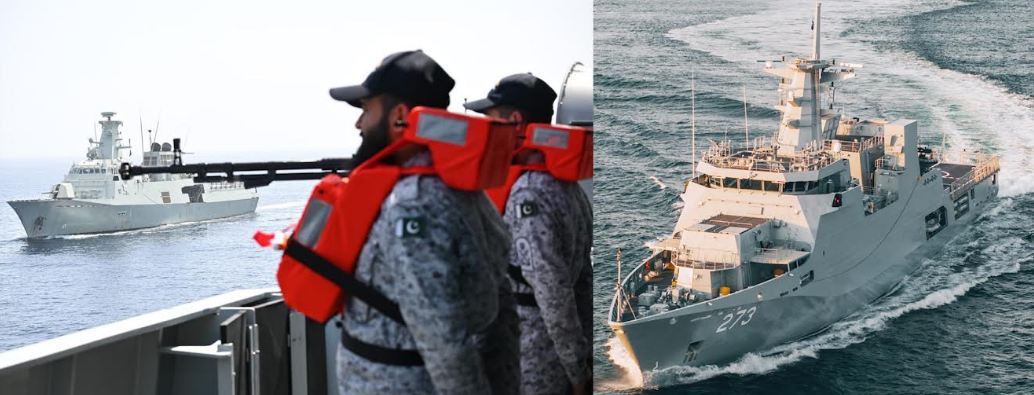
PNS Hunain (F-273) is a Yarmook-class offshore patrol vessel commissioned into the Pakistan Navy in July 2024. Pakistan describes the platform as a multipurpose vessel designed to expand the Navy’s operational presence and readiness in the Indian Ocean region.
The ship has already demonstrated that it can operate well beyond Pakistan’s immediate coastline.
In April 2026, PNS Hunain participated in the rescue of 18 crew members from the Panama-flagged merchant vessel MV Gold Autumn after a major fire in the Arabian Sea. Pakistan’s Maritime Incident Report records that PNS Hunain provided firefighting assistance and medical support during the rescue.
In July, the vessel was again deployed after a cargo dhow began sinking east of Ormara. Pakistan Navy and the Pakistan Maritime Security Agency rescued all 20 crew members.
Its presence in the North Arabian Sea during Sea Spark is therefore consistent with the ship’s established operational role.
The Kolkata Is a Much Larger Combat Platform
INS Kolkata, meanwhile, belongs to India’s Kolkata-class guided-missile destroyers.
It represents a significantly larger frontline combat platform than PNS Hunain.
That difference is relevant to understanding why the encounter has attracted attention.
The issue is not simply the physical contact between two ships.
A confrontation involving a major Indian guided-missile destroyer and a Pakistani offshore patrol vessel carries a different strategic meaning when both navies are operating in the same maritime theatre.
Neither side can afford to treat such encounters casually.

The 1991 Agreement Is Back in the Spotlight
India has invoked Article 10 of the 1991 Agreement between India and Pakistan on Advance Notice of Military Exercises, Manoeuvres and Troop Movements.
The provision says naval ships and submarines belonging to the two countries should not come closer than three nautical miles from each other while operating in international waters, specifically to reduce the risk of accidents.
Three nautical miles is approximately 5.56 kilometres.
This provision is important to the current dispute.
But it should not be misrepresented.
Article 10 is fundamentally a maritime separation and accident-prevention provision. It does not simply mean that an Indian warship cannot observe a Pakistani naval exercise in international waters.
The crucial factual issue is therefore whether the vessels entered the prohibited proximity and, if so, which manoeuvres caused that situation.
Could Sea Spark Have Been the Reason for the Surveillance?
This is one of the most important unanswered questions.
India has not publicly said that INS Kolkata was specifically tasked with collecting intelligence on Sea Spark.
At the same time, describing the mission as surveillance naturally raises questions about what the warship was observing.
Large naval exercises are valuable sources of information for foreign military planners.
An observing navy can potentially learn about patterns of movement, deployment procedures, communications discipline and tactical responses without entering another country’s territorial waters.
That is normal military behaviour.
But normal does not mean strategically insignificant.
For Pakistan Navy, knowing that an Indian frontline destroyer is operating near a major exercise is itself an operational consideration.
Why the Encounter Happened in International Waters
The reported location was in the North Arabian Sea, roughly 220 kilometres east of Oman’s coast according to Indian media reports.
That places the encounter well outside Pakistan’s territorial waters.
This is important because both navies have the right to operate in international waters, subject to international law and applicable bilateral arrangements.
India can operate there.
Pakistan can operate there.
Neither presence by itself constitutes a violation.
The legal and operational issue concerns how military vessels behave when they encounter each other.
That is precisely why the 1991 agreement remains relevant.
India Has Turned the Encounter Into a Diplomatic Issue
New Delhi has summoned Pakistan’s chargé d’affaires and lodged a strong protest.
Indian officials described the Pakistani naval conduct as unacceptable and unprofessional and said it was contrary to the 1991 agreement.
Indian reports also say there was no major damage to the Indian vessel and that it continued its mission.
That is an important detail.
India has not publicly described the encounter as an armed attack.
Instead, the official response has centred on alleged unsafe manoeuvring and the need to avoid a repeat.
That leaves diplomatic space for the incident to remain a maritime-safety dispute rather than develop into a broader military confrontation.
What About Claims That PNS Hunain Was Badly Damaged?
Indian media reports have carried claims that the Pakistani vessel suffered damage.
However, the extent of that damage has not been independently established through publicly released Pakistani Navy imagery or an official technical assessment.
Similarly, Indian authorities say their ship suffered no major damage.
Until photographs, official inspection reports or other independent evidence emerge, claims about “severe damage” should be treated cautiously.
This is especially important because photographs of warships from earlier incidents are already circulating online.
A genuine photograph of a naval vessel does not necessarily prove that it depicts the September 15 encounter.
The Image Battle Has Started Too
The maritime incident is already producing a second confrontation — this time in the information space.
Images and claims are circulating on social media purporting to show the vessels involved.
For a defence publication, verification is critical.
If the photograph being used by Pakistan-based reporting is genuinely from the current incident, its visual details could become useful evidence.
But the image should be accompanied by a clear caption identifying:
what the image shows, when it was taken, who released it and whether its origin has been independently verified.
That is particularly important because Indian and Pakistani social media users are already circulating conflicting claims.
The information war can move faster than the actual investigation.
Why India Would Monitor Sea Spark
There is nothing unusual about one military observing another country’s major exercise.
The United States monitors Chinese military exercises.
China monitors American exercises.
NATO watches Russian military activity.
Regional militaries routinely observe exercises involving neighbouring countries.
The strategic question is therefore not whether India could have been interested in Sea Spark.
It is how that surveillance was conducted and how close the Indian platform came to Pakistani naval forces.
If INS Kolkata was deliberately positioned to observe the exercise from international waters, that would fit a familiar pattern of naval intelligence collection.
If it instead approached too closely or manoeuvred in a manner that created a collision risk, the incident becomes a separate issue involving operational safety.
Those two questions should not be confused.
The Indian Navy’s Presence Is Also a Signal
The deployment of a Kolkata-class destroyer near an ongoing Pakistani naval exercise is strategically noteworthy regardless of the eventual findings.
The Indian Navy has been expanding its blue-water capabilities and maintaining a greater presence across the Indian Ocean.
Pakistan Navy, meanwhile, has increasingly emphasized sustained operational presence, maritime security and protection of sea lanes.
As both navies become more active, the probability of close encounters increases.
That makes communication and confidence-building mechanisms more important.
Pakistan’s Sea Spark Exercise
Sea Spark is not merely a ceremonial exercise.
Pakistan Navy uses major exercises to test operational readiness and the coordination of its fleet and supporting forces.
For a country whose economy depends heavily on maritime trade, the ability to protect sea lines of communication has direct economic importance.
PNS Hunain’s previous rescue missions illustrate the broader role of Pakistani naval vessels beyond combat operations. Its deployment in the Arabian Sea has included maritime security and humanitarian assistance missions.
The presence of PNS Hunain during Sea Spark therefore fits the wider operational pattern of the Pakistan Navy.
A Bigger Issue Than One Naval Encounter
The PNS Hunain-INS Kolkata incident should not be reduced to competing accusations from Indian and Pakistani media.
It raises a broader question about the rapidly changing naval environment in the Arabian Sea.
Both countries increasingly operate sophisticated warships, surveillance systems, submarines, aircraft and unmanned platforms.
Both conduct exercises designed to test operational readiness.
Both monitor the other’s military activities.
And both operate in the same strategically important maritime space.
That combination creates opportunities for intelligence collection but also creates risks of miscalculation.
Was INS Kolkata “Caught Spying”?
The answer requires a distinction.
If by “spying” we mean conducting intelligence or surveillance activity against Pakistan Navy, the Indian description of INS Kolkata being on a surveillance mission provides a factual basis for asking that question.
But there is currently no public evidence establishing that INS Kolkata was specifically collecting classified intelligence on Sea Spark.
The more defensible description is that an Indian frontline warship was conducting surveillance near a Pakistani naval exercise, and an encounter with PNS Hunain subsequently occurred.
That is already significant.
It also leaves room for the Pakistani Navy’s official account to clarify whether the Indian vessel was considered to be monitoring the exercise and what prompted PNS Hunain’s response.
The Real Strategic Issue
The real strategic issue is not whether an Indian ship has the right to operate in international waters.
It does.
Nor is the mere observation of a military exercise unusual.
It is not.
The issue is whether the manner in which the surveillance was conducted brought two armed naval platforms into an unsafe encounter, and whether either side violated the separation arrangements designed specifically to prevent such incidents.
India has put the blame on PNS Hunain.
Pakistan’s account should be considered before that allegation is accepted as the final version of events.
Until then, the September 15 incident remains a contested maritime encounter.
But one fact is already clear from India’s own account: INS Kolkata was conducting surveillance in the North Arabian Sea while Pakistan Navy’s Sea Spark exercise was underway.
That alone makes the location, timing and purpose of the Indian deployment an important part of the story.
And if the photograph circulating from the incident is authentic and independently verified, it could add another piece to understanding how close the two naval forces actually came.
For Pakistan, the episode is a reminder that major naval exercises are not conducted in isolation. When Pakistan Navy puts a substantial force to sea, Indian surveillance assets are likely to be watching — and the distance between observation and confrontation can become dangerously small when two armed navies operate in the same waters.