The battle for Yemen’s Red Sea coast has entered a potentially decisive phase.
Yemen’s Iran-aligned Houthi movement has seized the historic port city of Mocha, according to Yemeni military sources cited by Reuters, pushing government-aligned forces farther south toward Dhubab, a coastal area directly opposite the strategic island of Perim, also known as Mayyun. At the same time, Houthi forces are reportedly attacking other strategically important Red Sea islands, including Hanish.
⚡️WATCH: Mass Surrender of Pro-Saudi Forces to Yemen’s Houthis in Khalid Bin Walid Military Camp pic.twitter.com/VKlqzSf3Ar
— Iran Observer (@IranObserver0) September 10, 2026
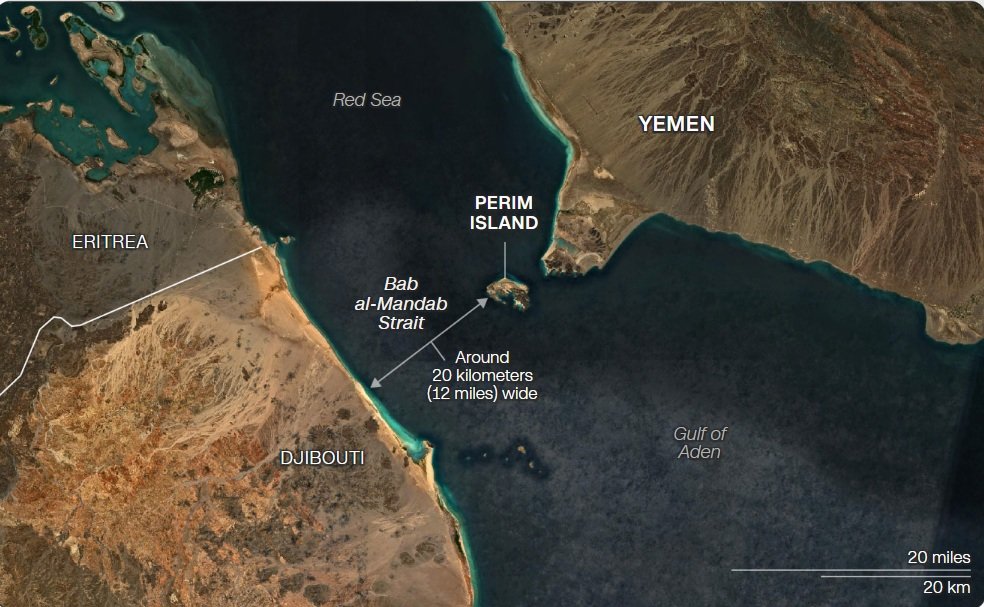
That creates a new and much more consequential military axis: western Taiz and Mocha, south toward Dhubab and ultimately Perim Island and the Bab al-Mandab Strait.
The significance goes far beyond Yemen’s civil war.
Perim sits inside the Bab al-Mandab, dividing the strait into two navigable channels. The strait is only about 18 miles wide at its narrowest point and connects the Red Sea with the Gulf of Aden and the wider Indian Ocean. Its geography has made Perim a strategic military position for centuries.
With the Strait of Hormuz already severely disrupted by the wider US-Iran war, control or sustained military pressure around Bab al-Mandab could give the Houthis another powerful means of influencing global shipping, Saudi Arabia and international energy markets.
The new Houthi battlefield: Mocha to Perim

The immediate military picture is now clearer than it was only days ago.
The Houthis have broken through toward the western coast, fought government forces around Taiz and moved against Mocha. On September 10, Reuters reported that the Houthis had taken control of Mocha, while government forces and their allies were relocating south toward Dhubab.
That movement matters because Dhubab lies directly on the Bab al-Mandab and faces Perim Island.
In other words, the fighting is no longer simply about controlling another Yemeni city. The battlefield has moved toward the maritime chokepoint itself.
The sequence is increasingly visible:
Taiz highlands → western Taiz → Mocha → Dhubab → Perim → Bab al-Mandab.
The Houthis do not necessarily need to occupy every kilometre along that route to change the strategic balance. Securing coastal positions, artillery and missile launch areas, surveillance sites and access routes could allow them to threaten the strait without physically controlling every part of it.
Government forces understand the danger. The relocation toward Dhubab represents an attempt to establish a final defensive line close to the strait and protect Perim, which remains under the control of forces aligned with Yemen’s internationally recognized government.
Why Perim Island matters so much
Perim is small, rugged and sparsely populated. On a map, it can appear almost insignificant.
Strategically, it is anything but.
The island sits almost in the middle of Bab al-Mandab and helps divide the waterway into two channels. Its location provides an unusually valuable position for surveillance and maritime control.
For centuries, outside powers recognized the importance of Perim. The British used it as a coaling station during the imperial era, when the Red Sea route became increasingly important for access to India. Today, its value comes from the same basic geographic reality: whoever can monitor and threaten shipping around Perim can influence one of the world’s most important maritime gateways.
But there is an important distinction.
Capturing Perim would not automatically mean the Houthis could physically close Bab al-Mandab.
Modern commercial shipping could still attempt to use the available channels, and international naval forces could contest any effort to impose a blockade.
The real advantage would be the ability to make the passage significantly more dangerous.
A Houthi-controlled Perim, combined with positions on Yemen’s mainland around Dhubab, could potentially provide a platform for surveillance, missile and drone operations and other forms of maritime harassment. The group already possesses ballistic and cruise missiles, drones and other systems that have demonstrated an ability to threaten shipping at considerable distances.
That could transform Bab al-Mandab from a waterway threatened from afar into a chokepoint threatened from both sides of its entrance.
Why the battle for Mocha was the key step
Mocha was not simply another coastal town.
The historic port sits roughly 50 miles north of Perim and has served as a major commercial and maritime centre for centuries. More recently, it became an important base for forces aligned with Yemen’s internationally recognized government and for efforts to monitor the Red Sea coast.
The Houthis had already demonstrated how important the city was by repeatedly attacking its port.
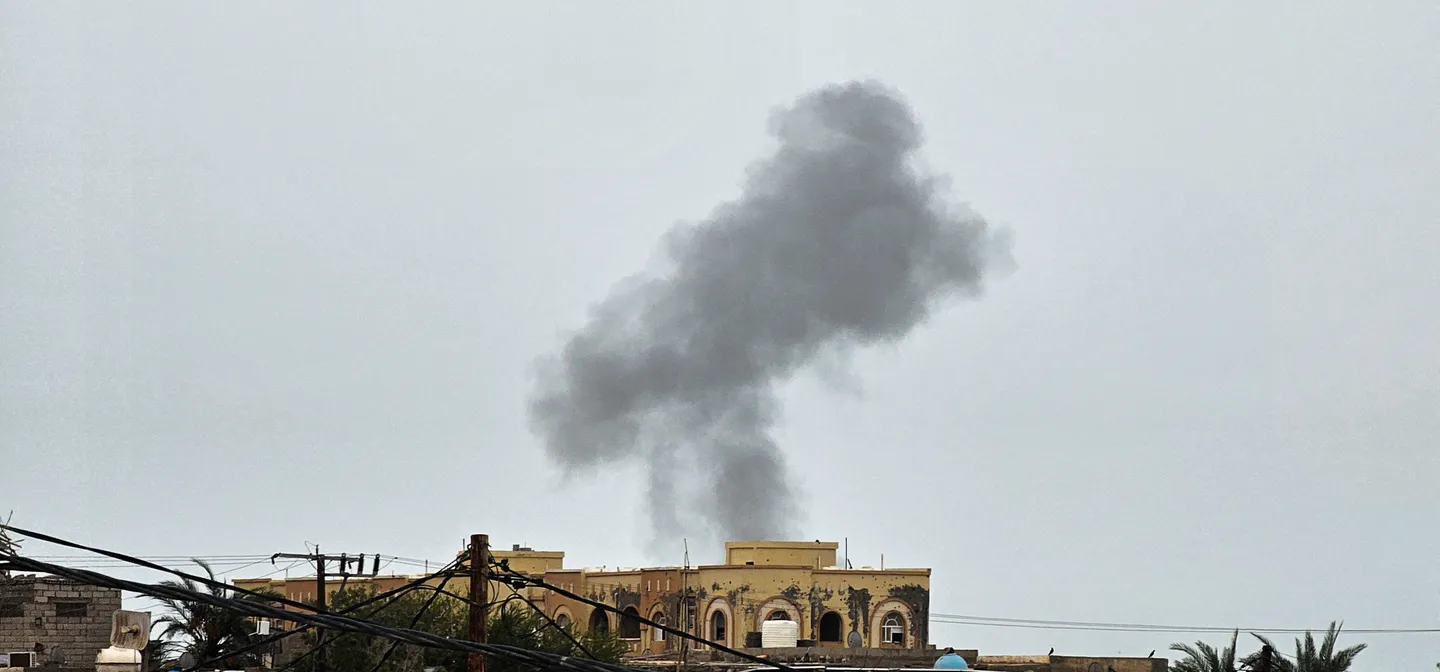
More than 25 missile attacks had struck Mocha’s port since August, according to the port director, with the attacks forcing the suspension of commercial and maritime operations and causing an estimated $16 million in damage.
The capture of Mocha therefore removes an important anti-Houthi coastal position and potentially gives the movement a logistical and geographical springboard for operations farther south.
It also weakens the ability of government forces to protect the approaches to Bab al-Mandab.
The main axis of the current fighting
The most important mistake in understanding the renewed Yemen war would be to view the fighting as a collection of disconnected clashes.
There is a geographic logic to the Houthi offensive.
1. Western Taiz
The Houthis have been fighting to break through government-held positions in western Taiz and seize the high ground overlooking routes toward the coast.
Those hills matter because terrain overlooking the coastal plain can provide observation and fire-control advantages.
Government forces have attempted counterattacks to prevent the Houthis from reaching the Red Sea.
2. Mocha
The next major objective was Mocha.
The city provides access to the coast, a port and an important logistical position for forces defending the southern Red Sea.
The Houthis have now captured the city, according to Reuters, giving them their most important battlefield gain in this sector.
3. Dhubab
The fighting is now moving toward Dhubab.
Dhubab is important because it sits close to the narrowest part of Bab al-Mandab and directly opposite Perim.
If government forces lose Dhubab, the distance between Houthi-controlled territory and the island becomes strategically much less significant.
4. Perim
Perim is the potential prize that changes the character of the conflict.
Government-aligned forces currently hold the island, but its defence becomes substantially harder if the Houthis control the nearby mainland and can bring more surveillance, missile and drone capabilities into the area.
5. Bab al-Mandab
The final objective may not be a formal declaration that the strait is closed.
A more realistic Houthi strategy would be to create a situation in which international shipping companies, insurers and ship operators conclude that the southern Red Sea has become too dangerous to use.
That distinction is critical.
A maritime chokepoint does not need to be physically sealed to be economically disrupted.
What happens if the Houthis capture Perim?
This is the most important question now emerging from the battlefield.
If the Houthis successfully capture Perim, the immediate effect would probably be psychological and military rather than an instant shutdown of global shipping.
But several developments could follow.
First: Bab al-Mandab becomes a contested military zone
The Houthis would gain a position inside the strait itself.
Combined with control of nearby mainland territory, that could allow them to monitor maritime activity much more closely and threaten vessels approaching or leaving the Red Sea.
The group would still face the challenge of defending the island from air and naval attack. Any attempt to turn Perim into a permanent military base could also make it a high-value target for Saudi, US or other international forces.
Second: shipping insurers could react before governments do
Commercial shipping does not wait for a formal blockade.
If attacks become frequent enough, insurance premiums rise, ship operators reroute and major carriers choose longer routes around Africa.
That already happened during the earlier Houthi Red Sea campaign.
The economic impact could therefore begin well before the first ship is physically stopped at Bab al-Mandab.
Third: Saudi Arabia’s Red Sea strategy comes under pressure
This could be the most immediate strategic concern for Riyadh.
Saudi Arabia has sought alternatives to the Gulf maritime route, particularly as the Strait of Hormuz has become severely disrupted.
The kingdom’s East-West pipeline connects its eastern oil infrastructure to the Red Sea port of Yanbu, providing an alternative export route that avoids Hormuz. But the Red Sea route still depends on secure passage through Bab al-Mandab for shipments moving toward the Suez Canal and Europe.
That makes the southern Red Sea increasingly important to Saudi energy strategy.
The EIA reported that oil flows through Bab al-Mandab reached an average of about 8.1 million barrels per day in the second quarter of 2026, although volumes have fluctuated sharply because of regional security conditions.
Fourth: Iran gains another pressure point
The strategic value of Perim becomes even clearer when viewed alongside Hormuz.
Iran does not need to directly control Bab al-Mandab for the waterway to become another pressure point against the United States and its regional allies.
The Houthis have demonstrated that they can act independently while simultaneously serving some of Tehran’s broader strategic interests.
Iran has denied controlling the Houthis, and analysts caution against treating the Yemeni movement as a simple Iranian puppet. The Houthis have their own domestic objectives, including territorial control, political survival and leverage over Saudi Arabia. But Tehran’s military and technological support has helped expand the group’s ability to threaten targets well beyond Yemen.
If the Houthis capture Perim, that distinction will matter less to shipping companies.
The practical question for a tanker captain or insurance company will simply be whether missiles, drones or other attacks can reach the shipping lane.
Could the Houthis actually close Bab al-Mandab?
Not easily.
A formal closure would almost certainly provoke a major international military response.
The United States and other naval powers have demonstrated that they regard freedom of navigation through the Red Sea and Bab al-Mandab as a strategic interest. European naval forces have also operated in the region to protect commercial shipping.
The Houthis would therefore be unlikely to need a conventional blockade in the traditional sense.
Their stronger weapon may be risk.
If they can establish positions around Perim and Dhubab, combine them with coastal missiles, drones, surveillance and maritime attack capabilities, and demonstrate an ability to strike commercial vessels, they could make the route commercially unattractive without permanently occupying every channel.
That is potentially enough to reshape global shipping.
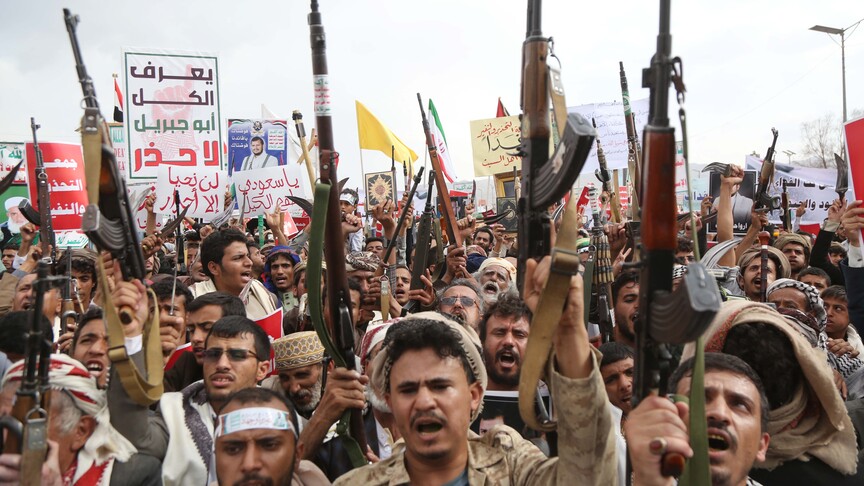
The Red Sea is already under pressure
The Houthis have spent years building experience in maritime warfare.
Since late 2023, the group has attacked commercial and military vessels in the Red Sea and surrounding waters, using combinations of anti-ship missiles, drones and other systems.
US maritime authorities have warned that vessels with US, UK or Israeli connections, as well as ships with certain commercial links, face elevated risks in the southern Red Sea, Bab al-Mandab and Gulf of Aden. The threats include missiles, one-way drones, unmanned surface and underwater systems, explosive boats and attempted boardings.
The latest campaign is therefore not starting from zero.
The Houthis already possess the operational experience to exploit a maritime chokepoint.
The difference would be geography.
Previously, much of the Houthi maritime threat came from territory north of Bab al-Mandab.
A successful advance toward Perim would bring the launch and surveillance infrastructure much closer to the shipping corridor itself.
The wider war is pulling Yemen back in
The renewed offensive comes after the collapse of the fragile calm that had frozen Yemen’s main battle lines since the 2022 truce.
The fighting has now become one of the most serious escalations since that ceasefire.
Government forces have launched air attacks against Houthi positions in western Yemen, while Saudi Arabia has responded to Houthi attacks against its territory and economic infrastructure. Recent Houthi strikes on southern Saudi Arabia wounded dozens of people and hit oil and economic facilities, according to Saudi and international reports.
More than 20,000 people have reportedly been displaced from parts of Taiz and al-Hodeidah in the latest escalation, adding a humanitarian dimension to what is increasingly becoming a regional strategic confrontation.
The danger is that Yemen could once again become a full-scale battlefield rather than a frozen conflict.
Why this matters beyond Yemen
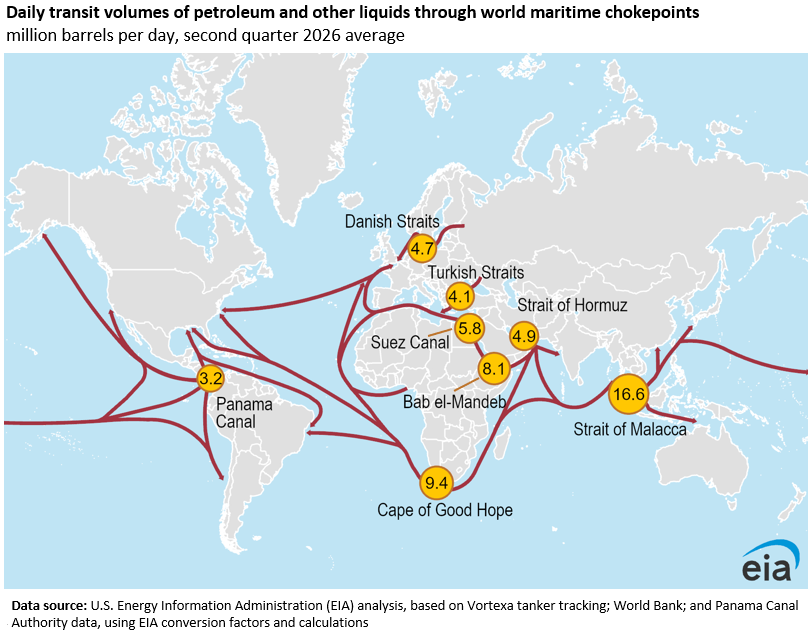
The geography of the current conflict links three major strategic points:
Strait of Hormuz — Bab al-Mandab — Suez Canal.
Hormuz connects the Gulf to the Arabian Sea.
Bab al-Mandab connects the Red Sea to the Gulf of Aden.
Suez connects the Red Sea to the Mediterranean.
Together, they form a maritime corridor linking some of the world’s largest energy-producing regions with Europe and Asia.
If both Hormuz and Bab al-Mandab become unreliable at the same time, the consequences would extend far beyond the Middle East.
Ships carrying oil and other commodities could be forced onto longer routes around the Cape of Good Hope. Freight rates could rise. Delivery times could increase. Energy prices could become more volatile.
The impact would be particularly serious for countries that depend heavily on imported energy and Asian-European maritime trade.
The most dangerous scenario: Perim plus the mainland
The capture of Perim alone would be significant.
But the far more serious scenario would be Perim combined with Houthi control of the adjacent mainland around Dhubab and Mocha.
That would give the movement a much stronger position on both the island and the Yemeni side of the strait.
It could then attempt to create a layered maritime threat involving coastal missiles, drones, surveillance systems and attacks from the surrounding waters.
At that point, the strategic calculation for the United States, Saudi Arabia and other maritime powers would change.
The question would no longer be whether the Houthis can disrupt shipping.
It would be how much military force is required to prevent them from doing so.
What comes next?
The immediate battle is likely to centre on Dhubab and the approaches to Perim.
Government forces and their allies will have strong incentives to hold the area because losing the mainland positions around the strait could make the island increasingly difficult to defend.
The Houthis, meanwhile, have already demonstrated that their offensive is not limited to Mocha. Their reported attacks on Hanish and movement toward the Bab al-Mandab suggest an effort to expand the geographical depth of their coastal position.
That leaves several possible outcomes.
The government camp could stabilize the front around Dhubab and prevent a Houthi assault on Perim.
The Houthis could capture more territory but stop short of the island, leaving Bab al-Mandab under persistent threat.
Or they could achieve the breakthrough that would fundamentally alter the strategic map: control of Mocha, Dhubab and Perim, creating a Houthi military presence around the southern gateway to the Red Sea.
That last scenario would be the most consequential.
Bottom line
The fall of Mocha has changed the geography of Yemen’s war.
The battle is moving south toward Dhubab and Perim, and that makes the conflict increasingly difficult to separate from the wider confrontation involving Iran, Saudi Arabia and the United States.
Perim is not simply another Yemeni island. It sits at the centre of one of the world’s most important maritime chokepoints.
If the Houthis capture it, they would not automatically acquire the ability to shut Bab al-Mandab at will. But they could gain something nearly as strategically valuable: a much stronger position from which to make the passage dangerous, expensive and unpredictable.
With Hormuz already under severe pressure, a Houthi advance toward Perim could turn Bab al-Mandab into the next major test of global energy security.
And the battle now appears to be moving directly toward it.