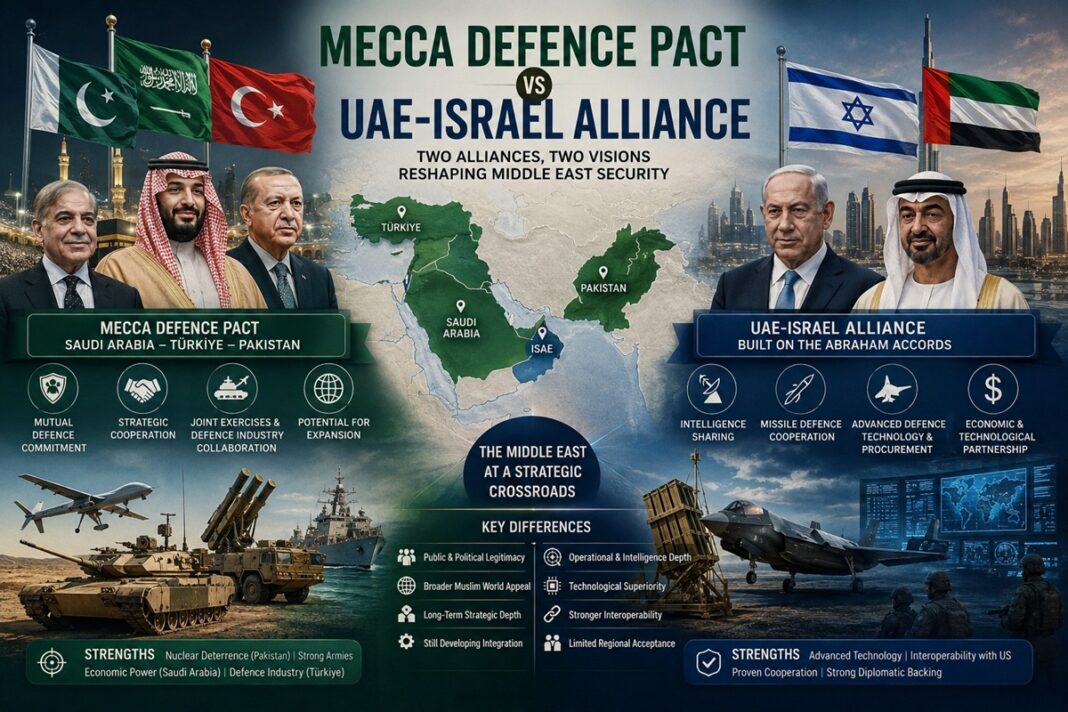
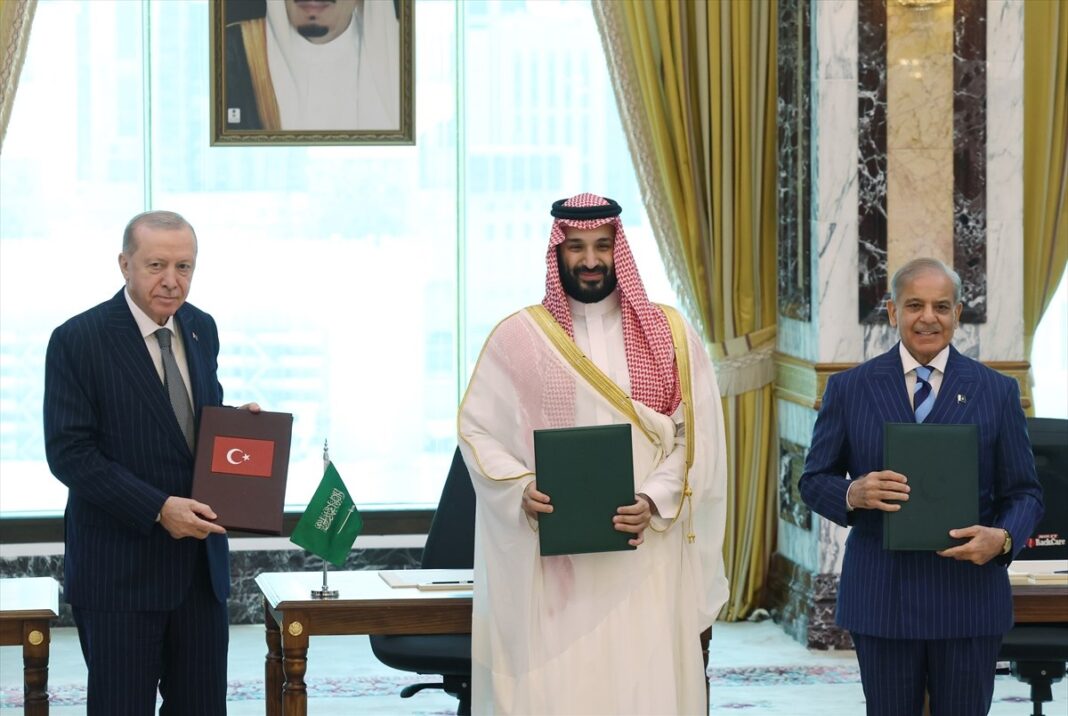
The Makkah Joint Defence Agreement, signed by Pakistan, Saudi Arabia and Türkiye, has generated intense debate across South Asia and the Middle East. While many commentators immediately portrayed it as a military bloc aimed at India or Israel, Indian defence analyst Praveen Sahni offered a markedly different interpretation.
According to Sahni, the agreement is not primarily a military alliance. Instead, he argues that it represents the emergence of a new regional security architecture based on “Collective Security”, replacing the traditional US-led model built around deterrence and military dominance.
His analysis has attracted attention because it challenges mainstream strategic thinking in India. However, while several aspects of his argument are grounded in observable geopolitical trends, other conclusions rely on interpretation rather than verifiable evidence. This article examines Sahni’s principal claims, distinguishes documented facts from analytical assumptions, and assesses what the Makkah Defence Agreement could realistically mean for regional security.
Sahni’s Central Argument: Collective Security vs Absolute Security
The foundation of Sahni’s analysis is the distinction between two competing security models.
According to him:
- Absolute Security seeks security through military superiority, alliances and strategic dominance.
- Collective Security emphasizes dialogue, regional cooperation, sovereign equality and development under the framework of the United Nations.
He argues that NATO represents the first model, while the Makkah Defence Agreement reflects the second.
This distinction broadly reflects concepts discussed in international relations literature. China and Russia have indeed promoted alternative approaches to international security over the past decade, particularly emphasizing multilateralism, sovereignty and reduced dependence on Western security structures.
However, Sahni goes further by presenting the Makkah agreement as the practical implementation of this concept.
That conclusion is considerably harder to establish.
Linking the Agreement to China’s Global Vision
One of Sahni’s most significant claims is that the agreement originated from China’s strategic thinking.
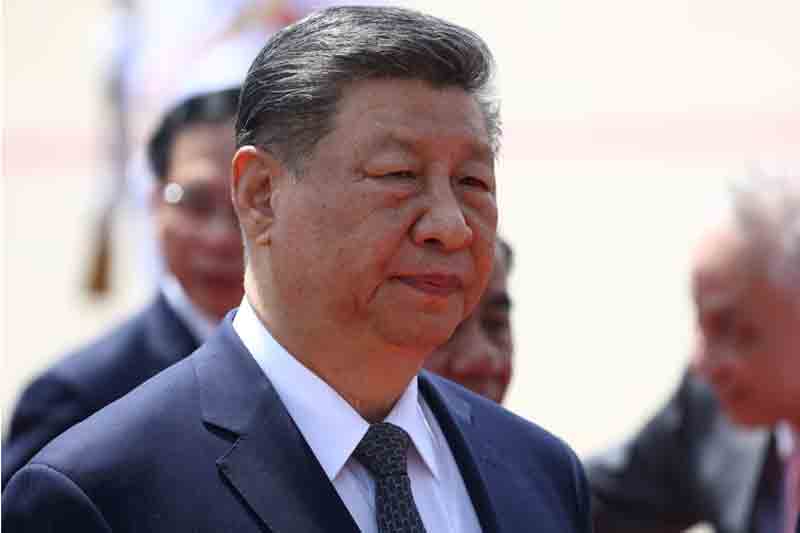
He traces the concept back to President Xi Jinping’s 2013 speech introducing a “new type of international relations,” arguing that this eventually evolved into today’s collective security framework.
There are elements of truth behind this observation.
China has consistently advocated:
- multipolarity,
- sovereign equality,
- regional dialogue,
- development-first security,
- opposition to bloc politics.
Beijing also played an important diplomatic role in restoring Saudi-Iran relations in 2023, enhancing its credibility as a regional mediator.
However, there is no official evidence that Pakistan, Saudi Arabia or Türkiye have described the Makkah Defence Agreement as an implementation of China’s 2013 strategic vision.
This remains Sahni’s interpretation rather than an officially acknowledged framework.
Is Iran Building a New Regional Security Architecture?
Perhaps Sahni’s most ambitious argument concerns Iran.
He suggests that after the Iran-Israel conflict, Tehran shifted from military confrontation toward diplomacy by attempting to establish a completely new regional security architecture.
He points to:
- Iranian diplomatic engagement with Russia;
- high-level consultations with China;
- intensified Pakistan-Iran contacts;
- subsequent defence cooperation among Pakistan, Saudi Arabia and Türkiye.
Chronologically, these events occurred.
However, chronology alone does not establish causation.
None of the governments involved has publicly confirmed that these developments formed a coordinated master plan designed to replace the American security framework.
Consequently, this portion of Sahni’s analysis should be viewed as a strategic hypothesis rather than a confirmed geopolitical reality.
Collective Deterrence: The Agreement’s Practical Dimension
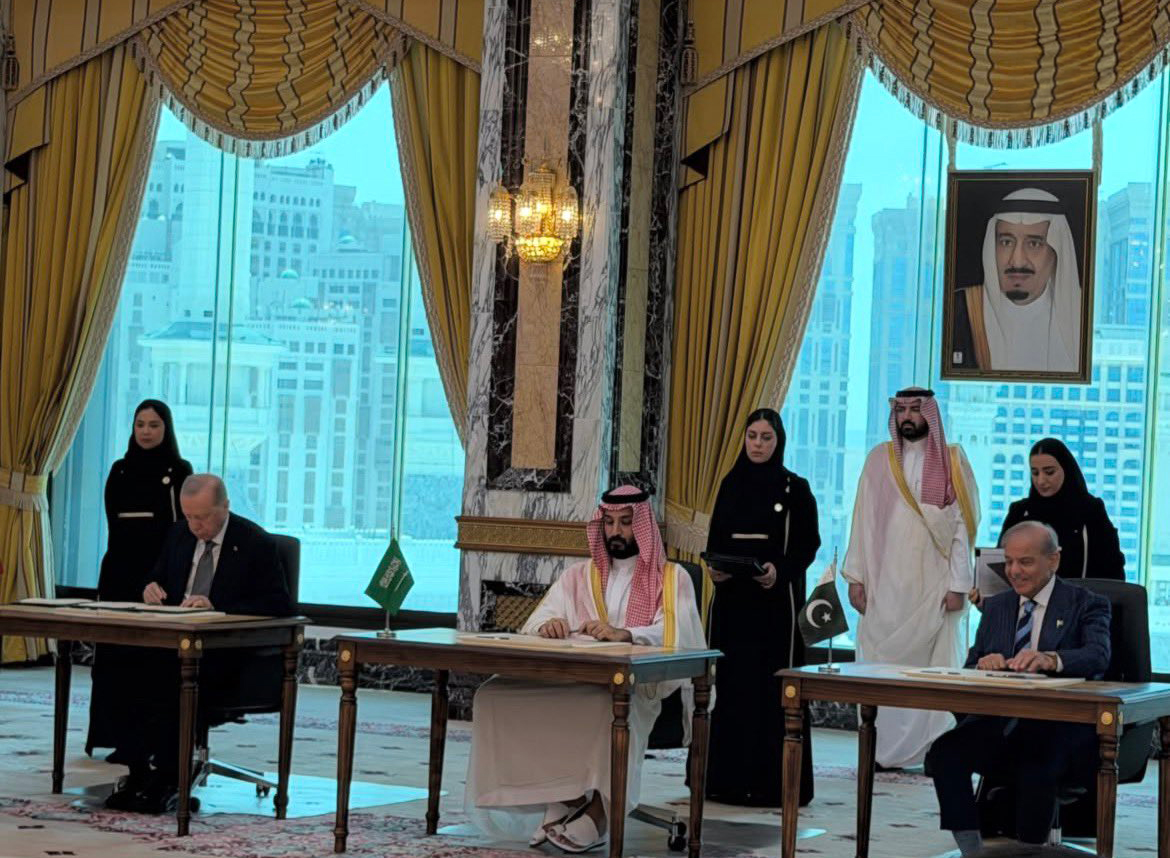
Unlike many commentators who focus solely on collective security, Sahni highlights another concept: Collective Deterrence.
His interpretation suggests that any attack against one member would trigger coordinated responses from the others, while implementation would remain within Article 51 of the UN Charter governing individual and collective self-defence.
This distinction is important.
The official language surrounding the agreement references cooperation and international law rather than a NATO-style automatic military response.
At present, publicly available information does not define:
- operational commitments,
- command arrangements,
- force deployment mechanisms,
- mutual defence obligations.
Without these institutional details, comparisons with NATO remain speculative.
Why Sahni Says India Is Not the Primary Target
One of Sahni’s most controversial conclusions is that the Makkah Defence Agreement is not directed against India.
Instead, he argues that India’s strategic challenge stems from:
- deteriorating relations with both Pakistan and China,
- regional diplomatic isolation,
- evolving military coordination among neighbouring states.
This view differs sharply from much of India’s television commentary, where the agreement has frequently been portrayed as an anti-India military alliance.
Interestingly, the governments signing the agreement have also publicly stated that it is not directed against any specific country.
That does not necessarily eliminate strategic consequences for India.
Defence cooperation, intelligence sharing, joint exercises and industrial collaboration naturally influence regional military balances regardless of whether a treaty explicitly identifies an adversary.
Where Sahni’s Analysis Is Strong
Several aspects of Sahni’s analysis deserve serious consideration.
1. The Middle East is changing
Regional states increasingly seek greater strategic autonomy rather than relying exclusively on external security guarantees.
2. China’s diplomatic influence is expanding
Beijing has become a significant political actor in Middle Eastern diplomacy, particularly through Saudi-Iran rapprochement and broader regional engagement.
3. Security and economic development are becoming increasingly interconnected
Many regional governments now view economic stability and security cooperation as mutually reinforcing rather than competing objectives.
These observations align with broader geopolitical trends.
Where the Evidence Becomes Less Convincing
Sahni’s analysis becomes more speculative when he suggests:
- the existence of a coordinated China-Russia-Iran-Pakistan strategic blueprint;
- the eventual replacement of the American regional security architecture;
- widespread future adoption of the Makkah model across the Global South.
These projections are plausible analytical possibilities, but they remain forecasts rather than established facts.
Future institutional developments, additional member states, integrated defence structures and sustained political coordination would be necessary before such conclusions could be validated.
What the Makkah Defence Agreement Means Today
At its current stage, the agreement should be viewed as:
- an important regional defence cooperation framework;
- a signal of growing strategic coordination among key Muslim-majority states;
- part of broader geopolitical diversification in the Middle East.
Whether it eventually develops into a transformational regional security organization depends on:
- implementation mechanisms,
- military integration,
- political cohesion,
- future regional crises,
- long-term commitment from participating governments.
Those questions remain unanswered.
Final Assessment
Praveen Sahni deserves credit for moving the debate beyond simplistic “pro-India versus pro-Pakistan” narratives.
His emphasis on Collective Security introduces an important conceptual framework for understanding changing regional dynamics.
Nevertheless, several of his broader conclusions extend beyond currently available evidence.
The Makkah Defence Agreement undoubtedly represents a significant diplomatic and defence development.
Whether it evolves into a genuine alternative to the decades-old US-led regional security system remains an open question that only future developments can answer.
For now, the agreement should be understood as an emerging strategic framework whose true significance will be measured not by political declarations but by its performance during future regional security crises.