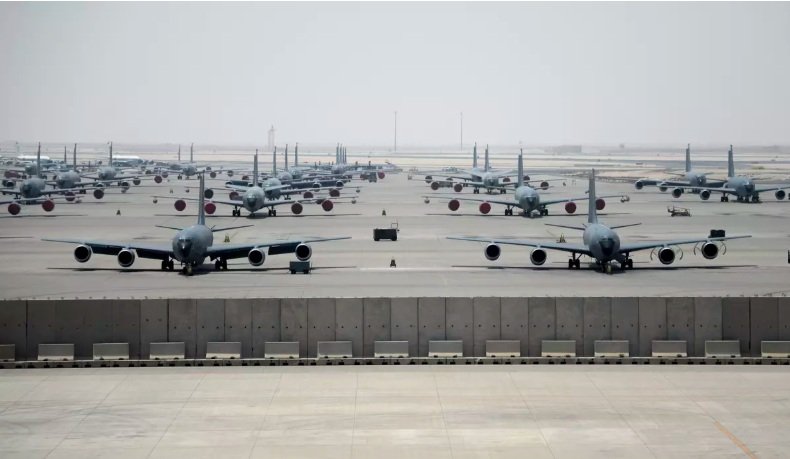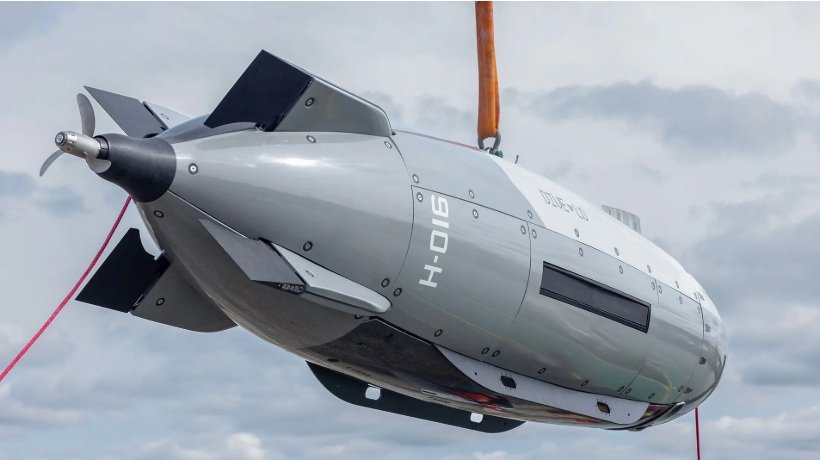
Pakistan Air Force appears to be accelerating its investment in ground-based short-range air defence, combining Chinese missile technology with Turkish gun and counter-drone systems in response to one of modern warfare’s fastest-growing threats: cheap drones and loitering munitions.
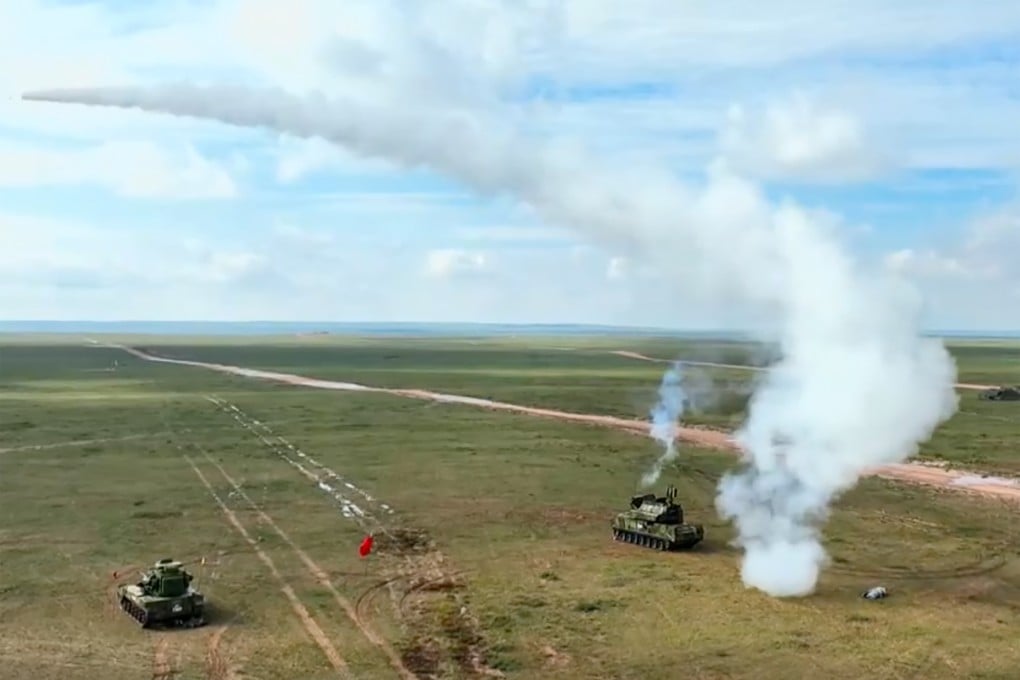
The growing use of drones, loitering munitions and other low-flying weapons is forcing militaries around the world to rethink one of the most difficult problems in air defence: how to defeat large numbers of relatively inexpensive aerial threats without exhausting stocks of costly surface-to-air missiles.
Pakistan appears to be responding with a layered approach.
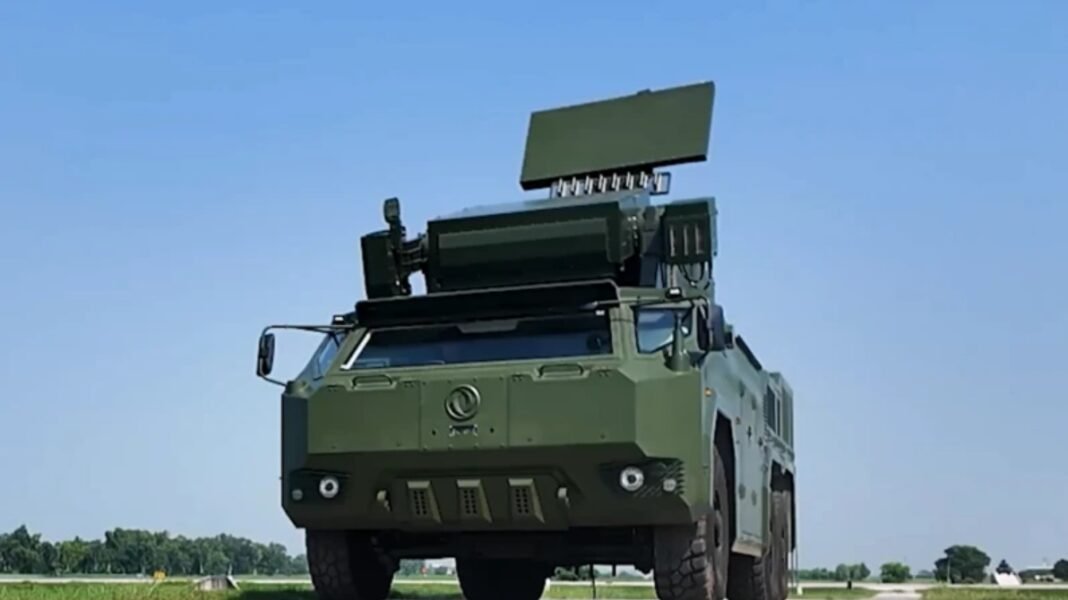
A Pakistan Air Force video released on September 7 showcased three different short-range air defence systems: China’s HQ-17AE surface-to-air missile system, Türkiye’s ASELSAN KORKUT 35mm air-defence gun system, and the Turkish ASELSAN ŞAHİN 40mm counter-UAS system.
Taken together, the systems point towards an emerging Pakistani concept of layered base defence, combining missiles, automatic cannons and dedicated counter-drone technology against threats ranging from small drones to helicopters, cruise missiles and other low-altitude targets.
The development is significant because Pakistan Air Force has traditionally relied heavily on fighter aircraft for air defence. The growing drone threat, however, is increasingly pushing air forces towards ground-based systems capable of defending critical installations around the clock.
A New Layered Air Defence Concept for Pakistan
The fundamental principle behind layered short-range air defence, or SHORAD, is straightforward.
Instead of relying on a single weapon system to destroy every incoming threat, multiple defensive layers are deployed at different ranges.
This provides defenders with several opportunities to detect, track and engage an incoming target before it reaches a protected installation.
Pakistan’s emerging architecture appears designed around precisely that concept.
At the outer end of the short-range defensive envelope, missile systems can engage larger or more distant threats. Automatic cannons then provide a cheaper and potentially more sustainable option against drones and low-flying targets. Finally, specialised counter-drone systems can defend the immediate vicinity of high-value facilities against smaller UAVs that penetrate the outer layers.
The model reflects a wider transformation in global air defence.
The challenge is no longer limited to stopping fighter aircraft, helicopters or cruise missiles.
Military planners must now consider the possibility of dozens—or potentially hundreds—of inexpensive drones attacking simultaneously.
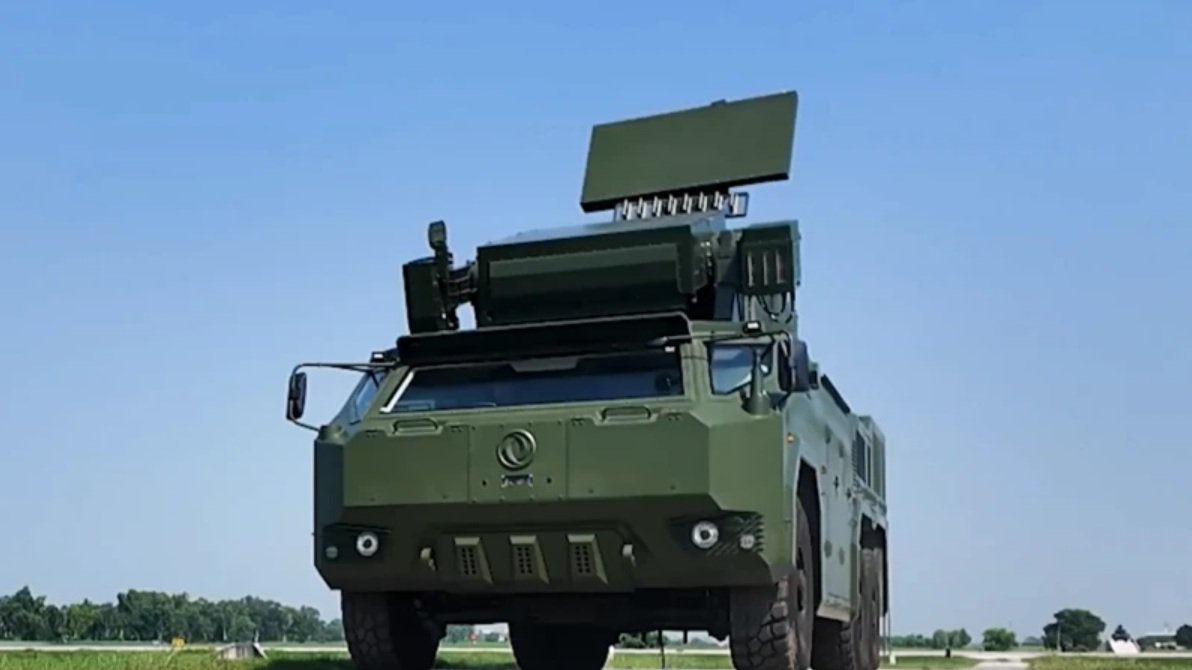
HQ-17AE: The Outer Missile Layer
The Chinese-made HQ-17AE appears to form the outer missile-based component of the emerging Pakistani SHORAD structure.
The system is a mobile short-range surface-to-air missile platform designed to engage a variety of low-altitude threats. Chinese official defence material describes the HQ-17AE as a highly integrated system capable of searching for, tracking and engaging targets while on the move, with improved capabilities against UAVs.
The system is intended to counter threats including:
- Fixed-wing aircraft;
- Helicopters;
- Unmanned aerial vehicles;
- Cruise missiles;
- Air-to-surface weapons; and
- Other low-altitude aerial targets.
Chinese sources describe the HQ-17AE as capable of independently conducting target search, tracking and missile engagements. Publicly available information also indicates that the system has been increasingly promoted as part of China’s wider counter-drone and layered air-defence architecture.
The reported range figures associated with the Pakistani concept should, however, be treated carefully because publicly available performance specifications can differ according to missile configuration, export variant and engagement conditions.
In Pakistan’s layered architecture, the HQ-17AE would logically serve as the first missile-based opportunity to engage incoming threats before they enter the gun-defence zone.
KORKUT 35mm: A Cost-Effective Layer Against Drones

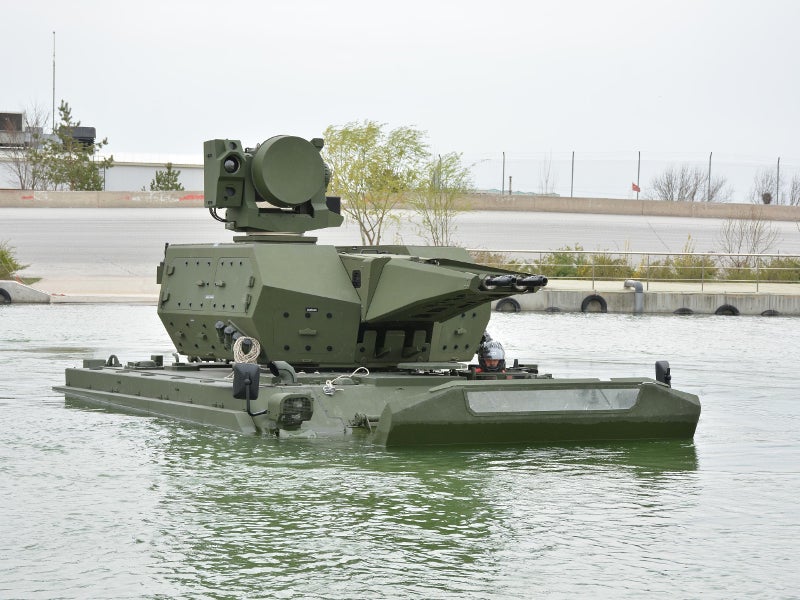
The second layer is represented by Türkiye’s ASELSAN KORKUT 35mm air-defence gun system.
KORKUT was developed to provide low-altitude air defence for mobile and mechanised forces. The system combines target detection and tracking capabilities with twin 35mm automatic guns.
Its importance in the drone era lies largely in its ability to use programmable airburst ammunition.
Rather than requiring a direct hit, airburst ammunition can be programmed to detonate near the target, creating a cloud of fragments in its flight path.
ASELSAN describes its KORKUT 150/35 system as having an effective range of approximately four kilometres when using 35mm programmable airburst ammunition. The company says the system is designed for short-range air defence of stationary and mobile units and incorporates 3D search radar, tracking radar and electro-optical sensors. (Aselsan)
The system’s ability to use airburst ammunition makes it particularly relevant against:
- Drones;
- Loitering munitions;
- Low-flying aircraft;
- Helicopters; and
- Certain missile threats.
Turkey’s defence industry has also highlighted the use of 35mm airburst ammunition against cruise missiles and UAVs, reflecting the increasing importance of gun-based systems in countering modern low-altitude threats.
This is particularly important from an economic perspective.
Using an expensive guided missile to destroy a cheap commercial-type drone can create what defence analysts often describe as an unfavourable cost-exchange ratio.
Automatic cannons firing programmable ammunition offer militaries a potentially cheaper way to deal with mass drone attacks.
ŞAHİN 40mm: Pakistan’s Inner Counter-Drone Layer

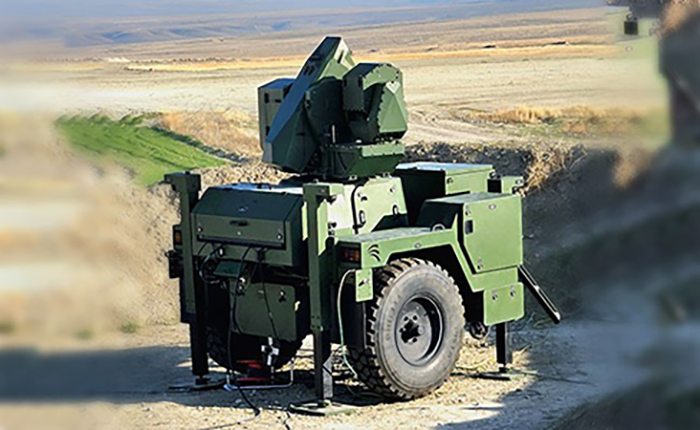
The third and closest defensive layer shown by the Pakistan Air Force is the ASELSAN ŞAHİN 40mm counter-UAS system.
The system is designed specifically to counter small and very small unmanned aerial threats.
According to the Pakistani assessment, ŞAHİN could provide very close-range protection against small drones at distances of around 700 metres.
Its role is different from that of the HQ-17AE.
The missile system is intended to engage threats at greater distances, while KORKUT provides a gun-based defence against targets entering the medium short-range zone.
ŞAHİN would function as the final protective layer around sensitive military infrastructure.
This reflects an increasingly important principle in modern counter-drone warfare: the smaller the drone, the closer and more specialised the defensive system often needs to be.
Small quadcopters and miniature UAVs can be difficult to detect because of their small radar signatures and low flight profiles.
Radar, electro-optical sensors and automated fire-control systems are therefore becoming essential components of counter-drone networks.
Where Does the LD-76 Fit Into the Picture?
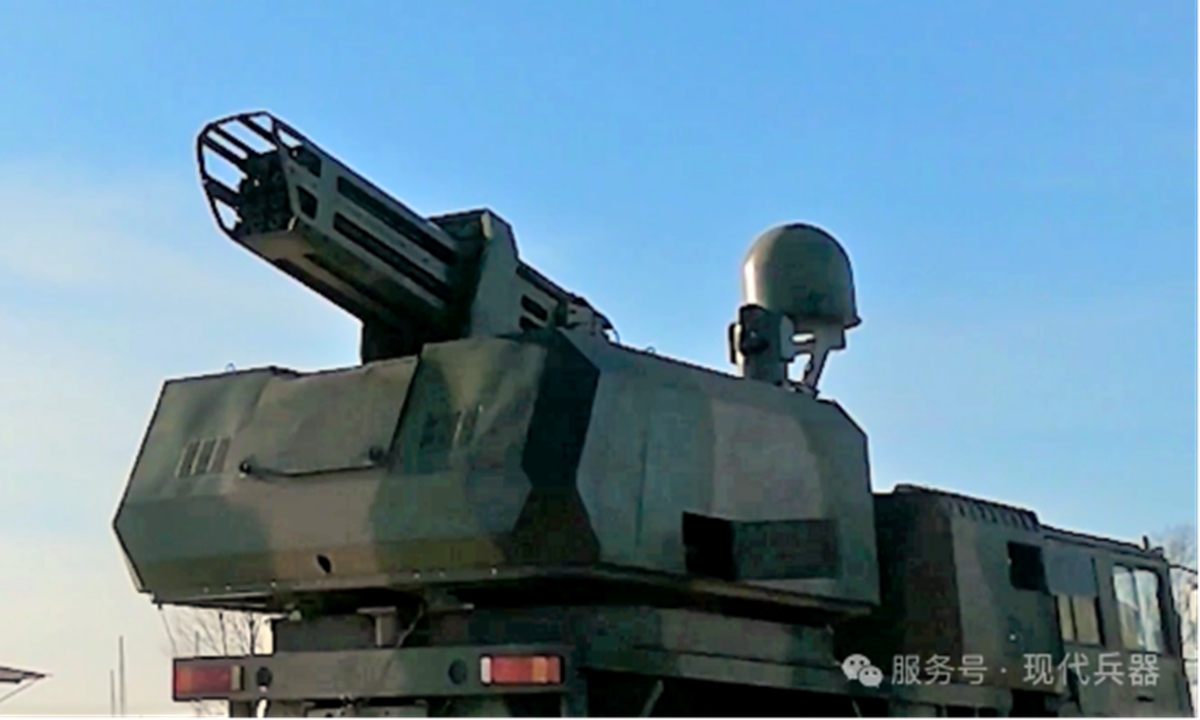
Open-source discussion surrounding Pakistan’s emerging air-defence architecture has also raised questions about a Chinese 76mm LD-76 gun-based system.
The system was not officially shown in the Pakistan Air Force’s September 7 video.
However, reports have pointed to the appearance of imagery featuring an LD-76-related shield alongside Pakistani and Chinese flags, leading to speculation that Pakistan could eventually consider the system as another layer in its ground-based air defence network.
At present, however, any Pakistani acquisition or operational deployment of the LD-76 should be treated as unconfirmed unless officially announced.
If introduced, a longer-range gun system could potentially provide an additional outer gun-based layer between close-in counter-drone weapons and missile systems.
For now, the systems publicly showcased by the PAF remain HQ-17AE, KORKUT and ŞAHİN.
Why Pakistan Needs Layered Defences Against Drones
Pakistan’s shift towards ground-based short-range air defence reflects a broader lesson from recent conflicts.
Drones and loitering munitions have changed the economics of warfare.
A relatively inexpensive drone can now threaten an aircraft on the ground, a radar installation, ammunition storage site, command centre or other high-value military target.
The attacking side can potentially launch multiple drones simultaneously.
The defender, meanwhile, faces the difficult challenge of detecting small targets and deciding which weapon to use against them.
This creates what could be described as the drone saturation problem.
A conventional surface-to-air missile battery may successfully intercept drones, but missile stocks are finite and expensive.
That is why militaries are increasingly combining multiple systems.
Missiles can engage more dangerous or distant targets.
Gun systems can engage drones and lower-value threats.
Dedicated counter-UAS systems can defend the final perimeter.
The objective is not simply to destroy every drone using the most powerful weapon available.
It is to use the right weapon against the right target at the right range.
Lessons From Recent Conflicts
Pakistan’s emerging SHORAD strategy appears to reflect lessons from recent regional and international conflicts, where drones and loitering munitions have become increasingly prominent.
The changing battlefield has demonstrated that traditional air defence systems were largely designed to counter:
- Fighter aircraft;
- Bombers;
- Helicopters;
- Cruise missiles; and
- Larger aerial platforms.
The rapid spread of small UAVs has created an entirely different category of threat.
These platforms can fly slowly, operate at low altitudes and possess radar signatures much smaller than conventional aircraft.
They can also be deployed in significant numbers.
The result is a growing requirement for air-defence systems that are able to detect, classify and engage targets across several layers.
China itself has increasingly presented the HQ-17AE as part of a wider low-altitude and counter-UAV air-defence network, highlighting the growing international focus on integrated defence against drones and swarm attacks.
Pakistan’s Shift After 2025
Pakistan Air Force’s decision to publicly showcase the three systems is also notable because of the apparent speed with which the service has moved towards expanding its ground-based SHORAD capability.
According to the assessment behind the report, Pakistan has incorporated or begun integrating these systems into its defensive structure within a relatively short period following the military developments of 2025.
If confirmed through further official disclosures, the pace would underline the urgency with which Pakistan now views the drone threat.
For decades, Pakistan’s air-defence posture has relied heavily on combat aircraft and a wider network of radar and surface-to-air missile systems.
The latest developments suggest a growing recognition that fighter aircraft alone are not the most efficient answer to every drone threat.
Launching a fighter aircraft to intercept a small drone is expensive.
Using a sophisticated surface-to-air missile against a low-cost UAV can also be economically inefficient.
Ground-based counter-drone and gun systems offer another option.

China and Türkiye Become Central to Pakistan’s New SHORAD Architecture
The combination of Chinese and Turkish systems is also strategically important.
Pakistan has traditionally maintained deep defence relationships with China, while military-industrial cooperation with Türkiye has expanded significantly over recent years.
The emerging SHORAD structure brings technologies from both countries into a common defensive mission.
The Chinese HQ-17AE provides the missile component.
Turkish systems provide gun-based and specialised counter-drone capabilities.
ASELSAN has continued to expand its air-defence portfolio and recently reported overseas deliveries of the KORKUT 150/35 system, highlighting the growing international market for short-range gun-based air defence as drone threats increase.
For Pakistan, the ability to integrate systems from different suppliers could offer greater flexibility.
However, the effectiveness of such a layered structure will ultimately depend on something more important than individual weapon specifications: integration.
The Critical Question Is Integration
A layered air-defence system works best when its components share information.
Radar detects the threat.
Sensors identify and track it.
Command-and-control systems determine its danger level.
The system then assigns the most appropriate weapon.
Without effective integration, several advanced weapons can operate as separate defensive islands.
With integration, they become part of a single defensive network.
KORKUT itself has been designed around this networked concept. Turkish defence sources describe the system as capable of operating autonomously or in coordination with wider air-defence command-and-control networks.
The same principle will be crucial for Pakistan.
The real capability of the proposed architecture will therefore depend on whether Chinese missile systems and Turkish gun systems can effectively share targeting information with Pakistan’s own command-and-control and radar networks.
The Pakistan Air Force has not publicly disclosed the technical architecture of such integration.
Therefore, it remains unclear whether the systems operate through a fully unified command network or as separate but coordinated layers.
A Close-In Weapon System for Air Bases?
Pakistan appears to be pursuing a concept similar to a Close-In Weapon System, or CIWS, adapted for the protection of land-based military facilities.
Traditionally, the term CIWS is strongly associated with naval systems designed to destroy incoming missiles at very close range.
A land-based equivalent follows a similar principle.
Outer layers attempt to destroy the threat first.
If they fail, closer layers receive another opportunity to intercept it.
In Pakistan’s case, the concept could potentially be used to protect:
- Air bases;
- Radar installations;
- Command centres;
- Ammunition depots;
- Aircraft shelters; and
- Other high-value military infrastructure.
The growing use of extended-range guided weapons and loitering munitions means that defending aircraft after they are parked on the ground is becoming almost as important as defending them in the air.
What These Systems Cannot Do
Despite their importance, the new SHORAD systems should not be viewed as a complete replacement for Pakistan’s wider air-defence architecture.
Short-range systems are designed primarily for low-altitude and nearby threats.
They cannot independently provide protection against every category of missile or aircraft.
High-speed cruise missiles, ballistic threats and advanced stand-off weapons may require other types of air-defence systems.
The specific claim that these SHORAD systems would be unable to counter every variant of weapons such as India’s BrahMos missile should also be approached with caution.
Interception capability depends on several factors, including:
- The missile’s speed;
- Flight profile;
- Detection range;
- Radar performance;
- Reaction time;
- Engagement geometry; and
- The specific interceptor available.
It would therefore be inaccurate to declare, without detailed operational data, that a particular system can or cannot reliably defeat every possible high-speed cruise missile threat.
What can be said with greater confidence is that SHORAD is only one layer of national air defence.
Pakistan would require separate medium-range and long-range capabilities for threats that exceed the engagement envelope of these systems.
The Drone Has Changed Air Defence Economics
Perhaps the most important development behind Pakistan’s new approach is economic.
Modern air-defence systems were historically built around the assumption that incoming targets would generally be expensive aircraft or missiles.
The drone revolution has disrupted that calculation.
A drone costing a few thousand dollars can force the defender to launch an interceptor worth hundreds of thousands—or potentially millions—of dollars.
That is not a sustainable model during a prolonged conflict.
The solution increasingly being adopted worldwide is a layered defence structure.
Missiles remain necessary.
But they are no longer the only answer.
Automatic guns, programmable airburst ammunition, electronic warfare, jammers, lasers and dedicated counter-UAS systems are becoming increasingly important.
Pakistan’s apparent decision to combine Chinese missiles with Turkish gun and counter-drone technology places it within this broader international shift.
What Comes Next for Pakistan Air Force?
The systems showcased by Pakistan Air Force represent an important indicator of where the service’s air-defence priorities are heading.
The focus appears to be shifting towards protecting critical installations from the growing threat posed by:
- Small drones;
- Loitering munitions;
- Low-flying aircraft;
- Helicopters;
- Cruise missiles; and
- Other precision-guided aerial weapons.
The ultimate effectiveness of this approach will depend on several unanswered questions.
How many systems has Pakistan acquired?
Where will they be deployed?
Can the Chinese and Turkish systems be integrated into a unified command-and-control network?
Will Pakistan acquire additional gun-based systems, including longer-range platforms?
And how will these new SHORAD assets fit into Pakistan’s wider network of fighter aircraft, radars and medium- and long-range surface-to-air missile systems?
Pakistan Air Force has not publicly provided detailed answers to these questions.
But the systems displayed on September 7 offer a clear indication of one major change.
For Pakistan—and militaries around the world—the future of air defence is no longer just about intercepting fast fighter jets.
It is increasingly about defending against small, cheap and numerous threats that can appear at low altitude and arrive in large numbers.
Pakistan’s emerging layered SHORAD architecture is an attempt to answer that challenge with multiple weapons, multiple ranges and multiple chances to stop the threat before it reaches its target.