
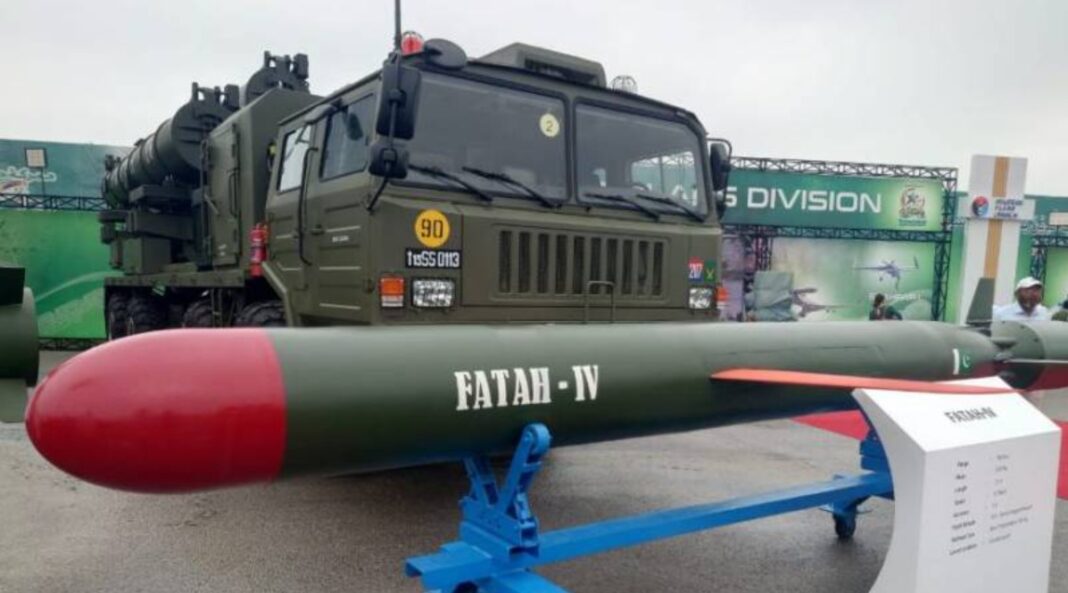
Pakistan has successfully test-launched an extended version of its indigenously developed Fatah-4 Ground-Launched Cruise Missile (GLCM), highlighting the country’s continuing effort to strengthen long-range conventional strike capabilities under the Army Rocket Force Command.
The latest test was announced by the Inter-Services Public Relations (ISPR) on October 6, 2026. According to the military’s media wing, the extended version of the Fatah-4 is equipped with advanced avionics and modern navigational aids and is designed to engage targets at extended ranges with high precision and lethality.
The test also validated additional technical parameters of several subsystems intended to improve accuracy and survivability, ISPR said.

Fatah-4 extended version: What Pakistan has confirmed
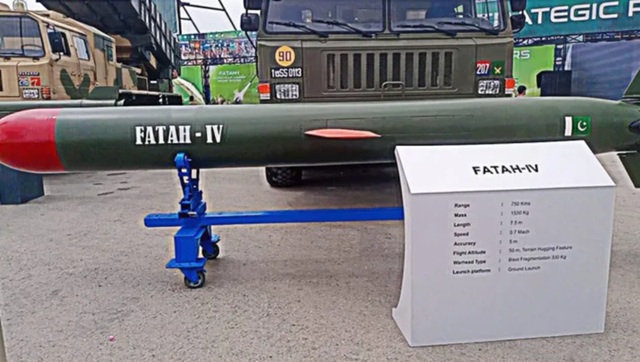
Pakistan has not disclosed the exact range of the extended Fatah-4 version tested on October 6. That distinction is important because the previously disclosed Fatah-4 configuration was publicly associated with a range of 750 kilometres.
In September 2025, ISPR announced a successful training launch of the Fatah-4 at a range of 750km and said the missile was capable of terrain-hugging flight, allowing it to improve survivability against missile-defence systems. ISPR also said the system would enhance the reach, lethality and survivability of Pakistan Army conventional missile forces.
The latest announcement therefore represents a significant development in the Fatah-4 programme, but the increase over the previously reported 750km range should not be assumed until Pakistan officially releases a figure.
That makes the wording “extended-range Fatah-4” more accurate than assigning it an unconfirmed range.
Why the Fatah-4 matters to Pakistan’s Army Rocket Force
The Fatah-4 programme is particularly significant because it fits into Pakistan’s developing Army Rocket Force Command (ARFC) structure.
Pakistan announced the creation of the Army Rocket Force Command in August 2025. Prime Minister Shehbaz Sharif said the new force would be equipped with modern technology and would strengthen the Pakistan Army’s conventional combat capabilities. Reuters reported at the time that the new force was intended to provide a dedicated command structure for missile capabilities in conventional conflict.
The Fatah-4 subsequently became one of the clearest publicly acknowledged systems associated with this new command.
In May 2026, the Army Rocket Force Command conducted a training fire of the Fatah-4. ISPR said that exercise was intended to improve troop operational efficiency while validating technical parameters of subsystems designed to improve accuracy and survivability.
The October test indicates that Pakistan is continuing to develop the system rather than treating the earlier Fatah-4 configuration as the endpoint.
From Fatah-4 to an extended-range conventional strike system
Cruise missiles provide a different capability from conventional ballistic missiles.
A ground-launched cruise missile can use controlled flight at relatively low altitude and, depending on its guidance architecture, can follow terrain and approach targets from directions that complicate detection and interception.
Pakistan’s 2025 statement specifically highlighted the Fatah-4’s terrain-hugging characteristics and advanced navigation.
For the Army Rocket Force, the importance of such a system is therefore not simply the number of kilometres it can travel.
The broader value lies in combining:
- Long-range conventional strike
- Precision guidance
- Improved navigation
- Greater survivability
- Mobile ground launch capability
- Dedicated command and control
- Integration with wider battlefield targeting systems
The Centre for International Strategic Studies (CISS), in an analysis of Pakistan’s Army Rocket Force Command, described the establishment of the command as a move toward centralising the planning and coordination of long-range conventional fires. The analysis also noted that separating conventional long-range fires from nuclear delivery systems could provide greater clarity between different levels of escalation.

What is new about the October 2026 test?
The key difference is Pakistan’s description of the weapon as an “extended version” of Fatah-4.
ISPR specifically said the test validated additional technical parameters of various subsystems for improved accuracy and enhanced survivability.
That suggests the latest test was not simply a repeat launch. It was also intended to evaluate modifications or improvements incorporated into the weapon system.
However, Pakistan has not publicly disclosed:
- The new maximum range
- Warhead specifications
- Exact guidance architecture
- Flight profile
- Speed
- Launch location
- CEP or circular error probable
- Number of missiles deployed
- Operational deployment status of the extended version
Those details should therefore not be presented as confirmed specifications.
A growing conventional missile architecture
The Fatah-4 is part of a wider expansion of Pakistan’s conventional missile capabilities.
The Army Rocket Force Command has also been publicly associated with the Fatah missile family. Earlier in 2026, the command conducted a training launch of another indigenous Fatah-series missile, demonstrating the continued development of Pakistan’s conventional long-range fires capability.
The development of the Army Rocket Force also comes after the intense India-Pakistan military confrontation in May 2025, during which missiles, drones and combat aircraft were employed by both sides. Reuters reported that Pakistan’s decision to establish a dedicated rocket force was announced shortly afterward.
Against that background, the Fatah-4 extended-version test can be viewed as part of Pakistan’s effort to strengthen its conventional deterrence and stand-off strike options.
Pakistan’s indigenous defence production push
Another important aspect of the test is the emphasis on indigenous development.
ISPR said the launch was witnessed by senior Pakistan Army officers as well as scientists and engineers from the developing agency. Pakistan’s political and military leadership subsequently congratulated the teams involved in the programme.
The repeated involvement of Pakistani scientists and engineers in the Fatah programme reflects Islamabad’s broader objective of developing increasingly sophisticated precision-strike systems domestically.
For the Army Rocket Force, indigenous development can also provide greater freedom to modify, upgrade and integrate missile systems according to Pakistan’s operational requirements.
The bigger picture
The October 6 test should therefore be understood as more than another missile launch.
It demonstrates that Pakistan is continuing to develop the Fatah-4 family, while simultaneously building an institutional framework—the Army Rocket Force Command—to manage long-range conventional strike capabilities.
The most important unanswered question is the actual range of the extended Fatah-4. Pakistan has previously disclosed a 750km range for the Fatah-4, but no new range has been announced for the version tested today.
Until Islamabad releases additional technical details, claims about a specific new range, warhead or ability to defeat particular air-defence systems should be treated as unverified.
What is confirmed is that Pakistan has successfully tested an extended version of the Fatah-4 and that the test focused on improved accuracy, survivability and subsystem performance—key attributes for the country’s evolving conventional long-range strike architecture.