
The United States has taken another major step toward rebuilding its long-range precision strike arsenal after Raytheon, an RTX company, secured a $22.9 billion, seven-year contract to accelerate production of Tomahawk cruise missiles for the U.S. Navy.
The award, announced under the Department of War’s Arsenal of Freedom Initiative, represents one of the largest missile production contracts ever awarded for the Tomahawk programme and signals Washington’s determination to rebuild munitions inventories amid rising geopolitical tensions.
🚨 JUST NOW: SecWar Pete Hegseth just announced a $22.9 BILLION contract to produce Tomahawk missiles with Raytheon
America’s defense industrial base is surging 🇺🇸 pic.twitter.com/ooOnccTiFZ
— Eric Daugherty (@EricLDaugh) August 17, 2026
Rather than simply replenishing stocks, the contract reflects a broader shift in U.S. defence planning—from maintaining limited peacetime inventories to sustaining industrial-scale missile production capable of supporting prolonged high-intensity conflict.
A Massive Increase in Missile Production
The most striking aspect of the agreement is not its value but its production target.
According to Raytheon, the company aims to increase annual Tomahawk production to more than 1,000 missiles per year.
That represents an extraordinary increase from previously reported production levels of roughly 60 missiles annually before the Pentagon’s February framework agreements.
If achieved, the expansion would represent more than a 15-fold increase in manufacturing capacity.
RTX also revealed that deliveries during the first half of 2026 were already three times higher than during the same period in 2025, indicating that production acceleration has already begun.
What Makes the Tomahawk So Important?

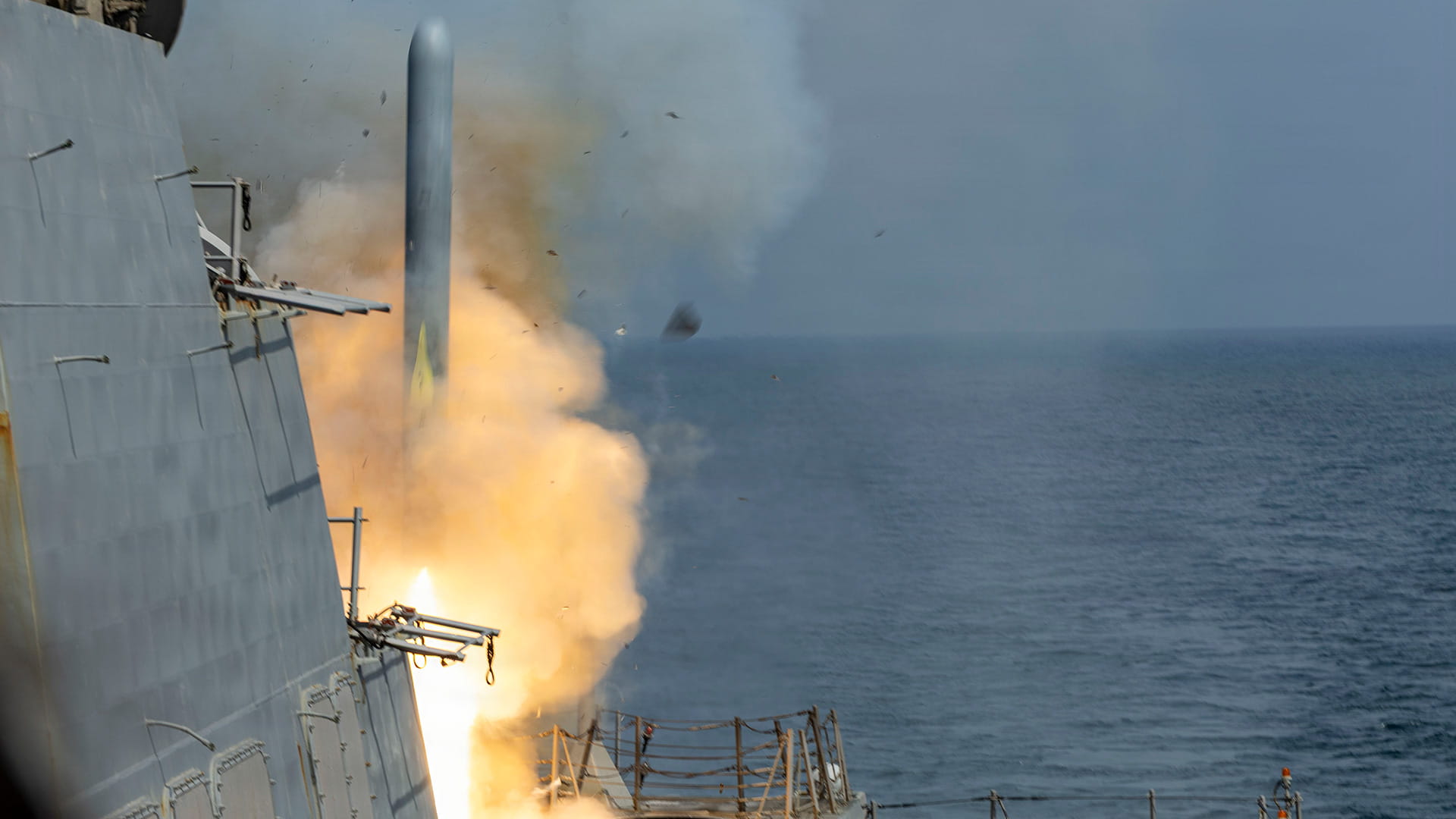
The BGM-109 Tomahawk remains one of America’s most effective long-range conventional strike weapons.
Key capabilities include:
- Range of approximately 1,600 kilometres (1,000 miles)
- Precision GPS and terrain-following navigation
- Sea-launched capability
- Low-altitude flight profile
- High survivability against air defences
- Conventional precision strike
The missile can be launched from:
- Arleigh Burke-class destroyers
- Ticonderoga-class cruisers (remaining operational units)
- Virginia-class submarines
- Los Angeles-class submarines
- Future U.S. Navy platforms equipped with the Mk 41 Vertical Launch System
Its long range enables naval forces to strike strategic targets without bringing warships close to hostile coastlines.
Why Is the US Increasing Production So Dramatically?
The decision reflects changing strategic realities.
For decades, the United States maintained relatively modest missile production because major interstate conflict appeared unlikely.
That assumption has changed.
Three developments have transformed Pentagon planning.
1. The Ukraine War
The conflict has demonstrated how quickly precision-guided munitions are consumed during sustained combat.
Military planners now recognise that peacetime production rates are insufficient for prolonged wars.
2. Rising Tensions With China
The Indo-Pacific has become the Pentagon’s primary theatre of concern.
In any future conflict involving Taiwan or the Western Pacific, long-range precision missiles would likely be among the first weapons employed.
Large inventories are therefore considered essential for deterrence.
3. Middle East Operations
Recent operations have again highlighted the importance of stand-off strike weapons capable of engaging targets without exposing aircraft or naval vessels to advanced air defences.
The Tomahawk remains one of the preferred weapons for such missions.
Arsenal of Freedom: Rebuilding America’s Munitions Base
The contract forms part of the Department of War’s Arsenal of Freedom Initiative, a programme intended to reverse decades of declining missile production capacity.
The initiative is not limited to Tomahawk missiles.
Earlier framework agreements also seek major increases in production of:
- AIM-120 AMRAAM air-to-air missiles
- SM-3 ballistic missile interceptors
- SM-6 multi-mission missiles
Together, these programmes indicate that the Pentagon is rebuilding capacity across offensive and defensive missile inventories simultaneously.
Raytheon Is Investing Billions
Meeting the new production targets will require significant industrial expansion.
RTX has increased planned capital expenditure for 2026 to $3.1 billion, compared with $2.6 billion previously.
The investment will support:
- Factory expansion
- Advanced manufacturing technology
- Workforce growth
- Supply-chain resilience
- Automation
- Missile assembly facilities
Tomahawk production is centred in Tucson, Arizona, but hundreds of suppliers across the United States are expected to participate.
The programme is also expected to benefit numerous small and medium-sized defence manufacturers.
Allied Demand Is Also Rising
Although the contract is primarily intended for the U.S. Navy, demand extends well beyond American forces.
Several U.S. allies are expanding long-range strike capabilities amid deteriorating global security conditions.
Countries such as Australia, Japan, and the United Kingdom have either acquired or announced plans to integrate Tomahawk missiles into their naval forces, reflecting a broader trend toward strengthening stand-off strike capabilities in the Indo-Pacific and Europe.
By increasing production, the United States can support both domestic requirements and allied procurement while reducing delivery times.
Strategic Implications for China
The production surge will be closely watched in Beijing.
The Tomahawk is specifically designed to strike:
- Command centres
- Air defence sites
- Radar installations
- Logistics hubs
- Air bases
- Naval infrastructure
In any Indo-Pacific contingency, these weapons would likely play a central role in suppressing enemy defences before manned aircraft enter contested airspace.
China has invested heavily in:
- Integrated air defence systems
- Long-range anti-ship missiles
- Electronic warfare
- Counter-access/area-denial (A2/AD) capabilities
The U.S. response increasingly emphasizes long-range precision strike and distributed naval operations.
Russia Will Also Be Watching
Moscow has extensive experience facing Tomahawk missiles in previous conflicts.
The expansion of U.S. production reinforces Washington’s ability to sustain conventional long-range strike operations during extended crises.
It also highlights the widening gap between Western defence-industrial capacity and wartime consumption rates that became evident during the Ukraine conflict.
Why Industrial Capacity Matters
Modern warfare is increasingly becoming a contest of industrial endurance.
Possessing advanced weapons is no longer sufficient.
Countries must also be capable of:
- replacing combat losses rapidly;
- sustaining production during conflict;
- protecting supply chains;
- expanding manufacturing under wartime conditions.
The Pentagon’s recent procurement strategy reflects growing recognition that defence industrial capacity is itself a strategic asset.
The Numbers Behind the Contract
| Category | Details |
|---|---|
| Contract Value | US$22.9 billion |
| Duration | 7 years |
| Missile | BGM-109 Tomahawk |
| Planned Annual Production | 1,000+ missiles |
| Previous Estimated Output | ~60 missiles annually |
| Range | Approximately 1,600 km (1,000 miles) |
| Primary Users | U.S. Navy and selected allies |
| Main Contractor | Raytheon (RTX) |
| Production Hub | Tucson, Arizona |
Strategic Comparison: Long-Range Cruise Missiles
| Country | Primary Long-Range Cruise Missile | Estimated Range | Launch Platforms |
|---|---|---|---|
| United States | Tomahawk Block IV/V | ~1,600 km | Destroyers, cruisers, submarines |
| China | CJ-10 / YJ-18 family | 1,500–2,000+ km (variant dependent) | Ground launchers, ships, submarines |
| Russia | Kalibr family | 1,500–2,500 km (variant dependent) | Ships, submarines |
| United Kingdom | Tomahawk | ~1,600 km | Attack submarines |
| Australia | Tomahawk (planned/being integrated) | ~1,600 km | Hobart-class destroyers, future platforms |
| Japan | Tomahawk (acquisition programme) | ~1,600 km | Planned naval integration |
Note: Exact capabilities vary by missile variant, payload and mission profile, and some performance figures are not officially disclosed.
What This Means for the Indo-Pacific
The contract reflects a broader transformation in U.S. military strategy.
Rather than preparing for short regional conflicts, Washington is building the industrial capacity required for potential long-duration competition with peer adversaries.
For the U.S. Navy, larger Tomahawk inventories provide greater operational flexibility across the Indo-Pacific, where vast distances make long-range precision weapons especially valuable.
At the same time, increased production strengthens deterrence by assuring allies and signalling to potential adversaries that the United States can replenish critical missile stocks at a much faster rate than in the past.
Final Assessment
Raytheon’s $22.9 billion Tomahawk contract is about far more than cruise missiles.
It represents a fundamental shift in American defence planning—from maintaining limited peacetime stockpiles to rebuilding an industrial base capable of supporting sustained, high-intensity warfare.
The dramatic increase in production capacity underscores lessons learned from Ukraine, growing competition with China, and rising demand for long-range precision strike weapons across multiple theatres.
Whether viewed through the lens of deterrence, alliance assurance or industrial strategy, the agreement signals that the United States is preparing not only to fight future wars—but also to sustain them if necessary.