


Britain’s intelligence agency MI5 and the Ministry of Defence have issued a public security warning that companies supplying weapons, military equipment and other material assistance to Ukraine could become targets of Russian-backed sabotage operations.
The November 24 warning identifies a growing threat from Russian intelligence-linked networks allegedly using criminal intermediaries and other proxy actors to attack European defence-related facilities. The potential methods include arson, intimidation, espionage and information operations designed to weaken Western support for Ukraine.
The warning, issued through MI5’s National Protective Security Authority (NPSA), is significant not simply because of the possibility of attacks on British companies, but because it highlights a changing dimension of the Russia-West confrontation. The industrial and commercial networks supporting Ukraine are increasingly being treated as part of the wider strategic contest.
For Moscow, disrupting these networks could offer an alternative means of imposing costs on countries supporting Kyiv without engaging their armed forces in direct military confrontation. For Britain and its European allies, the challenge is to protect an expanding defence-industrial base against operations that may be deliberately designed to remain below the threshold of conventional warfare.

From the Ukrainian battlefield to Europe’s industrial infrastructure
The latest warning reflects a broader strategic reality: Western military assistance to Ukraine depends on a complex network of manufacturers, component suppliers, transport companies, warehouses, procurement contractors and technology providers.
This infrastructure has become increasingly important as European governments attempt to sustain weapons deliveries and expand their own defence production capabilities.
A disruption at one point in the supply chain may not immediately affect the battlefield, but repeated incidents could create delays, increase costs and undermine confidence among companies involved in military procurement.
Russia would not necessarily need to destroy a major weapons manufacturing facility to produce such effects. A relatively small attack against a warehouse, logistics centre or specialised supplier could force a company to suspend operations, investigate security weaknesses and redirect resources towards protection.
This is where the strategic importance of the MI5 warning becomes clearer. It extends the security concern beyond prominent defence manufacturers to businesses that may have limited visibility but perform essential functions within the military supply chain.
The warning also suggests that the objective of hostile activity may not always be physical destruction. Intimidating employees, exposing sensitive information or creating fear among business executives could be sufficient to complicate commercial decisions and discourage participation in Ukraine-related contracts.
Criminal proxies: The attraction of deniable operations
One of the most important elements of the British warning is its emphasis on proxy actors.
Instead of relying exclusively on trained intelligence officers, a hostile state can potentially use intermediaries, criminal networks or locally recruited individuals to carry out operations.
This model offers several advantages to the sponsoring state. It can reduce the direct exposure of intelligence personnel, make attribution more complicated and create distance between the state and the individuals conducting an attack.
The use of relatively unsophisticated methods, such as arson, is particularly revealing. Such operations do not require sophisticated military capabilities, yet they can generate substantial economic damage, public anxiety and pressure on security agencies.
The approach also creates a difficult problem for counter-intelligence services. A person recruited to conduct surveillance or set fire to a facility may appear to be an ordinary criminal rather than part of a foreign intelligence operation.
Money, personal grievances, ideological sympathies or online recruitment networks could potentially be exploited to build these proxy relationships.
The result is a security environment in which the distinction between organised crime and state-directed hostile activity becomes increasingly difficult to establish.
This does not mean every suspicious fire, cyber incident or criminal act involving a defence company should be attributed to Russia. Attribution requires evidence. However, the growing use of intermediaries makes the investigation of such incidents more complicated.

Britain has already experienced the consequences
The warning is not emerging in a vacuum. Britain has already prosecuted individuals involved in an arson attack on a Ukrainian-owned business in east London.
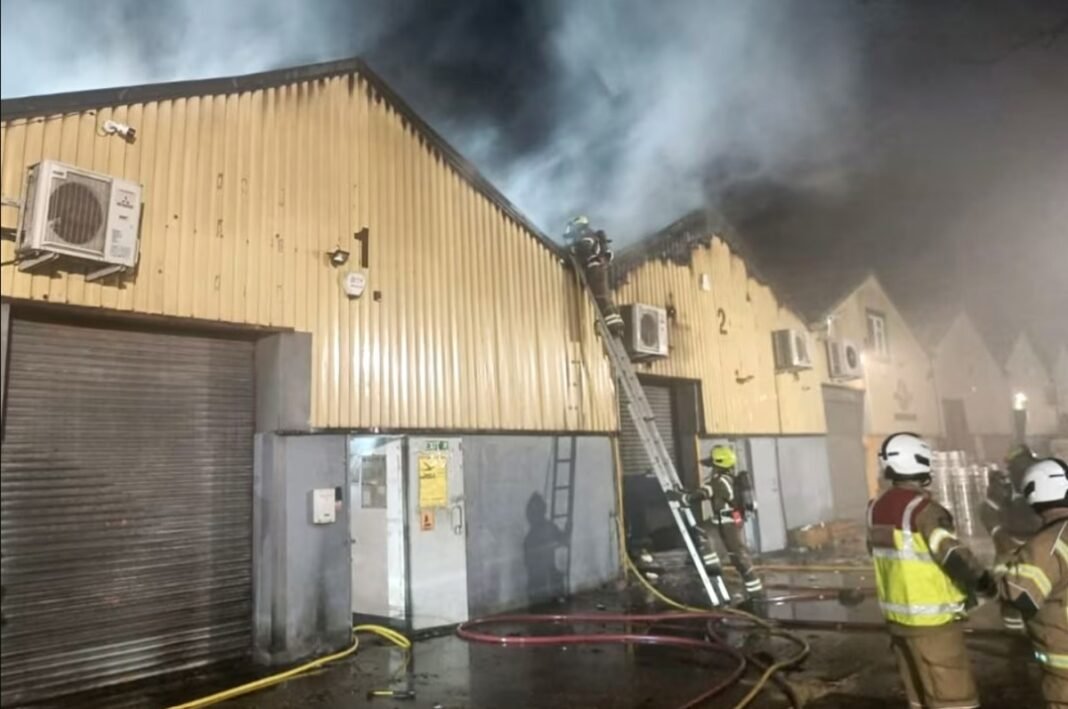
In March 2024, a warehouse in Leyton containing supplies destined for Ukraine was deliberately set on fire, causing approximately £1 million in damage.
British counter-terrorism investigators established that the operation had been organised on behalf of Russia, with the Wagner Group playing a role in the recruitment network.
In October 2025, six men were sentenced for their involvement in the attack. The case demonstrated how a foreign-linked operation could exploit locally recruited individuals to strike a commercial facility connected to Ukraine.
Another case emerged in September 2026, when British prosecutors accused Joshua Cammidge of assisting Russian intelligence-linked operatives in a potential sabotage operation involving drone manufacturing facilities in Swindon.
According to prosecutors, Cammidge allegedly provided information about four drone manufacturing sites and communicated with an individual believed to be associated with the GRU Volunteer Corps.
He has denied the allegations and a trial is scheduled for 2027. The allegations have not been established in court.
Nevertheless, the case highlights the importance of protecting industrial facilities that manufacture technologies increasingly central to the Ukraine war.
The Leyton prosecution and the Swindon allegations illustrate two different aspects of the threat: the use of criminal recruits to attack facilities and the alleged collection of information about strategically important industrial targets.
Together, they provide important context for the latest intelligence warning.
Why Russia might target the defence supply chain
The strategic logic behind targeting defence-related businesses is connected to the relationship between industrial capacity and military endurance.
Ukraine’s ability to sustain its defence depends not only on the weapons already delivered but also on the continued availability of ammunition, replacement components, repair services, drones, communications equipment and logistical support.
European industrial capacity has consequently become an important component of Ukraine’s long-term military position.
Disrupting this infrastructure could serve several Russian objectives.
First, it could delay the delivery of military equipment and complicate the maintenance of existing weapons systems.
Second, it could increase the financial burden on European governments and private companies by forcing them to invest more heavily in security, insurance and operational resilience.
Third, it could create political pressure by making the economic and security costs of supporting Ukraine more visible to European populations.
Finally, repeated attacks or attempted attacks could encourage uncertainty among businesses considering participation in defence contracts.
The last objective may be particularly important. A successful sabotage operation can damage a facility, but a sustained atmosphere of insecurity can influence investment decisions long after the physical damage has been repaired.
However, there is no publicly established evidence that every incident identified by European authorities is part of one centrally coordinated Russian campaign. The broader pattern should be assessed without assuming a single operational structure behind every attack.

Hybrid warfare is becoming an industrial security problem
The term hybrid warfare is frequently used to describe the combination of conventional military pressure with cyber operations, espionage, sabotage, disinformation and economic coercion.
Russia’s confrontation with Western countries increasingly demonstrates how these instruments can operate alongside the war in Ukraine.
The significance of the current warning is that hybrid activity is becoming a direct concern for private businesses rather than remaining primarily a matter for military installations and government institutions.
Defence companies are especially exposed because their commercial operations, personnel, supply networks and technological capabilities can have strategic consequences.
A cyberattack against a supplier could interrupt production. Espionage could expose sensitive information. Intimidation could affect employees. A physical attack could damage facilities.
These activities need not occur simultaneously to produce cumulative pressure.
The combination of different forms of disruption could also make it harder for governments and businesses to identify the source, purpose and wider significance of individual incidents.
For European governments, this means that industrial security can no longer be treated as a narrow corporate responsibility. It is becoming part of national security planning.
What could happen next? Five areas of growing concern
The British warning does not identify a specific future attack or provide evidence of an imminent Russian operation against a particular company. Nevertheless, the threat assessment points towards several areas that European security agencies are likely to examine more closely.
1. Greater pressure on drone and advanced weapons manufacturers
The growing importance of unmanned systems in Ukraine makes companies involved in drone production, sensors, communications and electronic warfare strategically significant.
The alleged Swindon case illustrates why such facilities attract security attention. European governments are likely to place greater emphasis on protecting defence technology manufacturers and the specialised suppliers supporting them.
2. Increased attention to logistics and storage facilities
Warehouses, transport contractors and distribution networks could represent vulnerable points in the military supply chain.
A disruption at a logistics facility might not destroy military equipment, but it could delay its movement and complicate delivery schedules.
3. A combination of cyber and physical disruption
Physical sabotage may be accompanied by cyber operations targeting business networks, procurement systems and industrial operations.
This could create additional pressure on companies that depend on interconnected digital systems but do not possess the cybersecurity resources of major defence contractors.
4. Intimidation and information operations
Employees, executives and contractors could face threats, harassment or attempts to expose personal information.
Online campaigns could also seek to damage the reputation of defence suppliers, portray their work negatively or generate public controversy around military assistance to Ukraine.
5. Wider European intelligence cooperation
Britain is unlikely to view the threat as exclusively domestic. Defence supply chains operate across national borders, and a company based in one country may depend on components, transport or technology from several others.
This creates an incentive for intelligence agencies and governments to share information about suspicious activity, recruitment patterns and vulnerabilities across the wider European defence sector.
These are plausible areas of concern, not predictions of confirmed Russian operational plans.
NATO’s dilemma: Responding without escalating into direct confrontation

The growing sabotage threat creates a difficult strategic question for NATO.
The alliance is structured around collective defence, but responding to covert operations conducted through criminal intermediaries is considerably more complicated than responding to a conventional military attack.
The first challenge is attribution. Governments need credible evidence to establish whether an incident was directed, financed or facilitated by a foreign intelligence service.
The second is proportionality. A criminal attack allegedly linked to a foreign state does not automatically provide the same grounds for a military response as an armed attack against a NATO member.
The third is deterrence. If proxy operations remain below the threshold of conventional warfare, hostile actors may calculate that the political and military consequences will be limited.
This is precisely why European governments are increasingly focusing on intelligence sharing, counter-intelligence, law enforcement cooperation and the protection of critical infrastructure.
NATO’s response will therefore need to extend beyond military deterrence. Protecting the industrial capacity that sustains European defence is becoming an increasingly important part of the alliance’s security posture.
There is also a potential counterproductive effect for Moscow. If sabotage attempts strengthen European perceptions of a direct Russian threat, they could accelerate defence spending, deepen intelligence cooperation and reinforce political support for Ukraine.
Rather than weakening Western commitment, attacks on European businesses could ultimately strengthen the argument for a more resilient and integrated European defence industry.
Europe’s defence expansion creates a new security priority
European governments are attempting to address a long-standing weakness: insufficient industrial capacity to sustain a prolonged high-intensity conflict.
The war in Ukraine has exposed the importance of ammunition production, repair facilities, supply-chain resilience and the ability to replace equipment at scale.
As defence expenditure increases, more private-sector businesses are likely to become involved in military production and procurement.
This expansion also increases the number of companies, facilities and workers whose activities have strategic relevance.
The security challenge is therefore likely to grow even if the number of actual sabotage incidents does not increase at the same pace.
Governments must ensure that defence expansion is accompanied by stronger physical security, cybersecurity, intelligence coordination and protection for personnel.
The private sector will also need to reconsider the assumption that commercial facilities are insulated from geopolitical confrontation simply because they are not military bases.
The strategic message behind the MI5 warning
Britain’s latest warning reflects a changing understanding of where the Russia-West confrontation is being fought.
The war remains centred on Ukraine, but its consequences increasingly extend into European industrial networks, commercial operations and domestic security systems.
For Moscow, covert disruption could offer a way to impose costs on Western governments without crossing the threshold of direct military confrontation. For Britain and its allies, the challenge is to prevent such operations from undermining the industrial and political foundations of their support for Kyiv.
The next phase of this confrontation may therefore be measured not only by weapons delivered to Ukraine or territory gained on the battlefield, but also by the resilience of the industrial networks behind European military assistance.
The central strategic question is no longer simply how much military equipment Europe can produce for Ukraine. It is whether Europe can protect the companies, supply chains and people required to produce and deliver it.
The battlefield may remain in Ukraine, but the contest over the infrastructure sustaining the war is increasingly reaching Europe’s own industrial heartland.


