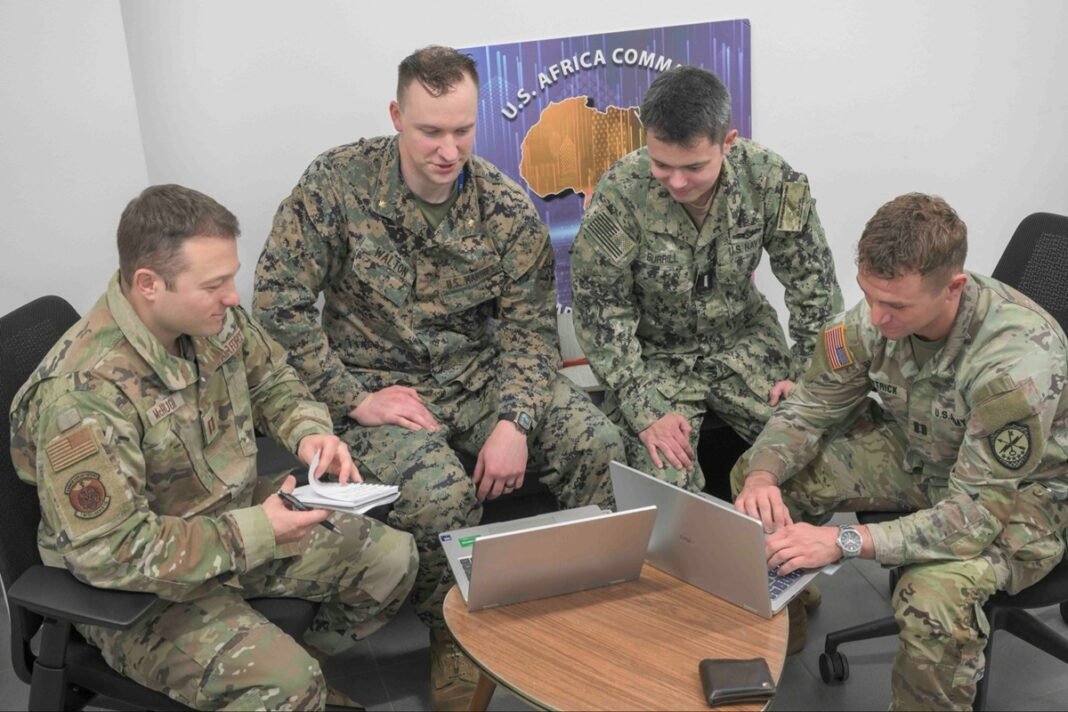
The workshops brought together software developers from the US Department of War’s Chief Data and Analytics Office (CDAO) and operational personnel from Special Operations Command Africa (SOCAF) and AFRICOM’s Directorate of Operations. The engagement focused on improving how military personnel use Maven to analyse surveillance imagery, process video intelligence and develop a clearer operational picture.

According to AFRICOM, the sessions took place at its headquarters in Stuttgart, Germany, with a hands-on workshop held at Kelley Barracks on November 12, 2026. The command announced the engagement on November 17.
The development is significant because Project Maven has evolved from an artificial intelligence initiative focused on analysing military surveillance footage into a broader system supporting intelligence processing, battlespace awareness and military command-and-control functions.
The latest engagement also highlights a growing Pentagon priority: ensuring that AI-powered military systems are developed around the operational requirements of personnel in the field rather than being designed exclusively by software teams at headquarters.
For AFRICOM, which coordinates US military activities across a vast geographical area, the ability to process large volumes of intelligence data and present relevant information to commanders could become increasingly important in addressing security challenges across the continent.
What Is Project Maven and How Does It Work?
Project Maven was launched by the US Department of Defense in 2017 to introduce artificial intelligence and machine-learning technologies into military intelligence operations.
Its initial objective was to help military analysts process the enormous volumes of imagery and full-motion video collected by drones, aircraft and other surveillance platforms.
The problem facing US military intelligence agencies was increasingly straightforward: modern surveillance systems were collecting more information than human analysts could efficiently examine.
Reviewing hours of drone footage and thousands of satellite images manually could consume considerable time and personnel resources.
Project Maven was developed to address this challenge by using computer vision and machine-learning algorithms to identify objects and activities of potential interest.
Instead of requiring analysts to examine every image and video frame, the software can automatically identify, classify and flag relevant information for human review.
Over time, the programme expanded into a wider digital military ecosystem, including the Maven Smart System (MSS).
According to a June 2026 analysis by the Center for Strategic and International Studies (CSIS), Maven Smart System provides a unified interface for integrating intelligence, surveillance and reconnaissance information, supporting battlespace management and connecting intelligence analysis with operational planning.
Its capabilities include:
-
Computer-vision detection of objects in imagery and video.
-
Integration of information from different intelligence sources.
-
Geospatial visualisation of battlefield information.
-
Battlespace awareness and management.
-
AI-assisted operational planning.
-
Target management and human validation of machine-generated detections.
The system is designed to reduce the time required to move from collecting intelligence to understanding its operational significance.

Why AFRICOM Is Bringing Developers Closer to Military Operators
One of the most important aspects of the November workshops is the Pentagon’s effort to involve operational users directly in the development of AI-powered military software.
Rather than relying exclusively on presentations and demonstrations, AFRICOM allowed personnel from SOCAF and its Directorate of Operations to work directly with the visiting development team.
Participants demonstrated existing Maven workflows, identified technical difficulties and discussed improvements that could make the platform more useful in operational environments.
The workshops focused on two main priorities.
Immediate improvements: Identifying existing software limitations, simplifying workflows and making current capabilities more responsive to operational requirements.
Long-term development: Collecting feedback from military personnel to guide future software improvements and identify additional capabilities that may be required.
US Army Captain Ryan T. Hetrick, lead of the Edge Super Intelligence Task Force, emphasised the importance of developing technology alongside the people who use it.
He said military software developers must go where warfighters operate, understand their missions and build capabilities alongside end users rather than expecting large-scale adoption of systems developed exclusively at the Pentagon.
This approach reflects a wider challenge facing military AI programmes: sophisticated software has limited operational value if personnel cannot easily integrate it into their existing decision-making processes.

What Is the Edge Super Intelligence Task Force?
The AFRICOM workshops also brought attention to the Edge Super Intelligence Task Force, whose personnel are working to connect AI development with military requirements at operational levels.
The task force’s involvement highlights the importance the US military is placing on deploying advanced digital capabilities closer to operational users.
In military terminology, the edge generally refers to environments where forces operate and where information must be processed and used despite potentially limited connectivity, time constraints and demanding operational conditions.
The objective is to reduce the gap between technology developers and military personnel who require practical solutions during missions.
The AFRICOM engagement suggests that the task force is using direct interaction with operational commands to identify where existing software can be improved and where future development should be directed.
However, AFRICOM has not disclosed specific new AI agents, software modules or operational capabilities introduced during these workshops.
Why AI-Powered Battlefield Intelligence Matters in Africa
Africa presents a complex operating environment for US military and intelligence organisations.
AFRICOM’s responsibilities extend across a continent involving multiple security challenges, including extremist organisations, armed insurgencies, maritime insecurity, transnational criminal networks and regional instability.
The command works with African governments and security partners to support counterterrorism operations, military training, intelligence cooperation and regional security initiatives.
In such an environment, intelligence gathering and analysis can involve information from numerous sources, including aerial surveillance, satellite imagery, ground-based reporting and other intelligence systems.
Processing this information efficiently is a major operational challenge.
AI-assisted intelligence platforms can potentially help military personnel:
Improve situational awareness: Combining information from different sources into a common operational picture can help commanders understand developments across large geographical areas.
Accelerate intelligence analysis: Automated image and video screening can help analysts identify potentially relevant objects and activities without manually reviewing every piece of collected material.
Support counterterrorism operations: Identifying patterns and changes in surveillance information could help analysts assess the movements and activities of armed groups.
Improve operational coordination: A shared digital picture can help different military units and command structures work with more consistent information.
Reduce information-processing delays: Automated systems can prioritise information for human examination, allowing analysts to concentrate on matters requiring greater attention.
These are potential applications of the wider Maven technology ecosystem. AFRICOM has not disclosed specific African missions or targets associated with the latest workshops.
Maven Smart System: From Surveillance Analysis to Military Command and Control
The development of Maven is particularly important because its capabilities have expanded beyond the original objective of identifying objects in surveillance footage.
The Maven Smart System brings together intelligence information and operational planning functions within a common digital environment.
A June 2026 CSIS assessment described the system as a major component of the Pentagon’s broader effort to integrate military information and decision-making across different operational domains.
The system can combine information from different intelligence sources and present it through a shared geographical interface.
This can help military personnel understand the relationship between surveillance observations, friendly forces, operational requirements and developing situations.
CSIS identified several functions associated with Maven Smart System:
| Capability | Military application |
|---|---|
| Computer vision | Identifying objects in imagery and video |
| Intelligence integration | Combining information from different sources |
| Battlespace management | Providing a shared operational picture |
| Target management | Organising and reviewing target-related information |
| AI-assisted planning | Supporting operational planning and decision-making |
| Generative AI | Supporting information analysis and user interaction |
Importantly, the system’s AI-generated detections and recommendations do not eliminate the need for human review. Human validation remains an important part of the process.
Palantir and the Pentagon’s Expanding Military AI Ecosystem

The development of Maven also highlights the growing role of private technology companies in US military modernisation.
Palantir Technologies has become a major industry partner in the development of Maven-related capabilities and the Maven Smart System.
The company’s software integrates information from different databases and intelligence sources, allowing users to analyse large volumes of information within a common operational environment.
According to CSIS, Palantir became the primary industry partner after Google’s withdrawal from the original Project Maven arrangement in 2018.
The original programme attracted controversy when Google employees protested against the company’s involvement in military AI development. Google subsequently did not renew its contract.
Palantir later became central to the programme’s software development and integration.
CSIS reported in June 2026 that the Department of War’s Maven-related contract ceiling had exceeded $1 billion in May 2025, with additional Maven Smart System work incorporated into the arrangement later that year.
The scale of the investment illustrates the Pentagon’s increasing reliance on commercial technology companies to develop and maintain advanced military software.
Human Oversight Remains a Critical Issue
The growing use of AI in military operations also raises questions about accuracy, accountability and human control.
AI-powered imagery analysis can identify objects and patterns much faster than conventional manual processes. However, machine-generated detections can also contain errors.
An object may be misclassified, surveillance information may be incomplete, and automated systems may produce misleading results when operating in unfamiliar environments.
These limitations are particularly important in military operations, where incorrect intelligence assessments can have serious consequences.
Human analysts must therefore remain involved in reviewing information, assessing its reliability and interpreting the operational context.
The distinction between AI-assisted intelligence and autonomous decision-making is particularly important.
AFRICOM’s announcement describes Maven as a system that flags information for human analysts. It does not announce that the workshops introduced autonomous weapons or transferred independent strike authority to AI systems.
The Pentagon’s wider use of AI therefore brings operational advantages alongside continuing questions about reliability, human oversight and accountability.
What Does This Mean for the Future of US Military Operations in Africa?

The latest AFRICOM engagement is part of a wider transformation in how the US military approaches intelligence, surveillance and operational decision-making.
Military organisations are increasingly dealing with information collected through satellites, unmanned aircraft, ground-based sensors and other surveillance systems.
The challenge is no longer simply collecting information but processing it quickly enough to provide useful intelligence to commanders.
Project Maven is designed to address that challenge by integrating automated analysis with human expertise and operational command systems.
For AFRICOM, improving Maven’s usability could help personnel manage complex intelligence workflows across a geographically dispersed command.
The workshops also suggest that the Pentagon is increasingly treating software development as a continuous process involving operational feedback rather than a one-time procurement exercise.
The significance of the November engagement therefore extends beyond a series of technical workshops.
It reflects the US military’s broader effort to make artificial intelligence an integrated part of its intelligence and command infrastructure.
As Project Maven continues to evolve, its ability to combine information, support human analysis and improve the speed of military decision-making will remain an important element of US defence modernisation.
For AFRICOM, the central objective is to ensure that these technologies provide practical operational value to personnel working in one of the world’s most complex regional security environments.