The United States reportedly examined an extraordinary military option involving Army Rangers, Navy SEALs and nuclear specialists to recover Iran’s enriched uranium following air strikes on its nuclear facilities, according to an exclusive report published by the New York Post on 25 July 2026.
The reported plan would represent one of the most complex special operations missions ever considered by the U.S. military, combining special operations forces, engineers, explosive ordnance disposal (EOD) teams, aviation assets and technical nuclear experts to secure highly sensitive nuclear material inside Iranian territory.
However, neither the U.S. Department of Defense nor U.S. Central Command (CENTCOM) has publicly confirmed that such a mission has been approved, assigned or placed into execution.
What Does the Report Claim?
According to the New York Post, citing a source familiar with U.S. military planning, Washington has explored a ground operation designed to recover enriched uranium that may have survived earlier air strikes on Iranian nuclear facilities.
Unlike a conventional bombing campaign aimed at damaging infrastructure, the reported mission would focus on physically locating, securing and removing enriched uranium before it could be concealed, relocated or reused.
The report suggests such an operation would require:
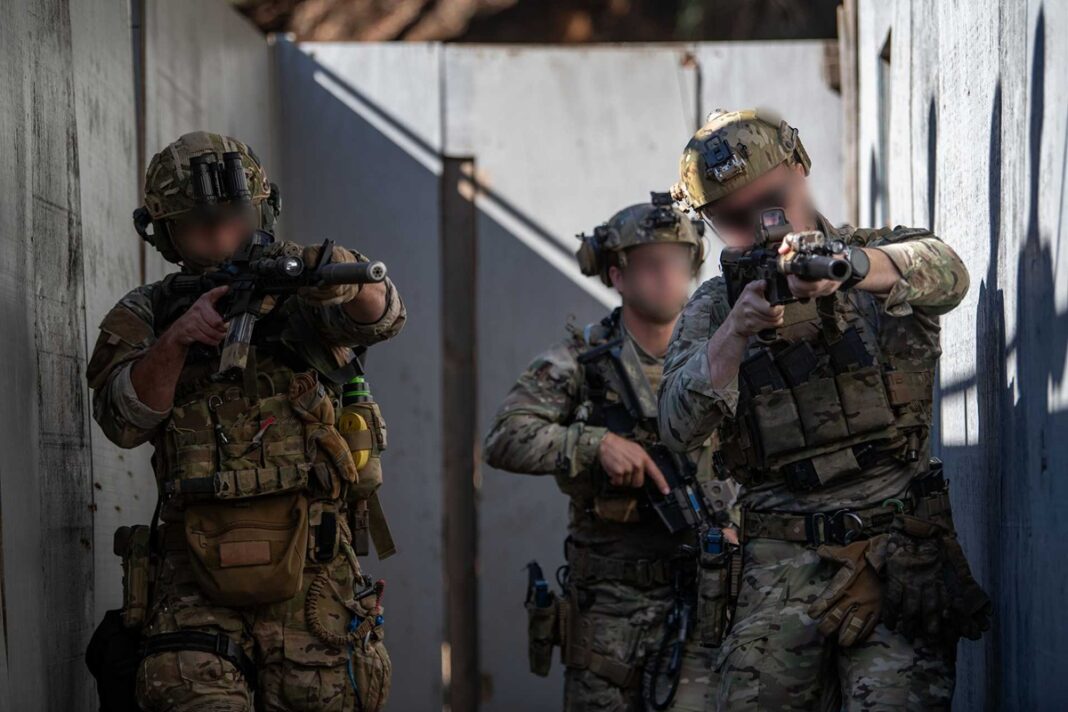
- Special operations assault teams
- Army Rangers for site security
- Nuclear material specialists
- Explosive ordnance disposal teams
- Combat engineers
- Helicopter and fixed-wing aviation support
- Intelligence, surveillance and reconnaissance (ISR) assets
- Electronic warfare support
The objective would be to seize nuclear material rather than simply destroy nuclear infrastructure.
Which U.S. Units Were Reportedly Mentioned?
The report states that a possible retrieval force could include:
- SEAL Team 6 (DEVGRU) – Silver Squadron
- 2nd Ranger Battalion
- 21st Ordnance Company (U.S. Army)
However, it is important to note that these unit-level details were attributed to the independent outlet The High Side, not official U.S. government sources.
There has been no official confirmation that these units have received orders or are preparing for such a mission.
Why Would Air Strikes Alone Be Insufficient?
Destroying a nuclear facility does not necessarily eliminate the nuclear material stored inside it.
Precision strikes can damage:
- Centrifuge halls
- Tunnel entrances
- Electrical infrastructure
- Ventilation systems
- Support facilities
However, uranium stored inside hardened containers or moved before an attack may remain intact.
A ground force would therefore have to:
- Locate the enriched uranium.
- Secure the surrounding area.
- Assess radiation hazards.
- Package the material safely.
- Transport it out of hostile territory.
This would make the operation fundamentally different from a conventional air campaign.
Why Is Iran’s Enriched Uranium So Important?
Before international inspectors lost regular verification access following attacks on Iranian nuclear facilities, the International Atomic Energy Agency (IAEA) had documented a substantial stockpile of uranium enriched to 60% uranium-235.
Although 60% enrichment is not equivalent to weapons-grade uranium, it is classified as highly enriched uranium (HEU) and requires significantly less additional enrichment to reach the approximately 90% level typically associated with nuclear weapons.
The exact amount, condition and current location of Iran’s enriched uranium remain uncertain.
Fordow and Isfahan Could Be Key Targets
The report identifies Fordow and Isfahan among the facilities that could be relevant to any recovery operation.
These sites present significant operational challenges, including:
- Deep underground infrastructure
- Structural damage from previous strikes
- Possible tunnel collapses
- Radiation hazards
- Potential Iranian defensive positions
- Unknown placement of enriched uranium storage cylinders
Any recovery mission would require precise intelligence before troops entered the facilities.
What Would Such a Mission Look Like?
Military analysts believe a uranium recovery operation would likely unfold in several stages.
Phase 1: Secure the Area
Army Rangers or other conventional forces would establish defensive positions, secure approach routes and protect landing zones.
Phase 2: Assault and Clearance
Special operations teams would clear entrances, tunnels and sensitive facilities while neutralising any remaining resistance.
Phase 3: Nuclear Site Exploitation
Nuclear specialists and EOD personnel would inspect damaged storage areas, identify radioactive material and determine whether containers remained intact.
Phase 4: Extraction
Recovered material would be packaged using specialised equipment before being transported by helicopter or strategic airlift under heavy military protection.
Why Would the Mission Be Extremely Risky?
Unlike a short-duration hostage rescue or counterterrorism raid, recovering enriched uranium could become a prolonged operation.
Potential challenges include:
- Iranian military counterattacks
- Underground infrastructure damage
- Radiation exposure
- Booby traps and unexploded ordnance
- Unknown uranium storage locations
- Complex logistics
- Long-distance extraction under hostile conditions
If Iran had dispersed its enriched uranium across multiple locations, the mission could evolve from a targeted raid into a lengthy search-and-security campaign.
Is There Any Historical Precedent?
The United States has conducted numerous sensitive special operations, but no previous mission provides a direct comparison.
Examples include:
Iraq Weapons Inspections (2003)
Following the invasion of Iraq, U.S. forces secured suspected weapons facilities with technical exploitation teams searching for prohibited programmes.
Operation Neptune Spear (2011)
The raid that killed Osama bin Laden demonstrated the integration of intelligence, stealth helicopters and elite special operations forces during a politically sensitive mission inside sovereign territory.
However, neither operation involved recovering highly enriched uranium from active nuclear facilities.
An operation inside Iran would likely be significantly larger, more dangerous and logistically demanding.
Strategic Significance
Physically removing enriched uranium could deliver a more lasting counter-proliferation outcome than simply destroying enrichment facilities.
If successful, such an operation could:
- Prevent uranium from being hidden or relocated
- Reduce Iran’s ability to resume enrichment rapidly
- Place recovered material under international custody
- Provide intelligence on the status of Iran’s nuclear programme
Conversely, failing to recover the entire stockpile could leave uncertainty over how much uranium remained and whether additional hidden reserves existed.
Multiple Reports Suggest the Option Was Studied
The New York Post is not the only outlet to report on such planning.
Earlier reporting by The Washington Post indicated that the U.S. military had prepared proposals to seize Iranian enriched uranium at the request of the president.
The New York Post’s report expands on that reporting by adding alleged operational details and possible participating units.
However, many of those details rely on anonymous sources and secondary reporting rather than official confirmation.
What Is Confirmed—and What Remains Unverified?
Confirmed
- Reports indicate the United States examined options for recovering Iranian enriched uranium.
- Iran possessed a significant inventory of 60% enriched uranium before international monitoring was disrupted.
- Facilities such as Fordow and Isfahan remain central to concerns over Iran’s nuclear programme.
Not Confirmed
- No official approval for a recovery mission has been announced.
- No U.S. military unit has been publicly tasked with executing the operation.
- The reported involvement of Army Rangers, SEAL Team 6 or other specific units has not been confirmed by the Pentagon.
- There is no evidence that such a raid is imminent.
Conclusion
The reported planning for a possible mission to recover Iran’s enriched uranium highlights the extraordinary challenges posed by modern counter-proliferation operations. Unlike conventional air strikes, such a mission would require elite special operations forces, technical nuclear experts and extensive logistical support to secure and remove highly sensitive material from heavily defended facilities.
While multiple media reports suggest Washington has examined this option, the available evidence does not establish that any operation has been authorised or that the specific U.S. military units named in the reports have received execution orders. For now, the reported plan remains a contingency rather than a confirmed military operation.