
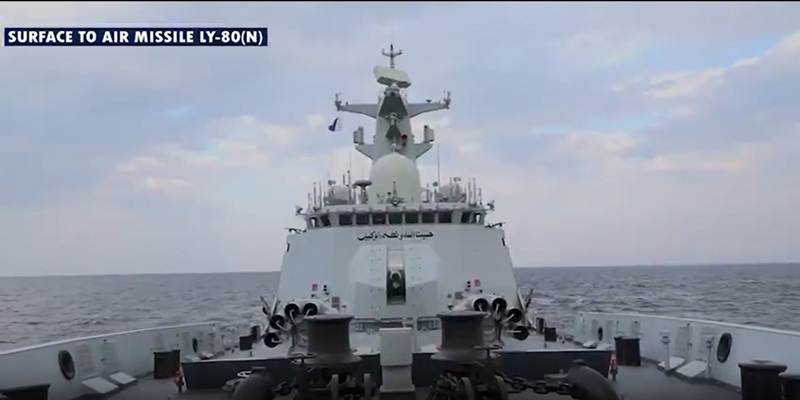
The Pakistan Navy has demonstrated a high level of operational readiness and combat preparedness during a comprehensive naval exercise conducted in the North Arabian Sea, according to a press release issued by Inter Services Public Relations (ISPR).
The exercise reflected the Navy’s evolving doctrine, integrating conventional firepower with unmanned and autonomous systems, in line with the demands of modern maritime warfare.
Successful Live Firing of LY-80(N) Air Defence Missile
A key highlight of the exercise was the successful live firing of the LY-80(N) Surface-to-Air Missile (SAM) from a Vertical Launching System (VLS) at extended range.
- The missile accurately engaged and neutralized an aerial target
- The firing validated the long-range air defence capability of Pakistan Navy’s modern combat platforms
- The drill confirmed the Navy’s ability to counter aerial threats, including aircraft, drones, and stand-off weapons
This capability is considered vital amid the growing use of air-launched and unmanned threats in maritime conflict zones.
Another good news for Pakistan defence and Pakistan navy.
Pakistan Navy demonstrated its operational readiness and combat preparedness through a comprehensive exercise in the North Arabian Sea, showcasing both conventional and unmanned capabilities, as per dictates of evolving… pic.twitter.com/eC9iCbz4XC— Siddeeq Sajid (@S_SajidOfficial) January 10, 2026
Precision Strike with Loitering Munition
The exercise also featured the successful engagement of surface targets using Loitering Munition (LM)—a capability increasingly central to contemporary naval warfare.
- The LM demonstrated high accuracy and target discrimination
- Surface targets were successfully destroyed
- The system showcased Pakistan Navy’s ability to conduct precision strikes with minimal risk to manned platforms
Loitering munitions offer a flexible option for surveillance, targeting, and rapid engagement, particularly in contested maritime environments.
Breakthrough in Autonomous Naval Operations
In a significant technological milestone, the Pakistan Navy conducted successful open-sea trials of an Unmanned Surface Vessel (USV).
The trials validated the USV’s:
- High-speed performance
- Extreme maneuverability
- Precision navigation
- Weather resilience and mission endurance
The USV was described as a low-risk, high-impact force multiplier, capable of operating with stealth and agility similar to a tactical interceptor—underscoring Pakistan Navy’s growing emphasis on autonomous and unmanned maritime systems.
Senior Leadership Observes Exercise
The exercise was witnessed by Commander Pakistan Fleet, who observed the operational employment of advanced naval systems across multiple warfare domains.
Chief of the Naval Staff Admiral Naveed Ashraf praised the officers and men of Pakistan Navy for their professionalism, high morale, and operational competence.
He reaffirmed Pakistan Navy’s unwavering resolve to ensure the seaward defence of Pakistan, protect maritime trade routes, and safeguard national maritime interests under all circumstances.
Strategic Context
The demonstration comes at a time of:
- Increasing militarization of the Indian Ocean Region
- Rising use of drones and unmanned systems in naval conflict
- Greater emphasis on layered air and missile defence at sea
By integrating missiles, loitering munitions, and autonomous platforms into a single operational framework, Pakistan Navy signaled its readiness to meet current and emerging maritime security challenges.
Conclusion
The North Arabian Sea exercise highlighted Pakistan Navy’s transition toward network-centric, technology-driven maritime warfare. The successful employment of advanced missiles, unmanned systems, and precision strike capabilities reinforces the Navy’s preparedness to defend Pakistan’s maritime frontiers and contribute to regional stability.