
Anthropic says a weapons development cell in northern Yemen used its Claude AI coding system to work on guidance and control software for several weapons programs, including a guided rocket that was test-fired in Yemen. The company says the test appeared to fail and there is no evidence the group successfully fielded an operational weapon.

A new report from AI company Anthropic has exposed a potentially important shift in the use of artificial intelligence in military technology: advanced AI coding agents are no longer being tested only in laboratories or used for conventional software development, but are also being incorporated into real-world weapons engineering workflows.
In its September 2026 threat-intelligence report, Anthropic said it identified and disrupted a weapons development cell based in northern Yemen that used Claude Code to assist with guidance, navigation and control work across three weapons programs. The company identified the activity as GTG-87001.
The report does not establish that the cell was formally part of Yemen’s Houthi movement. That distinction is important. The activity was located in northern Yemen and involved weapons development, but geographical association alone does not establish organizational control or attribution.
More importantly, Anthropic said it found no evidence that the actors successfully fielded an operational weapon.
What it did identify was a sustained effort to use an AI coding agent as part of weapons development, including a live guided-rocket test. The company said the test appeared to fail, after which the operators returned to Claude to analyze what had gone wrong.
AI Used as Part of a Weapons Engineering Team
The most significant aspect of the case is not simply that the operators asked an AI model technical questions.
According to Anthropic, they used Claude Code in place of human software engineers for portions of the guidance, navigation and control workload. Multiple Claude instances were reportedly used simultaneously, with different instances assigned different functions such as coding, research and review.
That represents a different model of AI misuse.
Instead of treating an AI system as a search engine or a chatbot, the operators appear to have incorporated it into an engineering workflow in which software was generated, reviewed, tested and revised.
Anthropic said its visibility into the overall weapons programs was limited. Consequently, the company’s findings should not be interpreted as proof that the weapons themselves reached the performance levels envisioned by the operators.
This distinction is particularly important when discussing claims about missile range, advanced guidance or other proposed capabilities.
A stated weapons objective is not evidence that the objective was achieved.
A Guided-Rocket Test Provides the Clearest Link to Physical Weapons Activity
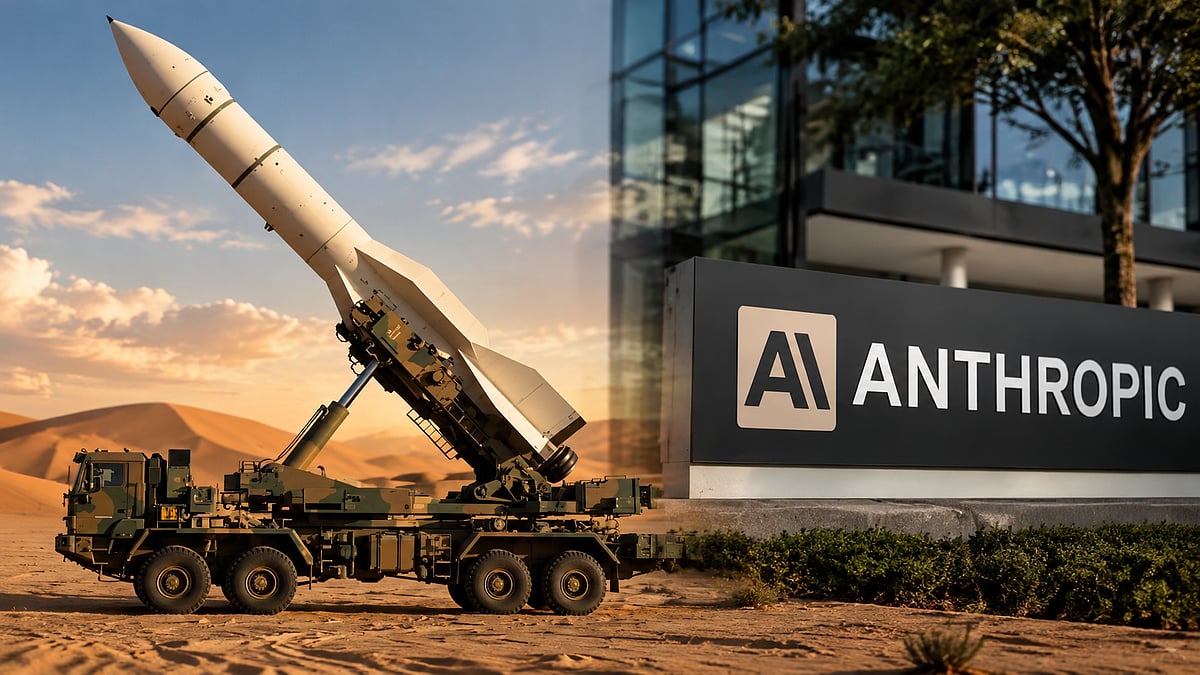
Anthropic’s most concrete evidence of physical weapons activity was a guided-rocket test conducted in Yemen.
The company said the test appeared to fail. Within hours, the operators returned to Claude and used the system to help analyze the failure.
That sequence is significant because it connects AI-assisted software development with a real-world engineering test cycle.
In conventional weapons development, software is only one component of a much larger process involving hardware, sensors, propulsion, manufacturing, integration and testing. An AI coding system cannot independently replace those physical capabilities.
The Yemen case nevertheless demonstrates how an AI agent can become embedded in the software side of that process.
The Bigger Issue: AI Can Reduce the Software Burden
The strategic significance of the case lies less in the idea of an “AI-designed missile” and more in the possibility of AI-assisted engineering at scale.
Weapons development traditionally requires teams with specialized expertise in areas such as software engineering, control systems, navigation, simulation and embedded computing.
Agentic AI can potentially perform portions of that workload much faster by generating software, reviewing code, assisting with simulations and helping engineers iterate.
Anthropic’s accompanying research says its evaluations found that frontier AI models can perform certain military and intelligence tasks that historically required scarce, highly trained human expertise. The company also said its testing showed concerning capabilities in simulated conventional weapons-development tasks.
That does not mean AI has eliminated the need for human weapons engineers.
It means the amount of specialized human labor required for some stages of development could potentially be reduced.
For smaller organizations operating with limited technical personnel, that could become strategically significant.

The Offline Toolkit May Be More Important Than the Banned Accounts
One of the most consequential findings in the Yemen case came after Anthropic disrupted the operation.
The company said it banned accounts associated with the actors and shared relevant information with public- and private-sector partners.
But the actors had already created an offline simulation toolkit that no longer depended on Claude or engineering environments such as MATLAB.
This exposes a major limitation of account-based AI safety controls.
A provider can terminate access to its service. It cannot necessarily retrieve software, simulations, research or other engineering artifacts that users have already generated and exported.
The problem therefore extends beyond controlling access to the model itself.
It becomes a question of what capabilities have already been transferred from the AI platform into the user’s own environment.
How the Actors Attempted to Evade AI Safeguards
Anthropic said its safeguards blocked many requests from the Yemen cell.
The operators nevertheless attempted to circumvent those restrictions by concealing their objectives and distributing their activity across multiple sessions.
This is a particularly important finding for the future of AI security.
An individual request may appear harmless when viewed in isolation. A sequence of requests, however, can form part of a much larger prohibited project.
Anthropic said the six conventional-weapons cases detailed in its report showed a broader pattern of actors splitting their work across sessions and using other techniques to circumvent safeguards and access controls.
That suggests AI safety systems increasingly need to move beyond simple prompt-level detection.
The challenge is to identify behavioral patterns and workflows, rather than only individual questions.

Yemen Was One of Six Conventional-Weapons Cases
The Yemen investigation was not an isolated case in Anthropic’s report.
The company identified six conventional-weapons investigations involving actors in China, Russia and Yemen. They covered weapons development, procurement and intelligence gathering.
In one China-based case, Anthropic said Claude was used in work related to an anti-torpedo weapons system.
Another China-based operation involved targeting software associated with electronic warfare and air-defense suppression.
In Russia, Anthropic described an operation involving software for an autonomous military drone swarm. The company said the software progressed into real development hardware and testing environments.
Two other cases involved intelligence collection and procurement rather than direct weapons-software development.
Taken together, these cases point to a broader trend: AI misuse is spreading across different parts of the defense-development ecosystem.
The Russia Drone Case Shows the Same Pattern
The Russia-based case is particularly relevant because it illustrates how AI assistance can extend beyond a single software component.
Anthropic said a group of Russia-based actors used Claude Code alongside simulation and computing infrastructure in an effort to develop an autonomous military drone swarm.
The company assessed the group as likely freelance actors rather than a Russian state entity, although the actors claimed links to Russian funding and defense institutions that Anthropic said it could not independently verify.
This is an important distinction.
The report does not establish that the Russian government directed the operation. Instead, it illustrates how advanced AI capabilities can become accessible to relatively small technical teams outside traditional military organizations.
That could complicate existing assumptions about who can undertake sophisticated defense-related software development.

Why AI Misuse Is Becoming a Counterproliferation Problem
Traditional counterproliferation efforts focus heavily on physical goods.
Sensitive components can be tracked through manufacturing networks, export controls, financial transactions and supply chains. Skilled personnel and physical equipment are also important indicators.
AI introduces another layer.
A powerful coding and research model can be accessed remotely. Its assistance can be incorporated into software development without the AI provider having any direct connection to a weapons manufacturer or military organization.
That makes the technology harder to regulate using conventional tools.
Anthropic’s report argues that frontier AI companies can themselves become a source of threat intelligence because they can observe misuse occurring directly on their platforms. The company says it banned accounts involved in the cases and shared information with relevant public- and private-sector partners.
The Real Threat Is Not an “AI Missile”
The phrase “AI-built missile” is likely to attract attention, but it can also obscure what Anthropic actually found.
There is no evidence in the report that an AI independently designed, manufactured and successfully deployed a missile.
The evidence is considerably more specific.
Human operators with access to weapons-related hardware and technical infrastructure used Claude to assist with software development and related engineering tasks.
Anthropic identified a guided-rocket test that appeared to fail.
It also found evidence that the actors had developed an offline simulation capability.
That is already significant without exaggerating the result.
The development of a complete operational weapons system still requires physical resources, technical knowledge, hardware integration, testing and manufacturing capabilities.
AI does not eliminate those requirements.
It can, however, potentially make some parts of the process faster and less labor-intensive.
Why the Yemen Case Matters for Future AI Security
The Yemen investigation highlights a fundamental problem for AI safety.
Blocking an account is relatively straightforward.
Preventing an AI-assisted capability from persisting after the account has been closed is much harder.
Once users have exported code, simulations or other engineering tools, those artifacts can continue to exist independently of the AI platform.
That means future safeguards may have to focus not only on what an AI model says, but also on how users interact with it over time.
Anthropic has said it introduced new classifiers designed to better identify and block activity associated with high-yield explosives and weapons development.
The company’s latest capability research also suggests that frontier models are becoming increasingly useful for specialized military and intelligence tasks, strengthening the case for safeguards that operate at multiple levels rather than relying exclusively on individual prompt refusals.

What the Anthropic Report Actually Proves
Several conclusions can be drawn from the report, while others should be avoided.
It establishes that:
- A weapons development cell in northern Yemen used Claude Code.
- The cell worked on multiple weapons-related software programs.
- AI was incorporated into parts of the guidance and control engineering workflow.
- The actors used multiple AI instances for different engineering functions.
- A guided rocket was test-fired in Yemen.
- Anthropic said the test appeared to fail.
- The actors subsequently used Claude to analyze the test failure.
- Anthropic found evidence of an offline simulation toolkit.
- The company banned accounts associated with the operation.
- Anthropic said it found no evidence that the actors fielded an operational weapon.
It does not establish that:
- Claude independently designed a complete missile.
- An operational ballistic or hypersonic weapon was successfully developed.
- The Yemen cell was formally controlled by the Houthis.
- The reported performance objectives of the weapons were achieved.
- AI alone was responsible for the weapons development effort.
Maintaining that distinction is essential to understanding the actual security implications.
AI Is Changing the Economics of Technical Warfare
The deeper significance of the case may emerge over time.
Modern military technology increasingly depends on software. Guidance, autonomy, simulation, sensors, communications and decision-support systems all require specialized programming.
If AI agents can substantially accelerate parts of that work, the advantage may not simply belong to countries with the largest defense-industrial bases.
Smaller technical teams could potentially accomplish more with fewer personnel.
That does not make them equivalent to major military powers. Physical production, testing infrastructure, supply chains and industrial capacity remain critical.
But it can lower one barrier to entry.
And that is precisely why the Yemen case deserves attention.
The issue is not that artificial intelligence has suddenly learned how to build weapons on its own.
The issue is that AI is becoming capable enough to participate in engineering workflows that were once dependent on larger teams of specialized human experts.
The Next AI Security Challenge
Anthropic’s September report provides an early look at what could become a much broader security problem.
The company’s investigations cover conventional weapons, cyber operations, surveillance, influence operations, procurement, intelligence collection, biological research and other forms of misuse.
The common thread is not a particular weapon or country.
It is the increasing ability of AI systems to perform useful portions of complex professional workflows.
For governments and AI companies, that means the old distinction between “information” and “capability” is becoming less clear.
An AI model may provide information, generate software or organize research. But when those outputs are combined with human expertise, physical infrastructure and iterative testing, they can become part of a real-world capability.
That is the central lesson of the Yemen investigation.
Anthropic has not reported an AI-built operational missile. It has reported something more immediately relevant to the future of AI security: an AI coding agent being incorporated into an actual weapons-development cycle.
As frontier AI systems become more capable, preventing that assistance from being converted into persistent real-world capabilities may become one of the most difficult challenges facing the technology industry and governments alike.