
India’s BRICS strategy is becoming increasingly relevant to the wider contest over strategic autonomy, economic resilience and influence in the Global South. As New Delhi hosts the 18th BRICS Summit on September 12–13, it is pushing practical cooperation on cross-border payments and digital currencies while resisting efforts to turn the grouping into an explicitly anti-American financial bloc.

For India, BRICS is therefore not simply an economic forum. It is another arena in which New Delhi is trying to balance China, Russia and the United States without becoming dependent on any one of them.
That balancing act matters for Pakistan as well.
Islamabad has sought BRICS membership since 2023, but remains outside the expanded grouping. Reports from Indian and international media indicate that India’s position remains a major obstacle because BRICS decisions on expansion require consensus among members. China and Russia can support Pakistan’s application, but they cannot by themselves secure its entry.
For a defence and strategic affairs audience, the significance of the current BRICS debate lies less in whether a new currency emerges and more in who gets to shape the financial and strategic architecture of the grouping.
India wants BRICS cooperation without a China-led financial bloc
India’s proposal to explore links between central bank digital currencies, or CBDCs, among BRICS members is an important part of this strategy.
Reuters reported that New Delhi is advocating greater interoperability between members’ digital currencies to make cross-border payments faster and easier. The proposal follows the 2025 BRICS agreement to improve payment-system interoperability. But India has simultaneously made clear that the objective is not to create a common BRICS currency or formally replace the US dollar.
That distinction is strategically important.
China has considerably greater financial weight than most BRICS members and already possesses an extensive digital-payment ecosystem. A financial architecture built primarily around Chinese systems could increase Beijing’s influence over the bloc.
India therefore has an incentive to support alternative payment mechanisms while ensuring that they remain decentralised enough to preserve national control.
The same logic explains why India’s BRICS approach is different from a straightforward de-dollarisation campaign.
New Delhi wants more options. It does not necessarily want to replace one dependency with another.
The China factor is impossible to ignore
The biggest strategic complication inside BRICS remains the relationship between India and China.
The two countries have moved cautiously toward stabilising relations after the 2020 military confrontation, including disengagement arrangements and a gradual restoration of economic and diplomatic contacts. Yet the underlying rivalry has not disappeared. Chinese and Indian forces remain deployed along the disputed Himalayan frontier, while competition continues over technology, investment, supply chains and regional influence.
China is also India’s largest source of imports, with Chinese supplies of critical components reaching about $132 billion in 2025–26. That creates a strategic contradiction for New Delhi: India wants to reduce vulnerabilities associated with Chinese dependence while simultaneously operating inside a multilateral grouping in which China is the largest economic power.
BRICS consequently gives India both an opportunity and a problem.
It gives New Delhi a platform where it can work with China on issues such as payments, trade and development finance. At the same time, it provides another arena in which India must prevent China’s economic weight from automatically translating into political leadership.
That competition is likely to remain one of the defining internal dynamics of BRICS.

BRICS is not becoming a military alliance
There is also a reason not to exaggerate what India’s BRICS strategy means.
BRICS is not a NATO-style military alliance, and its financial initiatives do not constitute a defence architecture. CBDCs cannot substitute for military power, strategic partnerships or defence-industrial capacity.
Their significance is indirect.
A country that has more resilient payment channels, alternative sources of financing and greater ability to conduct trade under geopolitical pressure has more room for manoeuvre in foreign and security policy.
That becomes particularly important in an era of sanctions, export controls, supply-chain disruptions and economic pressure.
For countries such as Russia and Iran, this issue is already highly consequential. For India, however, the objective is not to isolate itself from Western financial systems. It is to ensure that it has alternatives if geopolitical circumstances make existing channels more vulnerable.
That is classic strategic-autonomy thinking.
India does not want BRICS to become openly anti-American
This is another area where India’s position differs from that of some other BRICS members.
China, Russia and some other members have stronger incentives to reduce their exposure to the US-led financial system. India, by contrast, maintains extensive economic, technological and defence relationships with the United States and its partners.
Recent reporting indicates that Indian officials have been careful to distinguish payment diversification from an explicit de-dollarisation agenda.
This gives India a difficult but potentially useful position inside BRICS.
New Delhi can support local-currency trade, payment interoperability and financial alternatives while simultaneously maintaining relations with Washington.
The objective is not to choose one financial camp.
It is to preserve strategic flexibility.

Pakistan’s BRICS problem is becoming more strategic
This is where the issue becomes directly relevant to Pakistan.
Islamabad formally applied for BRICS membership in 2023. The bloc has since expanded, but Pakistan remains outside. Recent reporting again identifies India’s opposition as a central obstacle, while China and Russia have supported Pakistan’s efforts.
For Pakistan, membership would have economic as well as diplomatic value. BRICS includes some of the world’s largest economies, energy producers and emerging markets. Greater access could potentially create opportunities in trade, investment, development financing and payment connectivity.
But there is a more strategic consideration.
If India succeeds in shaping BRICS around its preferred model of strategic autonomy, digital-payment interoperability and selective financial diversification, Pakistan could find itself outside an increasingly important platform in which India has considerable agenda-setting influence.
That does not mean BRICS will become an instrument against Pakistan.
It does mean that Islamabad cannot assume that China’s or Russia’s support alone will determine the bloc’s future direction.
Pakistan cannot treat BRICS simply as an anti-Western platform
There is also a lesson for Pakistan in India’s approach.
If Islamabad views BRICS primarily as a mechanism for reducing dependence on the United States or Western institutions, it risks misunderstanding the interests of several members — particularly India.
India is demonstrating that a country can support stronger Global South institutions while maintaining close relations with the United States, Europe and other Western economies.
For Pakistan, the more useful strategy would therefore be to approach BRICS as an additional platform for economic and strategic diversification rather than as a replacement for existing international financial relationships.
Membership alone would not solve Pakistan’s balance-of-payments problems, improve exports or eliminate dependence on international financial institutions.
Those problems require domestic economic reforms.
The financial issue has a hard limit: trade imbalances
India’s own experience demonstrates why alternative payment systems cannot solve structural economic problems by themselves.
India’s trade deficit with BRICS members has become very large. Recent reporting put India’s BRICS trade deficit at more than $226 billion, reflecting the enormous imbalance between India’s exports to and imports from the grouping.
Digital payments can make transactions faster.
They cannot make an uncompetitive export sector competitive.
Currency swaps can provide liquidity.
They cannot permanently correct an imbalance in trade.
That is why the BRICS financial discussion is increasingly about practical mechanisms — payment interoperability, local-currency settlement, liquidity arrangements and development financing — rather than simply announcing a new currency.
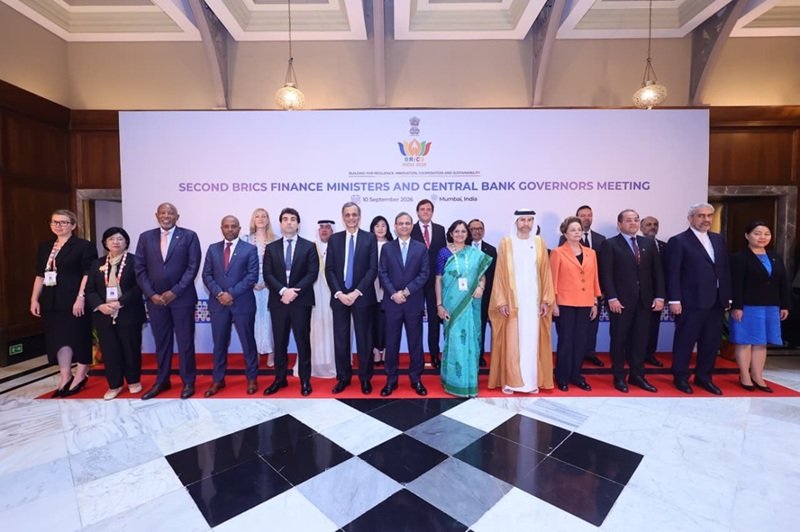
At the recent BRICS finance meeting, members also backed reforms of institutions such as the IMF and World Bank and supported more efficient, secure and low-cost cross-border payment systems.

The defence relevance is strategic resilience
For defence planners, the more important question is what happens when economic and security competition become inseparable.
Modern military power depends on industrial capacity, technology, energy security, access to components, financing and resilient supply chains. Financial restrictions can therefore affect strategic autonomy even when they are not directly military measures.
India’s attempt to develop alternative payment channels should be viewed within that wider framework.
The objective is not to create a “BRICS defence system”.
It is to reduce the possibility that geopolitical pressure in one domain automatically produces vulnerability in another.
This is particularly relevant to countries maintaining relationships with multiple major powers.
India buys defence equipment from Russia, works with the United States and Europe, competes with China and seeks greater influence across the Global South. Its foreign policy therefore requires mechanisms that allow it to keep several relationships functioning simultaneously.
BRICS can contribute to that flexibility.
BRICS is becoming another arena of India-China competition
The larger strategic picture is increasingly clear.
India does not appear to want BRICS to collapse into a China-led bloc. Nor does it want the grouping to become an explicitly anti-Western alliance. Instead, New Delhi is attempting to shape BRICS into a platform where emerging powers can gain greater room for manoeuvre without surrendering their individual strategic choices.
That is difficult because China’s economic weight inside the grouping is enormous.
The challenge for India is therefore not simply to oppose China. It is to prevent China’s economic advantage from becoming automatic political leadership.
The current push for interoperable payment systems fits that broader strategy.
India wants alternatives, but it wants them to remain plural.
What this means for Pakistan
Pakistan should watch three developments closely.
First, BRICS expansion. Islamabad’s membership bid remains a strategic issue because consensus gives India considerable influence over the process.
Second, BRICS payment architecture. If interoperability between national payment systems develops beyond the pilot stage, it could eventually make intra-BRICS trade easier and reduce some transaction costs. BRICS members are already discussing ways to connect domestic payment systems, although technical, regulatory and trade-balance problems remain substantial.
Third, the India-China balance. Any future BRICS architecture will be shaped by the competition between the two largest Asian powers inside the grouping. Pakistan’s strategic relationship with China means Islamabad cannot afford to ignore that contest.
Pakistan therefore needs a BRICS strategy of its own — one based on trade, investment, digital infrastructure and diplomatic engagement rather than simply seeking membership as a symbolic geopolitical victory.
The bigger contest is over strategic choice
The most important development at the 2026 BRICS summit is not the creation of a common currency. That remains far from reality.
The more consequential development is the gradual construction of mechanisms that give member states additional choices in trade, payments, development finance and economic cooperation.
For India, those choices support its long-standing doctrine of strategic autonomy.
For China, BRICS offers another platform through which its economic weight can translate into wider influence.
For Russia and Iran, alternative financial channels have obvious strategic value.
And for Pakistan, the issue is increasingly about whether it will participate in shaping these emerging mechanisms or remain outside while India helps define the rules.
BRICS is therefore becoming more than an economic grouping, but it is not yet a coherent geopolitical alliance.
Its future may be determined less by whether its members agree on a new global order and more by whether they can build practical institutions without allowing their rivalries — particularly the India-China competition — to paralyse the organisation.