
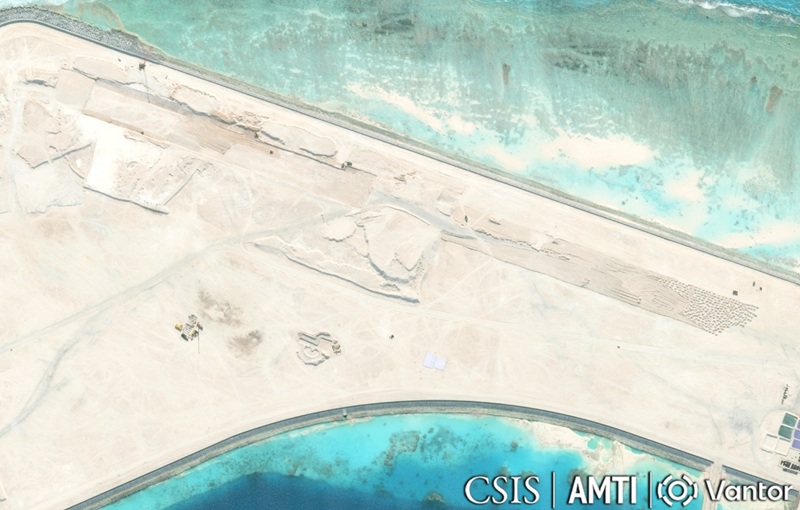
Fresh satellite imagery analyzed by the Asia Maritime Transparency Initiative (AMTI) indicates that China has entered the next phase of military infrastructure development at Antelope Reef in the disputed Paracel Islands, with earthworks strongly suggesting the early stages of a 10,000-foot military runway.
If confirmed, the project would add another strategic airfield to China’s growing network of military facilities across the South China Sea, significantly expanding the People’s Liberation Army’s (PLA) ability to project air power, conduct surveillance and support naval operations in one of the world’s most contested maritime regions.
Although construction remains at an early stage, the latest imagery suggests Beijing is moving beyond land reclamation toward establishing a fully operational military outpost.
What the Satellite Images Reveal

According to AMTI’s latest assessment, dredging operations that began roughly eight months ago appear largely complete.
The reclaimed island now measures approximately 1,458 acres, making it one of China’s larger artificial island projects in the Paracel archipelago.
The most significant new development is a long, straight earthwork extending along the island’s northwestern edge.
Several indicators suggest this could become a military runway.
These include:
- Approximately 180-foot width, matching China’s existing South China Sea runways.
- Alignment along the reef’s only section capable of accommodating a long runway.
- Current prepared length of roughly 4,300 feet, with additional grading indicating future extension.
- Evidence of adjacent construction matching the dimensions of aircraft hangars seen on other Chinese military islands.
No concrete has yet been poured, meaning the runway is still in the preparation phase.
However, the engineering pattern closely resembles the early stages of previous Chinese military airfield construction elsewhere in the South China Sea.
Why Antelope Reef Matters

Antelope Reef occupies an important position within the Paracel Islands, a group of disputed islands controlled by China but also claimed by Vietnam and Taiwan.
Unlike China’s heavily militarized bases in the Spratly Islands, the Paracels already function as a mature military network anchored by Woody Island, which hosts:
- Fighter aircraft
- Surface-to-air missile systems
- Radar installations
- Naval facilities
- Long military runway
A second major airfield at Antelope Reef would significantly increase operational flexibility by reducing dependence on Woody Island and allowing aircraft dispersal during crises.
A New Link in China’s South China Sea Airbase Network
If completed, Antelope Reef would join a growing chain of Chinese military airfields across the South China Sea.
China’s Major South China Sea Airbases
| Location | Runway | Primary Role |
|---|---|---|
| Woody Island (Paracels) | ~3,000 metres | Regional headquarters, fighter operations |
| Fiery Cross Reef | ~3,000 metres | Air operations, naval support |
| Subi Reef | ~3,000 metres | Air defence and surveillance |
| Mischief Reef | ~3,000 metres | Long-range military operations |
| Antelope Reef (under construction) | Estimated ~3,000 metres | Likely future airbase and logistics hub |
Together, these installations allow China to maintain overlapping coverage across much of the northern and central South China Sea.
More Than Just a Runway

The satellite imagery also reveals broader infrastructure development.
Recent construction includes:
- Administrative buildings
- Road networks
- Parking areas
- Landscaped sections
- Two concrete production plants
- Foundations for large hangars
The appearance of concrete batching facilities is particularly noteworthy.
During previous island-building campaigns, China established temporary concrete plants before constructing:
- aircraft shelters;
- barracks;
- ammunition storage;
- radar facilities;
- hardened infrastructure.
This suggests Antelope Reef may soon enter a much more intensive construction phase.
Why China Is Expanding Its Island Bases
Beijing argues that facilities built on islands under its control are defensive in nature and intended to support sovereignty, maritime safety and civilian services.
However, regional governments and many security analysts view these projects differently.
China’s island bases provide:
- extended air coverage;
- naval logistics;
- intelligence collection;
- maritime surveillance;
- anti-submarine support;
- air defence;
- rapid military reinforcement.
Collectively, they strengthen China’s ability to maintain a continuous military presence far from its mainland coastline.
Strategic Importance for the PLA
A completed runway at Antelope Reef would offer several operational advantages.
Increased Aircraft Dispersal
Multiple airfields complicate enemy targeting during conflict.
Instead of concentrating aircraft on Woody Island, the PLA could distribute assets across several bases.
Faster Response Times
Aircraft stationed at Antelope Reef could respond more rapidly to developments in the northern South China Sea.
This includes:
- maritime patrols;
- air intercept missions;
- reconnaissance flights;
- search-and-rescue operations.
Enhanced Logistics
The reclaimed island also appears capable of supporting larger naval vessels through its lagoon access, potentially combining naval logistics with air operations.
Regional Security Implications
China’s continued expansion comes as competition in the South China Sea remains intense.
Several overlapping territorial disputes involve:
- China
- Vietnam
- the Philippines
- Malaysia
- Brunei
- Taiwan
Although the Paracel Islands are primarily disputed between China and Vietnam, developments there affect the wider regional security environment.
Additional Chinese military infrastructure could:
- strengthen persistent surveillance;
- improve air defence coverage;
- support longer-duration naval deployments;
- increase operational resilience during crises.
What Does This Mean for the United States?
The United States does not take a position on sovereignty claims but regularly conducts Freedom of Navigation Operations (FONOPs) and aerial patrols challenging what it considers excessive maritime claims.
Washington has repeatedly criticized China’s militarization of artificial islands, arguing that expanded military infrastructure could increase regional tensions and complicate freedom of navigation.
A new operational runway at Antelope Reef would likely receive close attention from:
- U.S. Indo-Pacific Command;
- allied intelligence agencies;
- regional naval forces.
Comparison With Regional Military Infrastructure
| Country | Major South China Sea Air Facilities | Military Presence |
|---|---|---|
| China | Woody Island, Fiery Cross, Subi, Mischief, Antelope (under construction) | Extensive air, naval and missile infrastructure |
| Vietnam | Limited upgrades on occupied features | Primarily defensive facilities |
| Philippines | Small outposts and airstrips | Limited military aviation capability in disputed areas |
| Malaysia | Small facilities in southern Spratlys | Defensive deployments |
| Taiwan | Itu Aba (Taiping Island) | Airstrip and defensive infrastructure |
China’s military footprint remains substantially larger than that of any other claimant.
Is the Runway Confirmed?
Not yet.
The current satellite imagery provides strong indicators, but several uncertainties remain.
Confirmed
- Land reclamation is largely complete.
- Earthworks resemble runway preparation.
- Hangar-sized foundations are visible.
- Concrete production facilities are operating.
Not Yet Confirmed
- Runway paving.
- Airfield lighting.
- Taxiways.
- Aircraft shelters.
- Permanent military aircraft deployment.
Until these features appear, analysts should describe the project as likely runway construction rather than a completed military airbase.
Strategic Assessment
Antelope Reef appears to represent the next stage of China’s long-term strategy to establish a distributed network of military facilities across the South China Sea.
Rather than relying on a handful of major bases, Beijing is gradually expanding infrastructure that allows:
- greater operational resilience;
- dispersed aircraft operations;
- enhanced maritime surveillance;
- stronger logistics support;
- improved command-and-control.
This approach complicates any future military contingency because additional airfields increase redundancy and reduce vulnerability to precision strikes.
Final Assessment
The latest satellite imagery suggests China has moved beyond land reclamation at Antelope Reef and begun laying the foundations for what could become another strategic military airbase.
Although construction remains incomplete, the runway’s dimensions, associated hangar sites and supporting infrastructure closely resemble previous Chinese airfield developments in the South China Sea.
If completed, Antelope Reef would further strengthen China’s already extensive military network in the Paracel Islands, reinforcing its ability to sustain air and naval operations across one of the world’s most strategically important maritime corridors.
For regional claimants and external powers alike, the project is another reminder that infrastructure development—rather than dramatic military deployments—continues to reshape the strategic balance in the South China Sea.