Washington and Beijing are exploring a potentially significant confidence-building measure involving reciprocal visits to nuclear facilities, as the United States seeks greater transparency from China amid its expanding nuclear arsenal and the collapse of the US-Russia arms-control framework.
The Trump administration has discussed the possibility of reciprocal visits to nuclear-related facilities in the United States and China, according to people familiar with the discussions, opening a potentially important but highly uncertain channel for strategic-stability talks between the two nuclear powers.
The proposal comes as the United States confronts two major developments simultaneously: China’s rapid expansion and modernization of its nuclear forces, and the expiration of the New Strategic Arms Reduction Treaty (New START) between Washington and Moscow in February 2026.
The result is a nuclear environment in which the world’s three largest nuclear powers — the United States, Russia and China — are increasingly operating without a comprehensive framework capable of limiting or transparently managing their strategic competition.
What the US-China nuclear site visits could involve
According to people familiar with the discussions, the concept of reciprocal visits was raised by Chinese officials during meetings with US counterparts this year.
Possible visits could involve US Department of Energy national laboratories and their Chinese counterparts. The discussions have also reportedly touched on the possibility of visits to nuclear testing facilities.
Such visits would not necessarily mean that either country was prepared to disclose sensitive information about its nuclear arsenal.
Instead, the initial objective could be much narrower: allowing officials and technical experts to observe selected facilities, understand the other side’s nuclear infrastructure and establish communication channels that could later support more formal confidence-building measures.
That distinction is important.
A nuclear site visit is not the same thing as an arms-control agreement. It would not automatically impose limits on warheads, missiles or nuclear production. But it could help reduce uncertainty — one of the most dangerous elements in any nuclear relationship.
Why Washington is pursuing China
The United States already has a substantially larger nuclear arsenal than China.
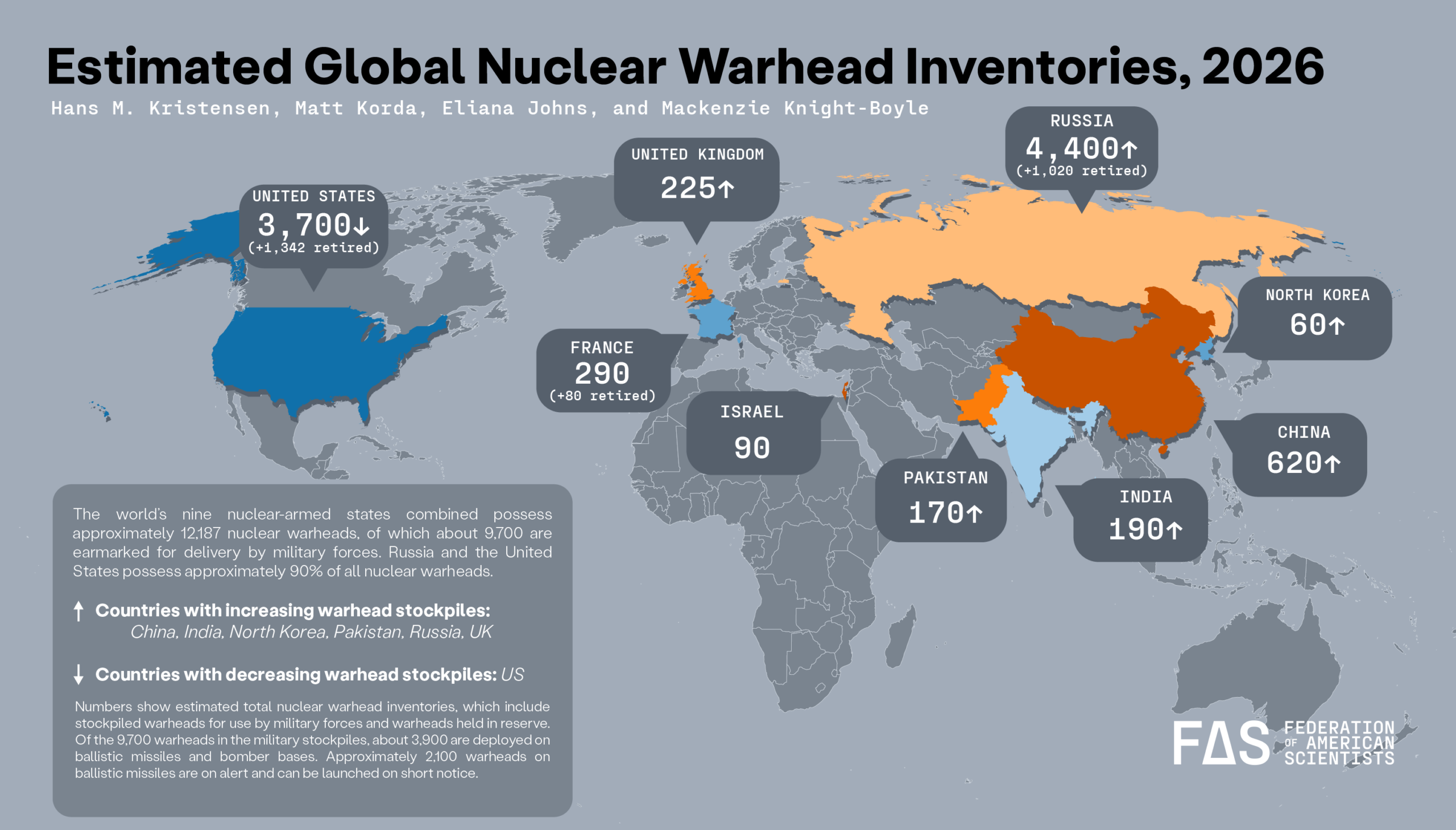
The Federation of American Scientists estimates that the United States has around 3,700 nuclear warheads in its military stockpile and approximately 5,042 warheads in its total inventory when retired weapons awaiting dismantlement are included.
China’s arsenal is considerably smaller, but its nuclear buildup has been much faster.
The latest FAS estimate puts China’s nuclear inventory at about 620 warheads in 2026, while US assessments have projected that Beijing could possess more than 1,000 warheads by 2030.
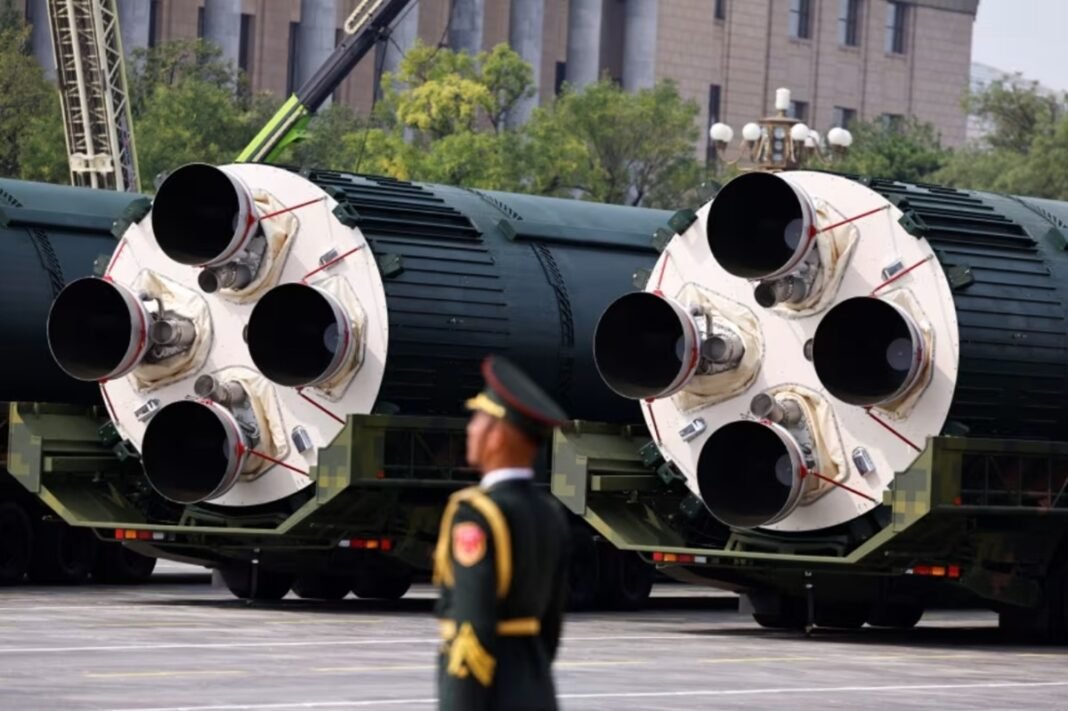
China is simultaneously expanding the delivery systems needed to support a larger nuclear force, including land-based missiles, missile silos, ballistic-missile submarines and nuclear-capable aircraft.
This does not mean China has reached US or Russian nuclear strength. It remains far behind both countries in total warhead numbers.
The strategic concern in Washington is the speed and direction of China’s expansion, rather than simply the size of its current arsenal.

China still rejects limits on its nuclear buildup
Beijing has consistently resisted pressure to enter a trilateral nuclear arms-control agreement with Washington and Moscow.
China’s argument has been straightforward: the United States and Russia possess nuclear arsenals many times larger than China’s, making it unreasonable, in Beijing’s view, to expect China to accept comparable limitations before the three countries reach a more balanced level.
That position remains one of the biggest obstacles to Trump’s broader ambition for a new nuclear agreement involving all three powers.
For Beijing, nuclear weapons are also closely linked to its assessment of the strategic environment surrounding China, including US military alliances in the Indo-Pacific and the Taiwan issue.
Consequently, China is unlikely to accept an arrangement that it believes could constrain its ability to strengthen its nuclear deterrent while the United States maintains overwhelming advantages in both nuclear weapons and conventional military capabilities.
The New START problem
The US-China discussions are taking place against a major change in the global arms-control system.
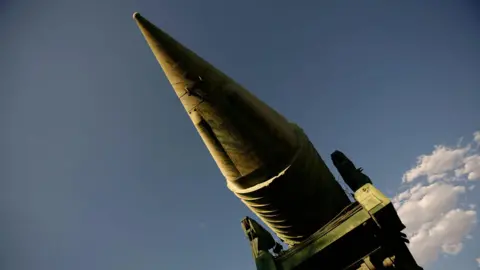
New START, the last remaining treaty limiting US and Russian strategic nuclear forces, expired on February 5, 2026.
The treaty had limited each side to 1,550 deployed strategic nuclear warheads and 700 deployed delivery systems, while establishing extensive verification and inspection mechanisms.
Its expiration means Washington and Moscow no longer have a legally binding bilateral treaty imposing those numerical limits.
President Donald Trump has argued that the next arms-control framework should be broader and should include China rather than simply replacing New START with another US-Russia agreement.
Beijing, however, has so far resisted that approach.
This creates a difficult strategic equation: Washington wants China inside the arms-control system, China does not want to accept restrictions designed around much larger American and Russian arsenals, and Russia itself remains deeply distrustful of the United States.
Why site visits matter
Nuclear weapons create a special problem of uncertainty.
A country cannot easily determine from outside what another state is doing inside highly secretive nuclear facilities.
That uncertainty can produce worst-case assumptions.
A missile silo may be empty or operational. A nuclear laboratory may be conducting routine maintenance or developing a new capability. An underground facility may be designed for conventional experiments or potentially adapted for nuclear testing.
Greater transparency can reduce the space for those assumptions.
This is why reciprocal nuclear visits could become useful even without an immediate arms-control agreement.
The International Atomic Energy Agency has historically used inspections and on-site verification as important tools for monitoring states’ compliance with nuclear commitments. A US-China strategic-stability arrangement would be different from an IAEA safeguards regime, but the broader principle is similar: physical access can provide information that satellites, intelligence assessments and seismic monitoring cannot always provide by themselves.
The disputed Chinese nuclear test allegation
The nuclear site-visit discussions also come amid an unresolved dispute over whether China conducted a covert nuclear explosive test in 2020.
The Trump administration has alleged that China conducted a yield-producing underground nuclear test at the Lop Nur test site on June 22, 2020, using a technique known as decoupling to reduce the seismic signature of an underground explosion.
China has rejected the allegation.
The available public evidence has not independently established the US claim as fact. The Comprehensive Nuclear-Test-Ban Treaty Organization’s monitoring system detected seismic events around the relevant period but did not publicly confirm that a nuclear explosion had occurred.
The issue nevertheless matters because it has become part of the broader US argument that existing nuclear monitoring mechanisms may not be sufficient against increasingly sophisticated testing techniques.
US conducts new detection experiment
Washington has responded by strengthening its ability to detect very small or concealed underground explosions.
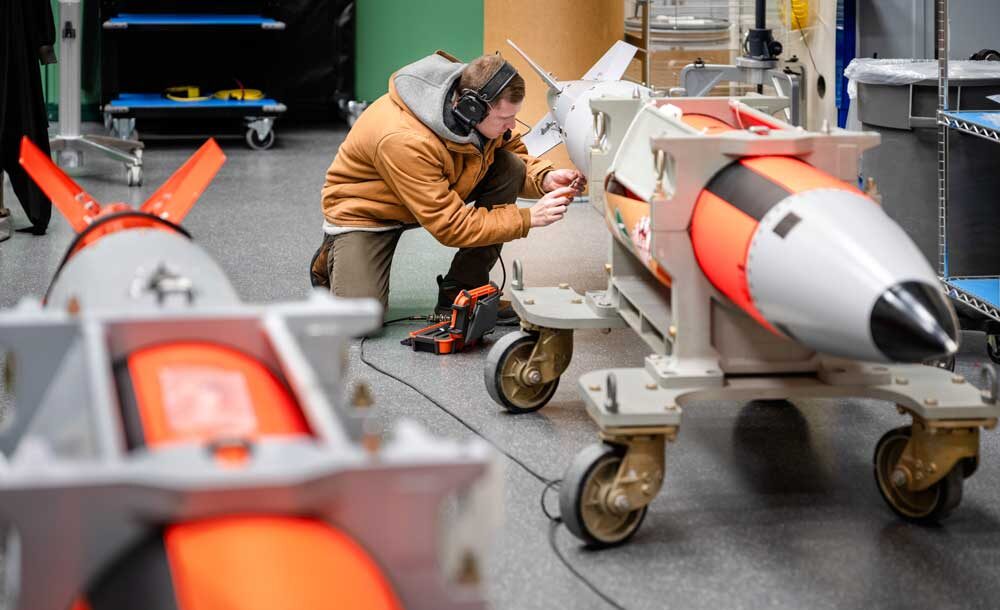
On September 30, the National Nuclear Security Administration announced a subsurface, non-nuclear chemical high-explosive experiment at the Nevada National Security Site.
The experiment was specifically designed to improve US capabilities for detecting a so-called “decoupled” explosion.
Researchers used a combination of sensors, including seismometers, accelerometers, infrasound equipment, electromagnetic sensors and chemical and radiotracer samplers.
The objective was not to conduct a nuclear weapons test. Rather, the experiment was intended to generate scientific data that could help distinguish and characterize underground explosions and improve detection models.
The development is significant because it shows that Washington’s nuclear strategy is currently moving along two tracks: pressuring China for greater transparency while simultaneously improving independent US verification and detection capabilities.
From nuclear testing to strategic stability
The issue is bigger than whether China conducted a nuclear test in 2020.
The fundamental problem is that the old architecture of nuclear arms control is weakening while nuclear capabilities are spreading and becoming more sophisticated.
The United States and Russia no longer have New START as a binding treaty.
China is expanding its nuclear forces.
Russia continues to modernize its strategic arsenal.
The United States is pursuing its own nuclear modernization programs.
At the same time, new technologies such as artificial intelligence, cyber capabilities, advanced missile defenses, hypersonic weapons and space-based systems are complicating traditional calculations of strategic stability.
That makes communication increasingly important.
A nuclear crisis does not necessarily begin with an intentional decision to use nuclear weapons. It can emerge from a miscalculation, a false warning, an intelligence failure or a mistaken assessment of an adversary’s intentions.
Why the proposal may still fail
The biggest question is whether the proposed visits can move beyond diplomacy designed to create a positive atmosphere.
Chinese officials could see limited site visits as a relatively inexpensive confidence-building measure without accepting restrictions on the size or structure of China’s nuclear force.
Washington, by contrast, may view transparency as the first step toward eventually discussing numerical limits, testing restrictions, notification mechanisms or broader strategic-stability arrangements.
Those objectives are not necessarily compatible.
There is also a fundamental asymmetry between the two countries.
The United States wants greater transparency precisely because China’s nuclear force is growing rapidly. China may calculate that greater transparency could eventually expose vulnerabilities or provide Washington with information useful for targeting and military planning.
For Beijing, therefore, transparency has both diplomatic benefits and security costs.
Trump-Xi diplomacy could determine what happens next
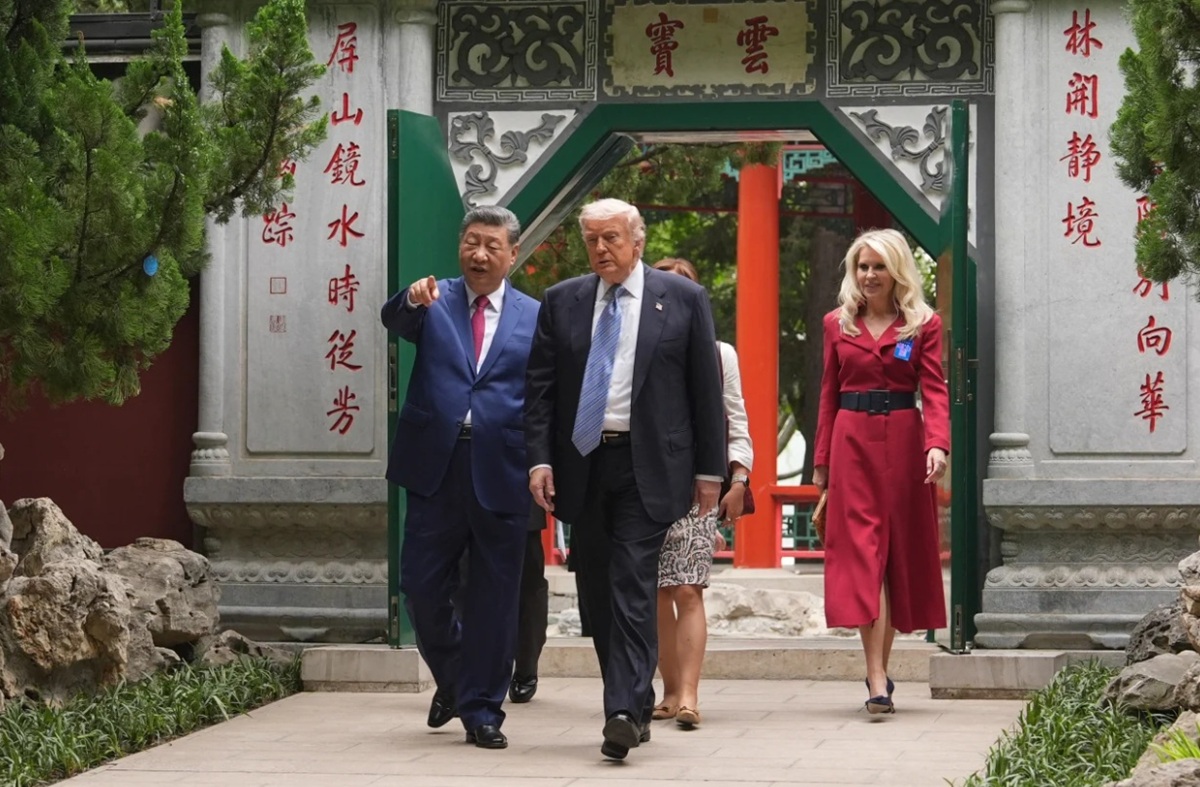
The issue could become more important if Trump and Chinese President Xi Jinping continue their expected high-level meetings.
The leaders have already expressed support for the broader concept of trilateral nuclear arms control, although China has not committed to negotiations that would impose limits on its arsenal.
That leaves lower-level diplomatic discussions particularly important.
If US and Chinese officials can agree on even limited reciprocal access, technical exchanges or procedures for communicating during nuclear emergencies, those steps could create a foundation for more ambitious negotiations later.
If they fail, the episode may become another example of Washington and Beijing discussing strategic stability without resolving the fundamental disagreement over nuclear force levels.
A small opening in a dangerous nuclear environment
The importance of the reported site-visit discussions should therefore not be exaggerated.
There is no US-China nuclear arms-control treaty on the table, no confirmed inspection agreement and no evidence that Beijing has accepted limits on its nuclear buildup.
But dismissing the proposal would also be premature.
Even limited reciprocal access could improve understanding between two nuclear powers whose military relationship is increasingly shaped by uncertainty.
The historical lesson from the Cold War is that nuclear risk reduction often began with modest confidence-building measures rather than sweeping disarmament agreements.
Hotlines, notifications, inspections, military-to-military communication and verification mechanisms did not eliminate strategic rivalry between Washington and Moscow. They helped prevent that rivalry from becoming uncontrollable.
The same logic could now apply to Washington and Beijing.
The challenge for the Trump administration will be to determine whether China’s proposal represents a genuine opening, a tactical diplomatic gesture ahead of future summits, or simply an effort to manage political pressure without accepting meaningful restrictions.
For China, the calculation is equally difficult.
Greater transparency could reduce the risk of misunderstanding with the United States, but it could also constrain Beijing’s strategic ambiguity at a time when its nuclear force is undergoing its most significant expansion in decades.
For now, reciprocal nuclear site visits are best understood not as a breakthrough, but as a potential first step toward restoring some guardrails to an increasingly unstable US-China nuclear relationship.
And with New START gone, the value of even limited guardrails is considerably greater than it was only a year ago.