The US-Japan agreement to establish an AMRAAM missile assembly facility advances Washington’s efforts to diversify defence manufacturing, expand weapons output and strengthen its industrial partnerships across the Indo-Pacific.
The United States and Japan have agreed to establish a facility in Japan for the final assembly and inspection of AIM-120 Advanced Medium-Range Air-to-Air Missiles (AMRAAM), expanding the network of allied manufacturers supporting US and partner forces.
Announced by Japanese Defence Minister Shinjiro Koizumi on October 28, 2026, the agreement forms part of Operation Supercharge, a bilateral initiative to accelerate defence-industrial cooperation. The facility’s location, production capacity and opening date have not yet been announced.
The deal comes as Washington seeks to increase missile production following extensive weapons use in Ukraine and the Middle East. It also reflects growing US-Japanese security concerns over China’s military expansion and tensions across the Indo-Pacific.
What the US-Japan AMRAAM Agreement Includes
The planned facility will handle the final assembly and inspection of AMRAAM missiles. The agreement follows discussions between Japanese and US defence officials, including a feasibility study involving Mitsubishi Electric and US defence contractor Raytheon, part of RTX.
In April 2026, the two countries discussed Japanese participation in circuit-card assembly and the possibility of conducting final assembly and inspection in Japan. The October agreement advances that cooperation, although the precise responsibilities of Japanese manufacturers remain unclear.
The arrangement does not mean Japan will manufacture every component domestically. The extent of local production will depend on the final division of work and the sourcing of specialised components.

$20.7 Billion US Contract Supports AMRAAM Expansion
The Japanese facility complements a major US effort to expand AMRAAM output.
In September 2026, the Pentagon awarded RTX’s Raytheon business a multiyear contract valued at up to $20.7 billion, covering five years with two additional option years. The broader production framework targets annual output of at least 1,900 missiles, according to Air & Space Forces Magazine.
That target applies to the wider production programme, not to the proposed Japanese facility alone.
The contract is intended to provide greater procurement continuity and support increased manufacturing capacity. The Japanese facility would add another location for final assembly and inspection, with its contribution dependent on the eventual production schedule, component availability and division of responsibilities.
Why AMRAAM Matters to Allied Forces
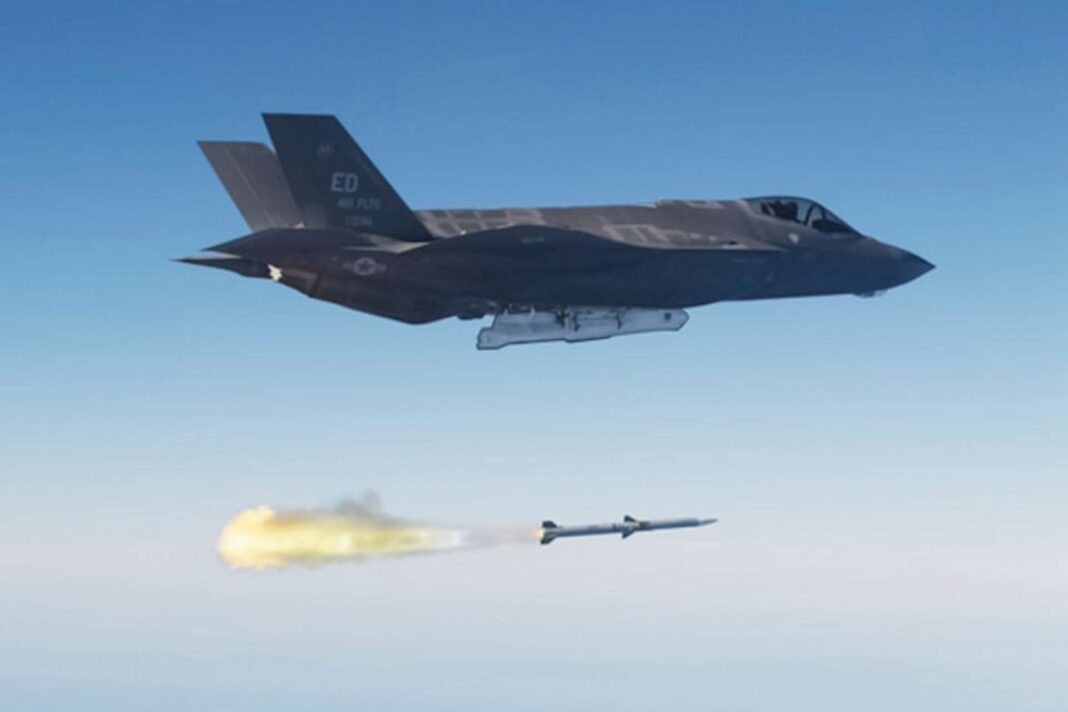
The AIM-120 AMRAAM is a radar-guided, beyond-visual-range air-to-air missile used by several US and allied aircraft, including the F-35 Lightning II, F-22 Raptor and F-16.
The missile family is also used in NASAMS, a ground-based air-defence system. Its role across multiple platforms and international customers makes it an important part of allied weapons procurement.
Japan operates F-35 aircraft, while the United States supplies AMRAAMs to its own forces and international partners. Japanese participation in production could therefore expand the industrial base supporting a weapon used across several military services.
The actual contribution will depend on the facility’s output and how its production is integrated into existing supply arrangements.
Japan Deepens Cooperation on Other Missile Programmes
The AMRAAM agreement is part of a broader US-Japanese defence-industrial partnership.
During their April 2026 consultations under the Defense Industrial Cooperation, Acquisition, and Sustainment framework, the two governments discussed expanding production of the SM-3 Block IIA interceptor and cooperation involving the PAC-3 Missile Segment Enhancement, used in the Patriot air-defence system.
The countries have also pursued measures to increase SM-3 Block IIA production. These initiatives extend bilateral industrial cooperation beyond air-to-air missiles to include missile defence and other critical weapons systems.
For Japan, the arrangements create opportunities for domestic defence manufacturers to take on additional work. For Washington, they broaden industrial cooperation with a key Indo-Pacific ally.
China and the Indo-Pacific Context
China’s expanding military capabilities form part of the strategic background to stronger US-Japan defence cooperation. Both countries have expressed concerns about regional security, including tensions around Taiwan and the East China Sea.
The AMRAAM agreement does not announce a new combat deployment or identify a specific country as its target. Its immediate purpose is industrial: establishing a Japanese facility for missile assembly and inspection.
Its broader significance lies in Washington’s effort to increase weapons output while involving allies more directly in defence manufacturing. The impact will become clearer when the governments disclose the facility’s location, production capacity and operating schedule.
What Remains Unconfirmed?
Key details still awaiting official clarification include:
- Location: Where the Japanese facility will be established.
- Timeline: When assembly and inspection will begin.
- Output: The facility’s expected annual production volume.
- Industrial responsibilities: The roles of Mitsubishi Electric and other Japanese suppliers.
- Component sourcing: The balance between Japanese-made and US-supplied components.
Conclusion
The US-Japan AMRAAM agreement marks another step in Washington’s effort to expand allied missile production and deepen defence-industrial cooperation in the Indo-Pacific.
It complements the Pentagon’s broader production expansion while creating a potential new role for Japanese manufacturers. The facility’s contribution will depend on its eventual output, component sourcing and operational timetable.
For now, the central development is the widening of the industrial partnership behind the US-Japan alliance—not a confirmed production volume or an already operational missile factory.