The Institute for the Study of War says Russian satellite activity has repeatedly coincided with Houthi and Iraqi militia attacks on Saudi energy and military sites, raising concerns about Moscow’s alleged role in targeting intelligence and the security of global oil supplies.
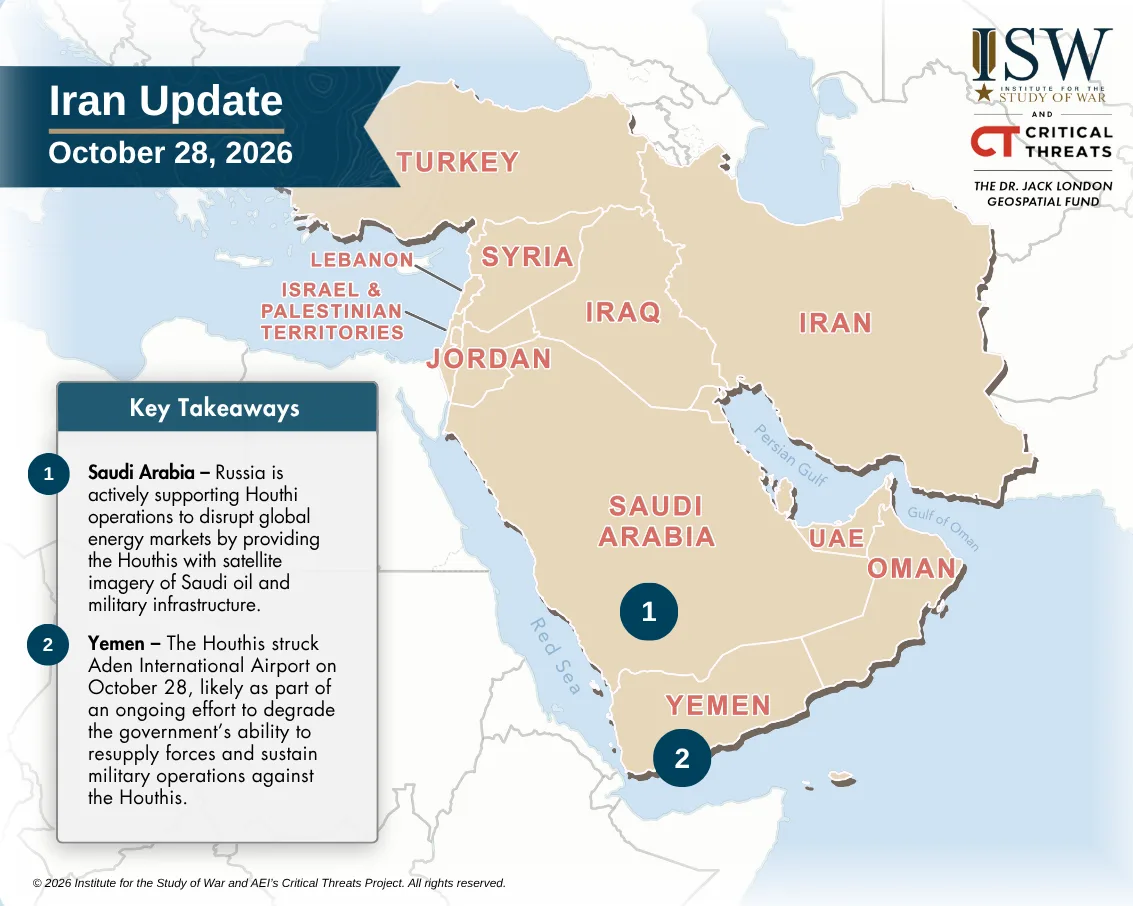
Russia is reportedly providing satellite-based targeting intelligence to Yemen’s Houthi movement, helping Iran-aligned forces identify and assess attacks against Saudi Arabia’s oil infrastructure and military installations, according to a new assessment by the Institute for the Study of War (ISW).
In its Iran Update, October 28, 2026, ISW cited an Associated Press investigation that identified repeated Russian military satellite activity above strategic Saudi sites in the days before and after missile and drone attacks. The findings suggest that intelligence support could be helping the Houthis and allied militias improve their targeting and assess the damage caused by their strikes.
The report raises concerns about a possible expansion of Russian involvement in the Middle East conflict, with satellite reconnaissance potentially strengthening Iran-aligned forces and increasing the risks to Saudi energy infrastructure.
The alleged assistance comes amid heightened regional tensions and disruptions to maritime energy shipments. Attacks against Saudi oil facilities could threaten an important alternative route for exporting crude if shipping through the Strait of Hormuz remains disrupted.
However, the evidence requires an important distinction: satellite movements were observed around the targets, while claims that Russia transferred the resulting intelligence to the Houthis rely on reporting from officials and other sources. The geospatial intelligence firm cited by AP said it had not directly observed the transfer of intelligence data.
Russian satellites monitored Saudi oil and military sites
The investigation cited by ISW was conducted by AURORAH Geosignal Intelligence, a Switzerland-based geospatial intelligence firm founded by Nawaf Obaid.
According to AP, the firm examined 40 missile and drone attacks involving the Houthis and Iraqi militias between July 1 and October 19, 2026. It identified repeated positioning of Russian government and military satellites over major Saudi energy and military sites before and after the attacks.
AURORAH tracked the trajectories and manoeuvres of Russian reconnaissance satellites and compared their activity with reported strikes on the ground.
The investigation identified 72 Russian reconnaissance satellites among the more than 11,000 spacecraft it examined. It reported a recurring pattern of satellite activity around the locations targeted by Iranian-aligned forces.
The firm said the pattern was consistent with intelligence collection and could have helped the attackers identify targets, refine their operations and assess the effects of strikes.
Nevertheless, satellite passes alone do not establish that imagery was successfully transmitted to the Houthis or that it was used to plan every attack. The claim of intelligence sharing is supported by separate accounts from a Saudi official and a senior Houthi figure cited by AP.
The distinction matters because satellite reconnaissance, intelligence transfer and operational use are separate stages. Establishing the full chain would require evidence connecting the collection of imagery to its delivery and use by the forces carrying out the attacks.
Saudi East–West oil pipeline targeted in September
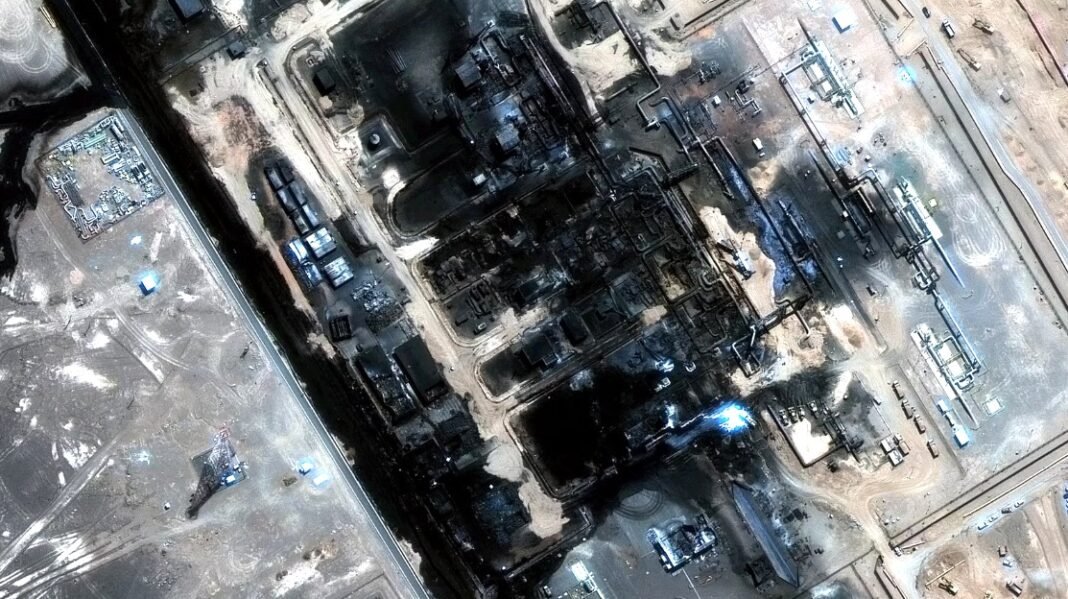
One of the most significant incidents examined in the investigation was the September 10 drone attack on pumping stations along Saudi Arabia’s East–West pipeline.
The approximately 1,200-kilometre pipeline connects Saudi Arabia’s eastern oil-producing region with its Red Sea export infrastructure. It provides Riyadh with an alternative route for moving crude to export terminals on the western coast, reducing its dependence on shipping through the Strait of Hormuz.
According to the Washington Post’s reporting on the investigation, AURORAH observed Russian Cosmos-series satellites concentrating over three pipeline pumping-station locations from July onwards. Satellite flybys reportedly increased in the period leading up to the September attack and around the time of the strikes.
The investigation also reported that Russian satellite activity over the relevant targets increased by approximately 50% during a 72-hour period around the September pipeline attack and a subsequent strike on King Fahd Air Base, compared with activity observed in July.
The pumping stations are strategically important because they maintain the movement of oil across the kingdom’s interior. Damage to several stations can interrupt the flow of crude even when production fields and export terminals remain operational.
The East–West pipeline has become particularly important during the current regional crisis because it offers Saudi Arabia an alternative to the Strait of Hormuz, where shipping has faced severe disruption.
An attack that interrupts pipeline operations can therefore have consequences beyond Saudi Arabia, affecting the availability of crude on international markets and adding pressure to an already uncertain energy outlook.
King Fahd Air Base strike raises further questions
The investigation also examined a subsequent attack on King Fahd Air Base near Taif, Saudi Arabia.
According to the Washington Post and AP reporting, Iranian-backed Houthi forces struck the base with multiple projectiles, damaging hangars and an Italian Air Force Eurofighter Typhoon. Italy’s defence authorities confirmed damage to the aircraft, according to the reports.
The incident drew attention because the aircraft was reportedly hit inside a hangar despite other Saudi aircraft being stationed at the same base.
Nawaf Obaid, the founder of AURORAH, argued that the apparent precision of the strike was consistent with access to specialised intelligence capabilities that the Houthis and Iranian advisers would not ordinarily possess independently.
That interpretation supports concerns about outside intelligence assistance, but the accuracy of a strike does not by itself identify the source of targeting information. The available reporting does not independently establish that Russian imagery directly determined the weapon’s final aim point.
The combination of satellite activity, reported strike timing and accounts from officials has nevertheless prompted renewed scrutiny of Russia’s alleged role in supporting Iranian-aligned operations.
How Russian intelligence could reach the Houthis
The AP investigation cited a Saudi official and a senior Houthi figure who separately said that Russian satellite intelligence was being provided to the Houthis through Iranian military advisers operating in Yemen.
Under this reported arrangement, Russian satellites would collect imagery over selected locations, while Iranian personnel would analyse the information and relay targeting intelligence to allied forces.
Such assistance could serve several purposes:
- Target identification: Helping identify the location and characteristics of military installations, oil infrastructure and other strategic facilities.
- Strike planning: Supporting assessments of potential targets and their importance to Saudi military or energy operations.
- Battle-damage assessment: Comparing imagery before and after an attack to determine whether infrastructure was damaged and whether further strikes might be required.
- Operational monitoring: Tracking changes at previously targeted locations and observing the effects of defensive or repair measures.
These are potential uses of satellite intelligence, rather than a verified account of every step in the reported Russian-Iranian-Houthi arrangement.
The AP investigation did not directly intercept a transfer of satellite imagery from Russia to Iran or the Houthis. Its conclusions instead draw on observed satellite activity, interviews with officials and intelligence-related sources, and comparisons with attacks on the ground.
The reported involvement of Iranian advisers would also be consistent with Tehran’s established relationship with the Houthis, although the precise extent of Iranian and Russian assistance in individual operations remains difficult to determine publicly.
Russia’s alleged support extends beyond Saudi Arabia
ISW assesses that the reported intelligence support fits a broader pattern of Russian cooperation with Iran and its regional partners.
Earlier reporting by the Wall Street Journal described Russian assistance with targeting information for Houthi attacks on international shipping in the Red Sea and Gulf of Aden during 2023 and 2024.
Those operations threatened commercial shipping and prompted international naval deployments to protect maritime traffic. The Houthis subsequently maintained a campaign against selected vessels, while Russia and Iran continued to deepen their military and strategic cooperation.
The latest allegations suggest that the use of satellite intelligence may extend beyond maritime targets to include Saudi energy infrastructure and military facilities.
AP also reported that Russian satellite activity was observed around attacks on Saudi and US-linked targets during the wider conflict involving Iran. Separate reporting has raised questions about possible Russian intelligence support for Iranian strikes on US military installations.
These reports do not establish that Moscow directed the attacks or controlled the forces involved. They point instead to an alleged intelligence-support relationship in which information collected by Russian satellites could strengthen the capabilities of Iran and its regional partners.
If substantiated, such assistance would demonstrate how a state can influence a regional conflict without deploying its own combat aircraft or missile forces against the targets.
Houthi attacks threaten Saudi Arabia’s alternative oil export route
Saudi Arabia’s East–West pipeline has acquired greater strategic importance as the regional conflict disrupts maritime transport through the Strait of Hormuz.
The pipeline allows crude oil to move from eastern Saudi Arabia towards export terminals on the Red Sea, providing a route that bypasses the strait. Its importance increases when shipping risks or restrictions make the traditional Gulf export route less reliable.
Attacks against pumping stations can reduce the effectiveness of that alternative even if the pipeline itself remains largely intact.
The broader concern is that repeated attacks could force Saudi Arabia to divert resources towards repairing damaged infrastructure, strengthening air defences and protecting strategic energy facilities.
Such pressure could affect export logistics and market expectations even without a prolonged shutdown of Saudi oil production.
The international consequences would depend on the extent of the damage, the duration of any interruption, available spare capacity and conditions in other producing countries.
Oil prices are influenced by multiple factors, including supply disruptions, shipping insurance costs, inventories and expectations about future production. It would therefore be premature to attribute any particular price movement solely to the alleged Russian intelligence support.
Nevertheless, the combination of attacks on energy infrastructure and threats to maritime routes creates a wider risk to global energy security.
Strategic implications for Saudi Arabia and the region
The reported satellite activity highlights a growing challenge for regional defence planners: the intelligence supporting a missile or drone attack may be as important as the weapon itself.
Low-cost drones and missiles can threaten infrastructure worth billions of dollars, but their effectiveness depends partly on the quality and timeliness of targeting information. External intelligence support could make it easier for armed groups to identify sensitive locations and assess the results of their operations.
For Saudi Arabia, the allegations reinforce the need to protect critical infrastructure, maintain alternative export routes and coordinate intelligence with regional and international partners.
For the United States and European countries, the reported activity raises questions about the security of military assets deployed in the Gulf and the extent to which outside powers are contributing to attacks on regional partners.
For Russia, the allegations point to a potential way of imposing strategic costs on countries aligned with Moscow’s adversaries without becoming a direct combatant in every engagement.
However, the available evidence does not establish Moscow’s full decision-making process, the extent of its knowledge of specific attacks or whether Russian authorities formally authorised every reported intelligence activity.
ISW warns of a wider Russian-Iranian effort
ISW argues that Russian intelligence support could help Iran and its partners sustain pressure on Saudi energy exports during a wider regional energy crisis.
The institute links the alleged assistance to a broader pattern of cooperation between Moscow and Tehran, including intelligence sharing and military-technology relationships.
The assessment is significant because it frames the attacks not merely as a series of isolated incidents, but as part of a potential effort to increase the economic and strategic costs of the regional conflict.
Even so, the strongest evidence presented publicly concerns the observed pattern of satellite activity and the accounts of sources interviewed by AP. The precise mechanism of intelligence transfer remains unverified independently.
The distinction between an intelligence pattern and a proven operational chain will remain central to any further assessment of Russia’s role.
Conclusion: Satellite intelligence emerges as a major regional security concern
The ISW assessment and the underlying AP investigation have raised serious questions about Russia’s alleged support for Houthi and Iraqi militia attacks against Saudi Arabia.
Repeated Russian satellite activity around key targets, including East–West pipeline pumping stations and King Fahd Air Base, provides evidence of a pattern that warrants further investigation. Accounts from Saudi and Houthi sources cited by AP suggest that Iranian advisers may be helping transfer and interpret satellite-derived intelligence.
If the allegations are substantiated, the reported assistance could strengthen Iran-aligned forces’ ability to threaten Saudi military facilities and energy infrastructure, with consequences for regional stability and global oil markets.
For now, the available evidence supports serious scrutiny of the alleged intelligence relationship, but it does not independently prove the full chain from Russian satellite collection to the planning and execution of every Houthi attack.