The proposed Mecca Defense Alliance is beginning to move beyond symbolism and toward an institutional security framework, with Türkiye, Pakistan and Saudi Arabia taking initial steps to establish its leadership structure, headquarters and mechanisms for future expansion.

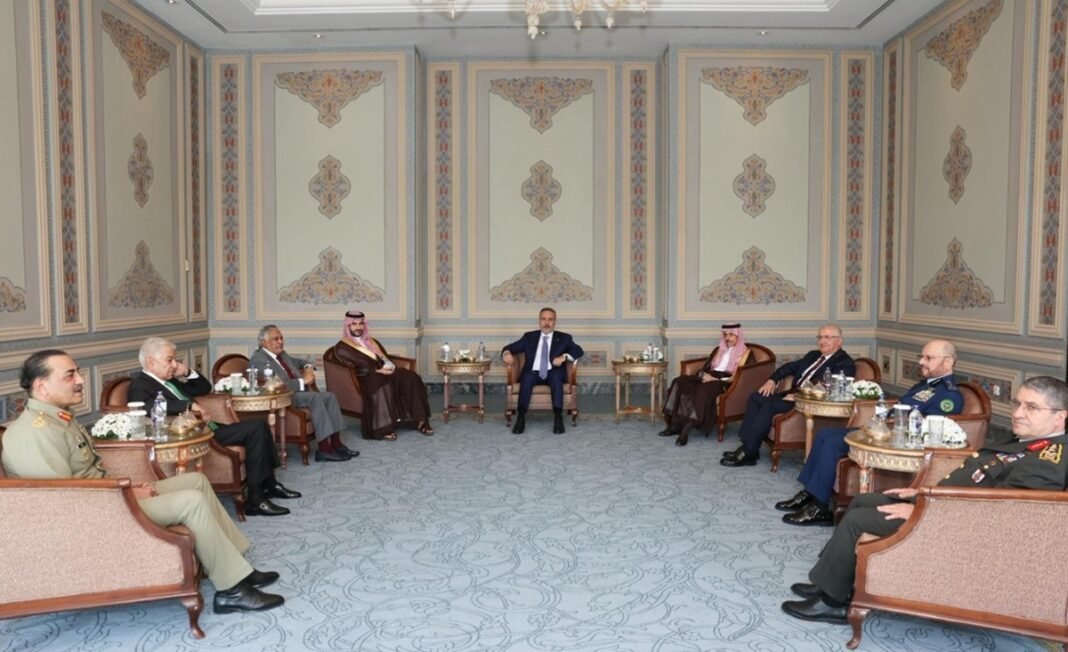
The first meeting of the alliance’s newly established Strategic, Political and Defense Committee in Istanbul focused on translating the Mecca Joint Defense Agreement into a functioning security organization.
The most significant announcements concerned the alliance’s official identity, headquarters, leadership and possible expansion.
Mecca Defense Alliance Gets an Institutional Identity
Turkish Foreign Minister Hakan Fidan said the three countries had decided to call the emerging security arrangement the Mecca Defense Alliance.
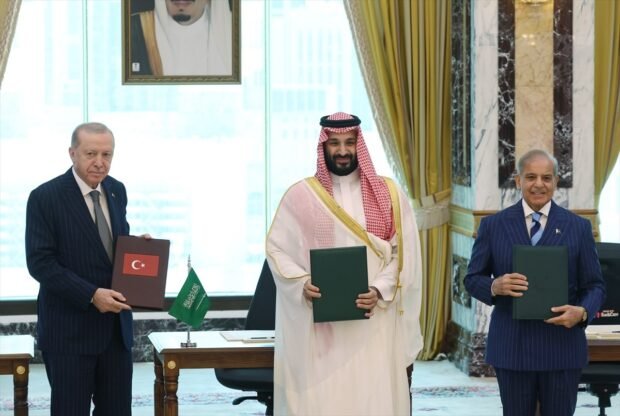
The naming is politically significant because it gives the agreement an identity beyond the original joint defense pact signed in Mecca on August 7 by Turkish President Recep Tayyip Erdoğan, Saudi Crown Prince Mohammed bin Salman and Pakistani Prime Minister Shehbaz Sharif.
More importantly, the Istanbul meeting suggests that the three governments are now attempting to create the institutions needed to turn the agreement into a long-term security mechanism.
The original agreement contains a potentially far-reaching collective defense principle: an attack against one participating state would be considered an attack against all parties.
However, such a commitment requires practical mechanisms. The central question is how the three countries would coordinate politically and militarily during a crisis.
The Istanbul meeting appears to have been an early effort to answer that question.

Riyadh Selected for Alliance Secretariat
One of the clearest decisions announced after the meeting was the selection of Riyadh as the location for the alliance’s secretariat.
The choice reflects Saudi Arabia’s central position within the new arrangement.
Saudi Arabia brings enormous economic resources, political influence in the Arab and Islamic world and strategic importance due to its geography, energy infrastructure and religious status.
Pakistan, meanwhile, possesses one of the Muslim world’s largest and most experienced armed forces and is the alliance’s only nuclear-armed member.
Türkiye brings a rapidly expanding defense industry, NATO military experience and significant expeditionary capabilities.
Placing the secretariat in Riyadh could therefore make Saudi Arabia the administrative and political center of the alliance while allowing the other two members to play major military and strategic roles.
The headquarters will be particularly important if the alliance develops permanent institutions, planning structures, military liaison mechanisms and defense-industrial cooperation programs.
Pakistani Official to Become First Secretary-General
Perhaps the most politically important development was Fidan’s announcement that the first secretary-general of the Mecca Defense Alliance will be a Pakistani official.
The decision gives Pakistan a prominent institutional role at the beginning of the alliance’s development.
The secretary-general is expected to become important if the alliance follows the model of other international security organizations, where the secretariat coordinates meetings, implements decisions and maintains communication between member states.
The choice of a Pakistani official may also reflect Islamabad’s particular importance in the security dimension of the grouping.
Pakistan has longstanding military relationships with Saudi Arabia and Türkiye. Pakistani military personnel have historically served in Saudi Arabia in training and advisory capacities, while defense cooperation between Pakistan and Türkiye has expanded significantly through naval programs, aerospace cooperation and joint defense production.
The appointment could therefore signal an attempt to distribute responsibilities among the three founding states: Riyadh as the institutional base, Pakistan in the first leadership role and Türkiye as a major driver of defense cooperation and military interoperability.
The official name of the alliance is Mecca Defence Alliance, and the first Secretary General will be from Pakistan. 🇵🇰🇹🇷🇸🇦 pic.twitter.com/RXDyxkomc2
— Black Bird (@BlackBird_Opps) August 31, 2026
The Alliance Is Open to New Members
Another major development is the possibility of expansion.
Fidan said the alliance was open to additional members and emphasized that its broader objective was to include more countries.
That statement could eventually become one of the most consequential aspects of the Mecca Defense Alliance.
At present, the organization is a three-country arrangement. But an expanded membership could transform its geopolitical significance.
The key question is likely to be which countries could join and under what conditions.
The alliance may attract interest from states seeking closer defense cooperation without joining existing Western-led security arrangements. However, expansion could also create challenges.
A larger membership would increase the alliance’s political weight but could make decision-making more complicated. Countries in the Middle East, South Asia and the wider Muslim world have different threat perceptions and rivalries.
For this reason, the founders may initially prioritize building a functioning institutional framework before moving aggressively toward expansion.
Building the Framework Matters More Than the Name
The Istanbul meeting’s most important outcome may not be the announcement of the alliance’s name, but the effort to build a framework for implementation.
The Strategic, Political and Defense Committee includes foreign ministers, defense ministers and military chiefs from the three founding states.
Such a structure brings together political leadership and military decision-makers, suggesting that the alliance is intended to operate across several levels.
The committee is expected to examine:
- Strategic and international security developments;
- Military cooperation and interoperability;
- Defense capability development;
- Joint research and development;
- Defense-industrial cooperation and production;
- Counterterrorism coordination;
- Institutional mechanisms and future road maps.
The proposed secretariat could eventually serve as the permanent mechanism connecting these areas.
However, major questions remain unanswered.
Will the alliance establish a joint military command structure? Will it conduct regular multinational military exercises? Will there be intelligence-sharing mechanisms? How will the collective defense clause be interpreted during an actual crisis?
These questions will determine whether the Mecca Defense Alliance becomes a serious security organization or remains primarily a political declaration.
From Political Agreement to Military Interoperability
One of the alliance’s most practical objectives appears to be improving interoperability among the armed forces of Pakistan, Türkiye and Saudi Arabia.
This could include joint exercises, officer exchanges, common training programs and greater coordination between air, naval and ground forces.
The three countries already possess different military strengths.
Pakistan has extensive operational experience and a large conventional military force. Türkiye has developed one of the fastest-growing defense industries in the wider region, including drones, naval systems, missiles and armored vehicles. Saudi Arabia has major financial resources and is pursuing an ambitious defense modernization and localization strategy.
The combination could create opportunities for joint production.
Türkiye and Pakistan already cooperate on defense projects, while Saudi Arabia has been seeking partnerships that can support domestic defense manufacturing.
A formal alliance framework could potentially connect these efforts.
A New Security Architecture?
Fidan described the alliance as an effort to establish a broader security architecture and reduce uncertainty and instability.
That language suggests the three countries may envision something larger than traditional bilateral defense agreements.
The Middle East’s existing security architecture has historically depended heavily on the United States and Western military partnerships.
But regional states are increasingly exploring alternative arrangements and indigenous defense partnerships.
The Mecca Defense Alliance could therefore represent an attempt to build a security mechanism based primarily on cooperation between three influential Muslim-majority states.
Whether it can achieve that ambition remains uncertain.
A collective defense alliance requires more than political declarations. It needs permanent institutions, military planning, intelligence coordination, crisis-management procedures and clarity about when members are actually obligated to support one another.
The Istanbul meeting suggests the three founding countries have now entered the difficult phase: building the machinery behind the political agreement.
What Happens Next?
The immediate focus is likely to be the establishment of the Riyadh secretariat, appointment of the first Pakistani secretary-general and development of a formal road map.
The next stage will reveal whether the alliance moves toward permanent military mechanisms or initially concentrates on political coordination and defense-industrial cooperation.
Expansion will also be closely watched.
For now, the Mecca Defense Alliance remains a young organization with many unanswered questions. But the Istanbul meeting demonstrates that the August agreement is moving toward institutional development.
The choice of Riyadh for the headquarters, Pakistan for the first secretary-general and the decision to leave the door open for new members provide the first visible outline of what the alliance could eventually become.
The real test, however, will not be its name or declarations.
It will be whether Türkiye, Pakistan and Saudi Arabia can build a credible framework capable of turning a collective defense promise into an operational security system.