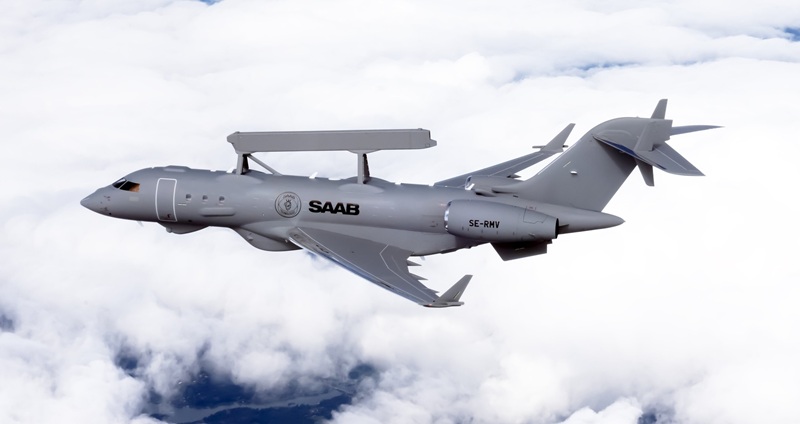
Swedish defence company Saab has announced a US$1.04 billion contract to supply two GlobalEye Airborne Early Warning and Control (AEW&C) aircraft to an undisclosed Middle Eastern customer, with deliveries scheduled for 2030.
Although Saab has not revealed the buyer’s identity, the announcement has sparked widespread speculation among defence analysts because GlobalEye is regarded as one of the world’s most capable airborne surveillance and battle management platforms.
The acquisition could significantly strengthen the customer’s ability to detect threats, coordinate fighters, manage missile defence and oversee air, maritime and land operations across the Middle East.
Why GlobalEye Is More Than Just Another Surveillance Aircraft
Unlike fighter aircraft that primarily add combat power through weapons and numbers, AEW&C aircraft multiply the effectiveness of an entire military.
GlobalEye functions as an airborne command centre capable of:
- Detecting aircraft hundreds of kilometres away
- Tracking cruise missiles and drones
- Monitoring naval activity
- Directing fighter interceptions
- Coordinating air defence systems
- Sharing real-time battlefield information
Rather than acting as a single aircraft, it serves as the nerve centre of a modern integrated air defence network.
Saab GlobalEye Specifications
| Feature | Saab GlobalEye |
|---|---|
| Platform | Bombardier Global 6000/6500 |
| Radar | Erieye Extended Range AESA |
| Detection Range | 450+ km (air targets) |
| Instrumented Radar Range | 650 km+ |
| Endurance | 11–12 hours |
| Surveillance Domains | Air, Land and Maritime |
| Crew | Mission crew plus flight crew |
| Delivery | 2030 |
What Makes GlobalEye Different?
GlobalEye combines several advanced sensors into a single aircraft.
Its core sensor is the Erieye Extended Range (ER) AESA radar, which uses a fixed dorsal radar instead of the rotating radome found on traditional AWACS aircraft.
The aircraft also carries:
- Maritime surveillance radar
- Ground moving target indication (GMTI)
- Electro-optical and infrared sensors
- Identification Friend or Foe (IFF)
- Automatic Identification System (AIS)
- Secure data links
Together, these sensors create a comprehensive picture of the battlespace across multiple domains.
How Far Can GlobalEye See?
Operating at around 35,000 feet, GlobalEye can detect airborne threats at distances exceeding 450 kilometres, while Saab states the radar’s instrumented range surpasses 650 kilometres under certain conditions.
The aircraft’s altitude provides a major advantage over ground-based radars by extending the radar horizon, allowing earlier detection of:
- Cruise missiles
- Low-flying aircraft
- Drones
- Maritime targets
Earlier warning translates into additional decision time for commanders to launch interceptors or reposition defensive assets.
Who Is the Mystery Customer?
Saab has deliberately withheld the buyer’s identity, citing national security and customer confidentiality.
However, defence analysts have identified several likely candidates.
Most Likely: Saudi Arabia
Saudi Arabia is widely viewed as the strongest possibility because:
- It already operates five ageing Boeing E-3A Sentry AWACS aircraft.
- It previously acquired Saab 2000 Erieye aircraft.
- Saab confirmed formal GlobalEye offers to Saudi Arabia in 2025.
- Saudi officials visited Sweden for GlobalEye briefings.
GlobalEye would modernise Saudi Arabia’s airborne surveillance fleet while complementing its existing AEW&C capabilities.
Strong Alternative: Qatar
Qatar is another credible contender.
Unlike Saudi Arabia, Qatar currently lacks a dedicated airborne early warning fleet despite operating advanced combat aircraft.
Acquiring two GlobalEye aircraft would provide Qatar with its first sovereign airborne battle management capability, dramatically enhancing its command-and-control architecture.
Other Possibilities
Analysts have also mentioned:
- Kuwait
- Egypt
- Bahrain
- Oman
However, available evidence supporting these countries remains considerably weaker than for Saudi Arabia or Qatar. The United Arab Emirates is excluded, having already received five GlobalEye aircraft between 2020 and 2024.
GlobalEye vs Boeing E-3 Sentry
| Feature | Saab GlobalEye | Boeing E-3 Sentry |
|---|---|---|
| Platform | Bombardier Global 6000/6500 | Boeing 707 |
| Radar | Erieye ER AESA | Rotating Pulse-Doppler |
| Endurance | 11–12 hours | Around 8–10 hours |
| Airframe Age | Modern business jet | Legacy airliner |
| Maritime Surveillance | Yes | Limited |
| Ground Surveillance | Yes | Limited |
| Operating Cost | Lower | Higher |
GlobalEye delivers comparable strategic surveillance capabilities using a much smaller, more fuel-efficient platform.
Why Two Aircraft Can Change Regional Air Power
Although two aircraft may appear modest, AEW&C platforms dramatically increase the effectiveness of every connected fighter, missile battery and warship.
GlobalEye enables commanders to:
- Detect threats earlier
- Allocate fighters more efficiently
- Prevent duplicate missile engagements
- Improve interception success
- Coordinate air and missile defence across multiple domains
In modern warfare, information superiority is often as decisive as firepower itself.
Strategic Impact on the Middle East
The acquisition comes as regional militaries continue adapting to increasingly complex threats involving:
- Ballistic missiles
- Cruise missiles
- Long-range drones
- Mixed saturation attacks
An aircraft like GlobalEye helps integrate sensors, fighters and missile defence systems into a single operational picture, allowing commanders to respond faster and more efficiently.
If Saudi Arabia is the customer, the aircraft would modernise an existing AEW&C capability. If Qatar is the buyer, the deal would establish an entirely new airborne command-and-control enterprise.
Either outcome is likely to influence future procurement decisions across the Gulf, encouraging neighbouring states to invest further in electronic warfare, counter-AEW&C capabilities and integrated air defence networks.
Saab’s Growing Global Success
The undisclosed Middle Eastern order further strengthens Saab’s position in the global AEW&C market.
GlobalEye is already operated by:
- United Arab Emirates
- Sweden (on order)
- France (on order)
The platform is also attracting interest from NATO and other international customers seeking a modern alternative to ageing E-3 AWACS fleets.
Conclusion
While Saab has kept the customer’s identity secret, the strategic significance of the deal is unmistakable. The US$1.04 billion contract will deliver two of the world’s most advanced airborne early warning and control aircraft, giving the buyer a powerful new capability to monitor air, land and maritime domains while coordinating complex military operations.
Saudi Arabia currently appears to be the leading candidate based on publicly available evidence, with Qatar remaining a credible alternative. Regardless of the final customer, the introduction of GlobalEye into another Middle Eastern air force is set to reshape regional surveillance, air defence and command-and-control capabilities well before the aircraft enter service in 2030.