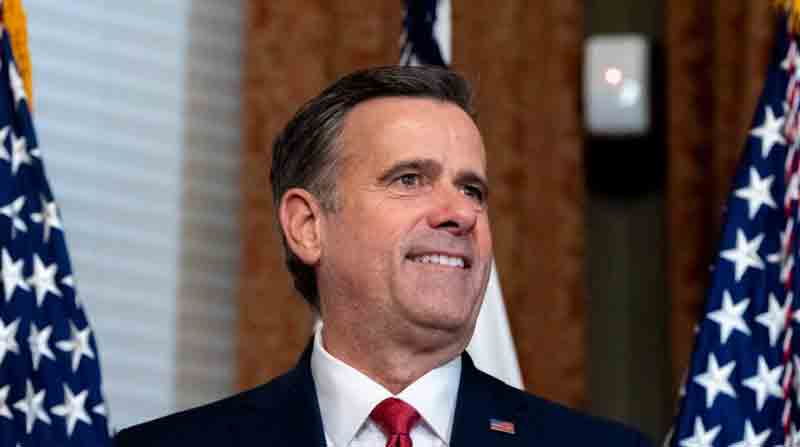
Poland says it knows why CIA Director John Ratcliffe made his unusually secretive trip to Moscow but cannot disclose the details. The statement comes as U.S. and European intelligence officials warn of possible Russian escalation, while Washington is simultaneously trying to prevent a wider confrontation involving NATO, Ukraine and Iran. The evidence now suggests Ratcliffe’s mission was broader than a routine intelligence meeting.
The mystery surrounding CIA Director John Ratcliffe’s surprise visit to Moscow has deepened after Polish Prime Minister Donald Tusk said Warsaw knows the reason for the trip but considers the information too sensitive to make public.
Tusk’s comments are important because they suggest Poland was not merely informed that Ratcliffe had travelled to Russia. Warsaw appears to have been brought into the wider strategic picture surrounding the mission.
Speaking as concerns grow over Russia’s intentions in the coming months, Tusk said Poland remains in close contact with CIA leadership and was therefore not surprised by Ratcliffe’s visit. He also warned that Russia appears to be preparing for a possible escalation and described the next seven to eight months as potentially critical for Ukraine, Poland and the wider region.
That combination makes the Moscow trip considerably more significant than President Donald Trump’s description of it as “semi-routine.”
What We Know About Ratcliffe’s Moscow Mission
Ratcliffe travelled to Moscow on August 25 aboard a U.S. Air Force C-17 military transport aircraft that had previously flown from the Washington area to Riga, Latvia.
The aircraft then continued to Moscow before returning to Europe.
The unusual movement immediately attracted attention because the United States and Russia remain deeply hostile over the Ukraine war, while formal diplomatic efforts have made little progress.
The CIA itself did not publicly announce the trip.
The Kremlin later confirmed that Ratcliffe had met Russian intelligence officials but said he did not meet President Vladimir Putin. Russian Foreign Intelligence Service chief Sergei Naryshkin subsequently described his meeting with Ratcliffe as a “working-level” encounter involving sensitive intelligence matters.
That alone is significant.
A CIA director travelling personally to Moscow during a major international crisis is not ordinary diplomacy. Intelligence chiefs can communicate through secure channels without making a physical visit.
The decision to send Ratcliffe personally suggests that Washington wanted something communicated at a level where ambiguity was reduced.
The Most Important Clue: Russia and NATO
The Wall Street Journal initially reported that Ratcliffe’s mission included a warning to Moscow against attacking a NATO member.
CBS and other US media subsequently reported the same basic account.
Reuters has now added an important qualification: two sources told the agency that Ratcliffe did raise the possibility of a Russian operation against a NATO member, although it was unclear whether that was the primary purpose of the trip.
This is more significant than simply saying Ratcliffe went to Moscow to “warn Russia.”
It suggests Washington was discussing a specific strategic contingency with Moscow.
The exact scenario remains classified.
There is no public evidence that Russia has decided to launch a conventional attack on NATO territory.
Indeed, Trump has explicitly rejected that possibility, saying Putin would not attack NATO territory.
But the fact that US intelligence officials were apparently discussing the possibility with their Russian counterparts indicates that the scenario is being taken seriously enough to warrant direct communication.
Why Poland’s Statement Matters
Poland is arguably the most strategically important NATO country in this story.
It borders Russia’s Kaliningrad exclave and Belarus, hosts major NATO military infrastructure and serves as one of the principal logistical gateways for Western support to Ukraine.
If there were a serious concern about Russian escalation affecting NATO’s eastern flank, Poland would be among the countries Washington would need to keep closely informed.
That makes Tusk’s statement particularly revealing.
He did not say Poland was merely “aware” of the trip.
He said Warsaw knows the reason for it but cannot disclose the information because of its sensitivity.
That suggests the intelligence picture shared among Washington and at least some European allies is more detailed than what has emerged publicly.
Tusk’s Seven-to-Eight-Month Warning Is Another Piece of the Puzzle
Tusk has separately warned that Russia is seriously preparing for escalation and that the next seven to eight months could be critical.
That does not prove that Moscow is preparing an attack on NATO.
But it does indicate that Poland’s government sees the current period as unusually dangerous.
The warning comes as European governments are strengthening their eastern defences and reassessing the possibility that Russia could test NATO through actions below the threshold of full-scale conventional war.
That distinction is important.
The most immediate concern may not be Russian tanks crossing a NATO border.
It could involve hybrid operations, sabotage, cyberattacks, covert action, drones, disinformation or other deniable activity designed to test how quickly NATO responds.
US intelligence officials have reportedly been examining precisely these possibilities.

Russia Could Test NATO Without Starting a Full War
A conventional attack against a NATO member would carry enormous risks for Moscow.
Article 5 creates the possibility of collective military action by the alliance.
That makes a deliberate large-scale invasion of a NATO state a dramatically different proposition from the type of deniable operations Russia has repeatedly been accused of conducting in Europe.
A more plausible concern for Western planners is therefore a limited or ambiguous provocation.
The objective could be to create uncertainty over whether Article 5 applies.
That could involve a cyberattack on critical infrastructure, sabotage, an unidentified drone incident, attacks attributed to proxies, or a limited border incident.
The strategic calculation would be straightforward: test NATO’s political cohesion without immediately triggering a full-scale war.
This is one reason Poland and the Baltic states are particularly sensitive to developments in Moscow.
The Iran War May Be Part of the Equation
There is another important dimension that should not be overlooked.
Reuters sources said Ratcliffe’s discussions also touched on Russia’s support for Iran.
That makes the mission potentially broader than Ukraine or NATO.
The United States is already engaged in a major confrontation with Iran.
Washington therefore has an interest in preventing Russia from providing Tehran with military or economic assistance that could prolong the conflict or undermine US pressure.
CNN reported that Ratcliffe used the Moscow meetings to encourage Russia to cut economic and military support to Iran.
This could explain part of the unusual timing.
Washington is confronting multiple strategic problems simultaneously.
Russia is fighting in Ukraine.
Iran is under US military and economic pressure.
China remains an important factor in the global sanctions and energy picture.
And the United States is attempting to prevent these crises from reinforcing each other.
Why Washington May Be Worried About Russian Calculations
A Washington Post report said the Ratcliffe visit was preceded by US intelligence indicating that the Kremlin sees the United States as weakened by the Iran war and may view that as an opportunity to increase pressure on American interests and European allies.
If accurate, that would explain the urgency behind the trip.
The concern would not necessarily be that Putin has decided to attack NATO.
It would be that Moscow might calculate that the United States is temporarily distracted or overstretched.
That is a very different proposition.
From Moscow’s perspective, the Iran war could create an opportunity to increase pressure on Europe while Washington’s military resources and political attention are focused elsewhere.
From Washington’s perspective, the message to Moscow would therefore be:
Do not mistake American preoccupation in the Middle East for reduced commitment to NATO.
Why Trump Is Downplaying the Mission
Trump’s public comments have created an interesting contrast with the intelligence reporting.
The president has called Ratcliffe’s trip “semi-routine” and rejected the idea that Putin is preparing to attack NATO.
That may simply reflect an attempt to prevent unnecessary escalation.
There is a practical reason for Washington not to publicly announce that it believes Russia is preparing an attack.
Doing so could create a self-fulfilling cycle:
US warning → Russian denial → military alert → counter-alert → greater tension → increased risk of miscalculation.
Keeping the intelligence channel private gives both sides room to adjust their behaviour without publicly backing themselves into a corner.
The CIA-SVR Channel Is Especially Important
The meeting itself also demonstrates that intelligence channels between Washington and Moscow remain functional despite the collapse of broader relations.
Naryshkin confirmed that he and Ratcliffe discussed sensitive matters within the responsibilities of their agencies.
He also said such contacts were not unusual.
That matters because intelligence channels can sometimes remain open when diplomatic channels become politically difficult.
They can be used to discuss:
- military movements;
- detainees;
- escalation risks;
- covert activity;
- nuclear issues;
- crisis communication;
- and red lines that governments may not want to discuss publicly.
The fact that Ratcliffe went personally suggests the channel was considered sufficiently important to warrant a face-to-face meeting.
Ukraine Was Almost Certainly Part of the Background
The Moscow mission also came at a particularly difficult moment for US efforts to end the Ukraine war.
Negotiations have largely stalled.
Russia and Ukraine remain far apart on fundamental questions.
At the same time, Ukraine has continued striking targets deep inside Russia.
The United States reportedly informed Kyiv in advance that a senior delegation would travel to Moscow and asked Ukrainian officials to pause strikes during the delegation’s departure from Russia.
Ukraine’s President Volodymyr Zelensky has since confirmed that Washington provided Kyiv with information about meetings in Moscow.
He did not disclose what the information contained, but thanked Washington for both the information and the “tone” of its conversations with Russia.
That is another indication that the mission was coordinated within the wider Western intelligence and diplomatic framework rather than being an isolated CIA operation.
Is Russia Really Preparing to Attack NATO?
This is where caution is essential.
There is no publicly available evidence proving that Moscow has decided to launch a conventional attack on a NATO member.
European officials have also pushed back against some reports suggesting an imminent Russian military assault on the alliance.
The available information supports a narrower conclusion:
US and European intelligence agencies are concerned about Russian escalation and are assessing scenarios involving NATO.
That is not the same as predicting an invasion.
The distinction matters because intelligence assessments deal in probabilities and contingencies, not certainties.
What Could Happen Next?
Several scenarios are possible.
1. The warning works
Russia could decide that testing NATO is not worth the risk.
The intelligence channel would then have achieved its primary purpose without anyone publicly acknowledging a crisis.
2. Russia increases pressure below the threshold of war
Moscow could intensify cyber operations, sabotage, disinformation or other forms of pressure against European states.
This would allow Russia to challenge NATO without immediately triggering a conventional military confrontation.
3. Ukraine remains the main battlefield
The Ratcliffe mission may ultimately have been primarily about Ukraine rather than NATO.
The CIA chief could have been communicating Washington’s assessment of the war and attempting to persuade Moscow that continued escalation would worsen its strategic position.
4. Iran becomes increasingly connected to the Russia-NATO problem
If Russia expands military or economic assistance to Iran, Washington could face a two-theatre problem.
That would make Moscow’s cooperation—or restraint—more important to the Trump administration.
The Bigger Message Behind Ratcliffe’s Trip
The most revealing aspect of the episode may not be what Ratcliffe told Russia.
It may be who needed to hear about it.
Poland knows.
Ukraine knows that Washington shared information.
Russia confirms the intelligence meeting.
European governments are discussing possible escalation.
And yet the United States is deliberately refusing to publicly explain the mission.
That combination suggests the trip was designed for a very specific purpose: private strategic communication rather than public diplomacy.
The objective could have been deterrence, negotiation, intelligence exchange—or several of these at once.
Why the Mission Matters for Europe
For European governments, particularly those on NATO’s eastern flank, the episode is a warning that the strategic environment remains unstable even while Washington publicly downplays the prospect of a direct Russia-NATO war.
Poland’s military preparations, NATO’s eastern-flank posture and the growing emphasis on hybrid threats all point toward the same conclusion:
Europe is preparing not only for the continuation of the Ukraine war, but also for the possibility that Russia could seek new ways to pressure the alliance.
That does not mean war is inevitable.
In fact, much of the current activity may be designed precisely to prevent one.
The Bottom Line
John Ratcliffe’s Moscow trip remains officially unexplained, but the picture is becoming clearer.
The CIA director met Russian intelligence chief Sergei Naryshkin in Moscow and discussed sensitive matters.
Reuters sources say Ratcliffe raised the possibility of Russian operations against a NATO member and that Russia’s support for Iran was also discussed.
Ukraine was informed about meetings in Moscow, while Poland says it knows the reason for Ratcliffe’s mission but considers the information too sensitive to disclose.
At the same time, Donald Trump has publicly rejected the idea that Putin intends to attack NATO and has characterized Ratcliffe’s trip as routine or semi-routine.
The most credible reading is therefore not that a Russian attack on NATO is imminent.
It is that Washington has intelligence suggesting the risk of further Russian escalation is serious enough to warrant a direct, high-level warning—and that the United States is simultaneously trying to manage Russia’s role in the Iran crisis and the stalled Ukraine war.
That makes Ratcliffe’s Moscow visit less mysterious in one sense, but more consequential in another.
The real question now is whether the private warning produces restraint—or whether the next few months reveal that Washington and its European allies were preparing for a threat that Moscow intends to test.