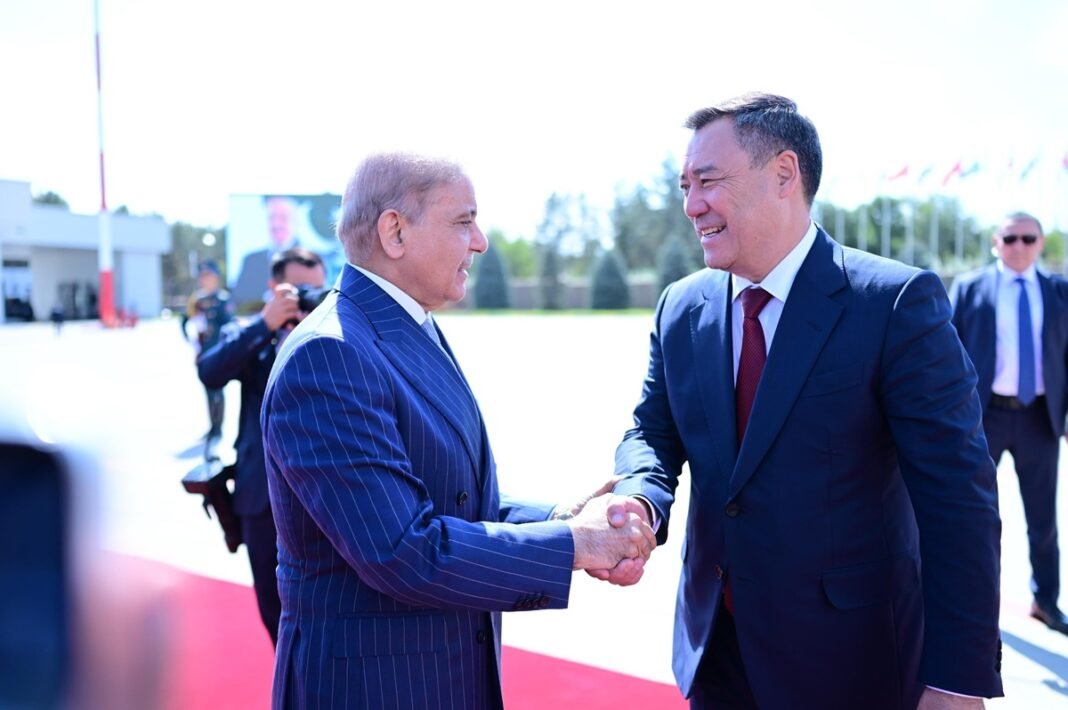
Pakistan and Kyrgyzstan have set a $200 million trade target, signed a transit trade agreement and expanded cooperation in energy, security and regional diplomacy.
But the real significance of Prime Minister Shehbaz Sharif’s September 2 visit to Bishkek goes beyond the agreements themselves.
The visit signals a more practical phase in Pakistan’s engagement with Central Asia—one focused on trade routes, energy, investment and security rather than diplomatic goodwill alone.
For Kyrgyzstan, closer ties with Pakistan offer an opportunity to diversify economic partnerships and access new markets. For Pakistan, the relationship fits into a broader push to strengthen its economic and strategic presence in Central Asia.
The question now is whether the political momentum can produce results on the ground.

Transit trade agreement is the biggest strategic outcome
The Agreement on Transit Trade could prove to be the most important outcome of the Bishkek talks.
Kyrgyzstan is landlocked and depends on transport corridors through neighbouring countries to reach international markets. Pakistan, meanwhile, offers access to the Arabian Sea and has long sought a larger role in Central Asian trade.
The joint statement specifically highlighted the potential use of Pakistan’s seaports to expand Kyrgyzstan’s foreign trade and transit opportunities.
The two countries also agreed to improve freight movement, develop multimodal transport and address barriers affecting trade.
The geopolitical logic is straightforward: Kyrgyzstan wants more options, while Pakistan wants stronger economic links with Central Asia.
But agreements do not automatically create functioning trade routes.
Transport costs, customs delays, infrastructure and regional security will determine whether businesses actually use the corridors now being discussed.
The $200 million trade target will test the relationship
Pakistan and Kyrgyzstan have agreed to prepare an action plan aimed at gradually increasing bilateral trade to $200 million.
The two sides identified mining, agriculture, food production, textiles, pharmaceuticals, halal industries and digital technologies as priority sectors.
They also want to promote joint ventures, investment and technology cooperation.
The target is ambitious, but that is precisely why it matters.
Pakistan’s relationship with Central Asia has long carried greater strategic potential than economic results. Political leaders have repeatedly highlighted opportunities in trade and energy, while difficult geography and weak transport links have limited commercial growth.
The Bishkek agreements represent an effort to close that gap.
Success will depend less on official announcements and more on whether businesses can move goods cheaply, reliably and profitably.
Afghanistan remains the biggest uncertainty
The joint statement repeatedly links regional economic development to stability in Afghanistan.
Both leaders stressed that peace and security in Afghanistan are essential for closer cooperation between South and Central Asia. They also reiterated that Afghan territory should not be used for activities threatening other countries.
This is more than diplomatic language.
Afghanistan remains a major strategic uncertainty for several projects linking Pakistan directly with Central Asia.
Instability affects transport planning, energy infrastructure and investment decisions. It also creates wider concerns over terrorism, narcotics trafficking and organized crime.
That explains why Pakistan and Kyrgyzstan combined their economic agenda with new agreements on extradition, legal assistance and cooperation against drug trafficking.
Their message is clear: regional economic ambitions will remain difficult to achieve without improved security.

CASA-1000 is a major test of regional cooperation
Energy cooperation was another major focus of the visit.
Pakistan and Kyrgyzstan reaffirmed their commitment to the timely implementation of CASA-1000, which is designed to transmit surplus electricity from Kyrgyzstan and Tajikistan to Afghanistan and Pakistan.
For Pakistan, the project offers another potential source of electricity. For Kyrgyzstan, it could expand energy exports.
But CASA-1000 carries broader importance.
It is a test of whether countries across Central and South Asia can successfully operate a major infrastructure project despite political and security challenges.
The two countries have also established a Joint Working Group on Energy to explore cooperation in hydropower, renewable energy, electricity infrastructure and modern technologies.
Pakistan’s Central Asia strategy is becoming more practical
The Bishkek visit is part of a growing pattern of high-level engagement.
President Sadyr Zhaparov visited Pakistan in December 2025. President Asif Ali Zardari travelled to Kyrgyzstan in July 2026. Shehbaz Sharif’s visit now adds another layer to the relationship.
The two governments have described these exchanges as part of a continuing process rather than isolated diplomatic events.
That matters because Pakistan’s engagement with Central Asia has often suffered from a gap between strategic ambition and implementation.
The latest agreements suggest Islamabad is now seeking a more practical relationship—built around transit, trade, energy and investment.
Whether that approach succeeds will depend on sustained follow-up after the leaders return home.
Security cooperation is moving to the centre of the relationship
The Bishkek talks also expanded the security dimension of Pakistan-Kyrgyzstan relations.
The two countries signed a treaty on extradition, an agreement on mutual legal assistance and a memorandum on combating narcotics trafficking.
They also pledged closer cooperation against terrorism, extremism, organized crime, human trafficking, illegal migration and cybercrime.
These agreements reflect a wider regional reality.
Pakistan and Kyrgyzstan may not share a border, but many of the security challenges affecting Central and South Asia cross national boundaries.
The expansion of security cooperation suggests that the relationship is evolving beyond trade and diplomacy into a more comprehensive strategic partnership.

The SCO adds a wider geopolitical dimension
Pakistan and Kyrgyzstan also reaffirmed cooperation within the United Nations, the Shanghai Cooperation Organisation, the Organization of Islamic Cooperation and the Economic Cooperation Organization.
The SCO is particularly important because it connects Pakistan with China, Russia and Central Asian states through a shared political and security framework.
For Pakistan, stronger ties with Central Asian SCO members reinforce its role in wider Eurasian diplomacy.
For Kyrgyzstan, closer engagement with Pakistan strengthens its links with South Asia.
The SCO cannot remove practical barriers to trade or infrastructure development, but it provides an important platform for political coordination.
The real challenge is implementation
The most important question after the Bishkek visit is not whether Pakistan and Kyrgyzstan want closer relations.
They clearly do.
The challenge is implementation.
The $200 million trade target will require stronger business links and commercially viable transport arrangements.
The transit trade agreement will require efficient customs systems and reliable infrastructure.
CASA-1000 will depend on sustained regional cooperation and a manageable security environment.
The two governments have now created an extensive framework for cooperation. It covers trade, transit, energy, security, education, tourism and climate change.
But frameworks alone do not transform regional relationships.
Pakistan and Kyrgyzstan will need regular follow-up, clear timelines and institutional accountability to ensure the agreements move from diplomatic documents to functioning projects.

A strategic relationship with real potential
Shehbaz Sharif’s Bishkek visit marks an important moment in Pakistan-Kyrgyzstan relations.
The two countries are no longer limiting their engagement to traditional diplomacy. Their discussions increasingly connect bilateral ties with larger questions of trade diversification, energy security, Afghanistan and Eurasian politics.
For Pakistan, Kyrgyzstan represents an important partner in its wider Central Asia strategy.
For Kyrgyzstan, Pakistan offers another avenue for trade and economic engagement beyond its immediate region.
The strategic potential is clear.
The outcome, however, is far from guaranteed.
If Pakistan and Kyrgyzstan can deliver on trade, transit and energy commitments, their partnership could become an important example of deeper engagement between South and Central Asia.
If implementation slows, the agreements signed in Bishkek risk becoming another example of regional ambition outpacing regional execution.
For now, the direction is unmistakable: Pakistan and Kyrgyzstan are seeking a broader strategic partnership. The next challenge is proving that their political momentum can survive the far more difficult test of implementation.