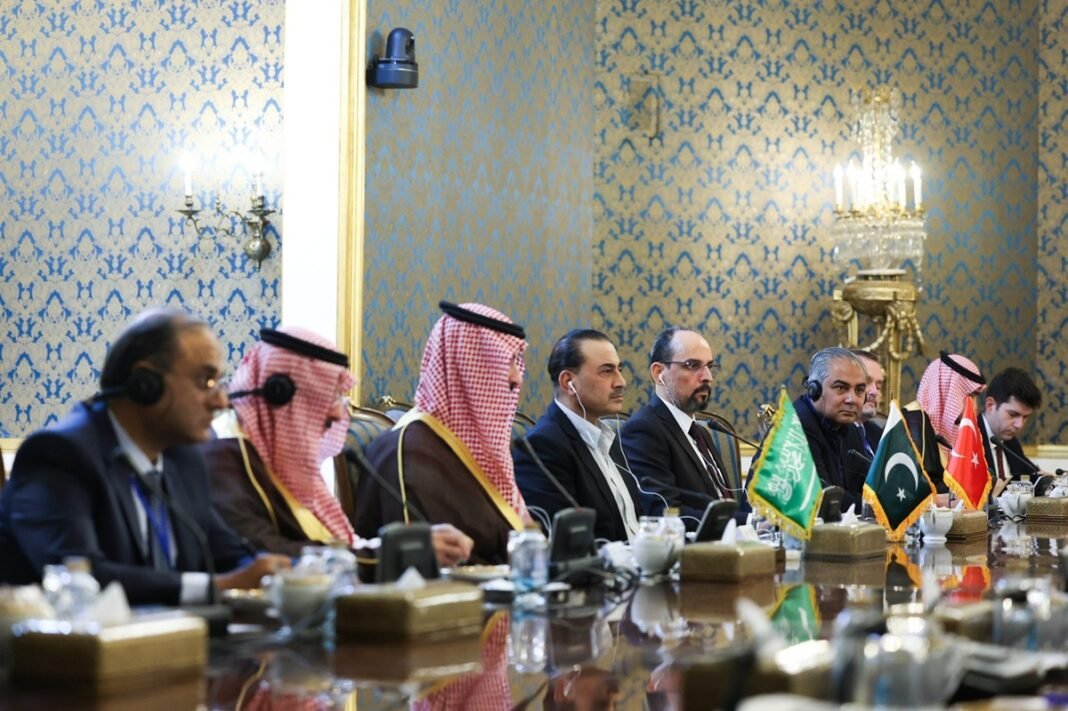
Pakistan, Saudi Arabia and Türkiye are stepping up diplomatic efforts to prevent a renewed regional war, with senior officials from the three countries meeting Iranian leaders in Tehran as tensions rise over the Strait of Hormuz, the US naval blockade of Iranian ports and Houthi attacks on Saudi Arabia.
The October 26 meeting brought together Pakistan’s Chief of Army Staff Field Marshal Asim Munir, Saudi Defence Minister Prince Khalid bin Salman and Türkiye’s intelligence chief Ibrahim Kalın with senior Iranian officials, including President Masoud Pezeshkian, Supreme National Security Council Secretary Mohsen Rezaei and Foreign Minister Abbas Araghchi.
According to Reuters, a senior Pakistani security official said the central objective was to develop a regional non-aggression network. The discussions reportedly covered efforts to resume US-Iran negotiations, security in the Strait of Hormuz, the blockade of Iranian ports and the escalating conflict involving Yemen’s Houthi movement.
The talks mark a significant diplomatic development because Saudi Arabia, Pakistan and Türkiye are seeking engagement with Tehran despite their growing security concerns over the expanding conflict.
Tehran Meeting Focuses on Regional Security and Non-Aggression
Reuters reported that the proposed regional non-aggression network was a central objective of the Tehran discussions. Iranian Foreign Ministry spokesperson Esmaeil Baghaei also described the meeting as a possible first step towards establishing regional security mechanisms.
Iranian officials said the agenda extended beyond the immediate military confrontation to include Israel’s regional policies, developments in Palestine and Lebanon, and the consequences of US and Israeli military action against Iran.
The four countries agreed to continue dialogue aimed at strengthening regional cooperation, peace and security, according to the joint statement released after the meeting.
However, the statement did not announce a formal non-aggression treaty or a new collective military commitment. The proposed network remains a diplomatic objective rather than an established regional security arrangement.
The initiative comes as Washington and Tehran face pressure to prevent the resumption of large-scale hostilities. Previous mediation efforts produced an interim understanding in June, but that arrangement subsequently unravelled as fighting resumed.
Pakistan and Qatar Support Efforts to Restart US-Iran Negotiations
Pakistan and Qatar have emerged as important intermediaries in efforts to reduce tensions between Washington and Tehran.
The Associated Press reported that Qatari mediators arrived in Tehran on October 25 in coordination with the United States. Their visit preceded the four-country meeting and formed part of continuing efforts to prevent further escalation.
Saudi Arabia also publicly supported mediation led by Qatar and Pakistan. Saudi Deputy Foreign Minister for Public Diplomacy Rayed Krimly described the Tehran visit as an effort to promote diplomatic solutions, reduce tensions and strengthen regional security.
Pakistan’s involvement reflects its interest in preventing a wider conflict that could threaten Saudi security, disrupt regional trade and energy supplies, and draw additional countries into the fighting.
The diplomatic challenge is substantial. Tehran has demanded an end to the US blockade of Iranian ports and relief from restrictions affecting Iranian oil exports. Washington, meanwhile, has sought concessions on Iran’s nuclear programme as part of a broader settlement.
The two sides have yet to resolve the differences that undermined earlier negotiations.
Strait of Hormuz Becomes Central to the Diplomatic Bargaining
The Strait of Hormuz is one of the most consequential issues in the negotiations because disruptions to the waterway threaten international energy supplies and commercial shipping.
The proposed interim arrangement, described in earlier reporting by Reuters and the Financial Times, would link the reopening of the strait to the lifting of the US blockade on Iranian ports. Further measures under discussion have included possible relief involving Iranian oil exports and access to some frozen Iranian assets.
The two sides have struggled to agree on the order in which commitments should be implemented. Iran wants relief from US pressure, while Washington wants assurances that shipping can resume and that a wider settlement will address its security concerns.
Iranian Foreign Minister Abbas Araghchi has previously discussed reopening the strait within a seven-day period. However, the existence of an agreed five-day schedule for reciprocal concessions has not been independently established.
The distinction is important: the reports describe proposals under negotiation, not a completed agreement guaranteeing the immediate reopening of Hormuz.
A successful arrangement would reduce pressure on energy markets and give mediators an opportunity to pursue a broader settlement. Failure would leave the region exposed to further military escalation and prolonged disruption to shipping.
Houthi Attacks on Saudi Arabia Add Urgency to the Talks
The Tehran meeting took place as Yemen’s Houthi movement intensified its attacks on Saudi Arabia, creating another potential obstacle to regional de-escalation.
Reuters reported on October 26 that the Houthis claimed to have targeted pumping stations on Saudi Arabia’s East-West crude oil pipeline and King Khalid International Airport in Riyadh. Saudi Arabia had not immediately confirmed those specific attacks.
The Saudi-led coalition separately reported intercepting a missile directed towards Riyadh and conducting strikes against Houthi military infrastructure in Yemen.
The coalition said its operations destroyed ballistic missile launchers and facilities used to store missiles. These figures and operational details were reported by the coalition and should be distinguished from independently verified battlefield assessments.
The attacks have raised concerns about the security of Saudi energy infrastructure and the vulnerability of alternative export routes at a time when the Strait of Hormuz remains severely disrupted.
The East-West pipeline is particularly important because it allows Saudi crude to be transported towards the Red Sea, reducing dependence on exports passing through Hormuz. However, threats to infrastructure and shipping near the Red Sea and Bab al-Mandab could undermine that alternative.
The Yemen conflict therefore adds a second maritime-security dimension to the US-Iran confrontation.
Saudi Arabia, Pakistan and Türkiye Face a Difficult Strategic Balance
The Tehran initiative carries particular importance for the three visiting countries, which signed the Mecca Joint Defence Agreement in August 2026.
The agreement establishes a framework for mutual defence cooperation among its signatories. Reuters reported that its provisions require members to use necessary means to address threats to one another’s territorial integrity, sovereignty and internationally recognised borders.
Pakistan and Saudi Arabia have strong reasons to prevent the conflict from widening. Riyadh faces direct security threats from Houthi attacks, while Islamabad must weigh its defence commitments, relations with Iran and the risks of a prolonged regional confrontation.
Türkiye also has an interest in preventing further instability across the Middle East and preserving diplomatic influence with both regional powers and Washington.
Nevertheless, the presence of the three countries in Tehran does not mean that the Mecca defence agreement has been extended to Iran or that the participants have agreed to act collectively against the United States or Israel.
The immediate objective is diplomatic: to reduce the risk of renewed fighting and establish channels through which regional governments can address shared security concerns.
Can a Regional Non-Aggression Network Work?
A regional non-aggression arrangement could offer a mechanism for reducing the risk of direct confrontation, improving crisis communication and addressing threats to energy infrastructure and international shipping.
Its effectiveness would depend on whether the participating governments could agree on clear commitments, procedures for resolving disputes and mechanisms for responding to violations.
The most difficult issues remain unresolved. Iran wants an end to the blockade and relief from economic pressure. Washington wants guarantees concerning maritime access and Iran’s nuclear activities. Saudi Arabia needs credible assurances against further attacks, while Pakistan and Türkiye must balance regional security commitments with their wider diplomatic and economic interests.
The Yemen conflict also complicates the picture. Even if Washington and Tehran reach an interim understanding, continued attacks on Saudi infrastructure or shipping could undermine confidence in the negotiations.
For now, the Tehran meeting represents an attempt to create diplomatic space before the conflict expands further. Its significance lies in the willingness of regional powers to engage Iran directly, not in any confirmed agreement to divide control over strategic waterways or establish a new military bloc.
What the Tehran Talks Mean for Pakistan
For Pakistan, the diplomatic initiative presents an opportunity to demonstrate regional influence while seeking to prevent a wider war that could threaten its economic and security interests.
Islamabad’s engagement with Iran, Saudi Arabia and Türkiye places it in a position to support dialogue between countries whose interests increasingly overlap in regional security but remain far from identical.
A durable settlement would require more than a temporary reopening of Hormuz or a pause in military operations. It would need credible commitments on maritime security, the blockade, sanctions, nuclear negotiations and the prevention of further attacks on neighbouring states.
The October 26 meeting has opened another channel for that effort. Whether it can produce a lasting non-aggression framework will depend on decisions made in Tehran, Washington, Riyadh and other regional capitals in the coming days.
The key question is no longer whether regional governments want to prevent a wider war, but whether they can translate that shared interest into an agreement that survives the next military or political crisis.