Friday, June 5, 2026
Home Blog Page 141

ASEAN leaders urged for a consensus on a code of conduct for the South China Sea

0

Southeast Asian leaders urged on Sunday for a prompt consensus on a code of conduct for the South China Sea, emphasizing adherence to international law. They also called for an immediate cessation of hostilities in Myanmar and advocated for inclusive peace negotiations to resolve the ongoing civil conflict.

The statement from the ASEAN chairman reflects the agreement reached during meetings that concluded on Friday among the ten-member Association of Southeast Asian Nations in Laos, which included representatives from the United States, Russia, China, Japan, India, and South Korea.

Tensions have been escalating in the contested waters of the South China Sea, where China asserts its claim over nearly the entire region, leading to disputes with ASEAN nations such as the Philippines and, more recently, Vietnam. These conflicts heighten the risk of escalation that could potentially involve the United States, which has a treaty obligation to defend the Philippines in the event of an attack.

The South China Sea, through which $3 trillion in trade flows annually, was a significant topic of discussion at the ASEAN meetings, particularly as Russia and China opposed references to the 1982 U.N. Convention on the Law of the Sea, according to a U.S. official.

The ASEAN statement emphasized the need for confidence-building measures aimed at “reducing tensions and the risk of accidents, misunderstandings, and miscalculations” in the South China Sea. It highlighted the “positive momentum” in discussions regarding a maritime code that could aid in resolving disputes. Although China and ASEAN reached an agreement on this matter in 2002, the formal process for its development did not commence until 2017.

The bloc expressed its anticipation for the prompt establishment of an effective and substantive code of conduct that aligns with international law, including the U.N. convention, as stated in the announcement.

Regarding the escalating conflict in Myanmar, ASEAN urged for “an immediate cessation” of hostilities and the establishment of a “conducive environment for the delivery of humanitarian assistance and inclusive national dialogue” that is “Myanmar-owned and -led.” The ongoing conflict between Myanmar’s military government and a growing armed resistance poses a significant concern for the bloc, which has seen limited progress on a five-point peace plan introduced shortly after the 2021 coup that installed the junta.

An estimated 18.6 million individuals, representing over one-third of Myanmar’s population, are believed to require humanitarian aid.

ASEAN has expressed support for Thailand’s proposal to facilitate informal discussions regarding Myanmar, which may include participation from additional ASEAN member states later this year.

Taiwan reports Chinese carrier, China military video says ‘prepared for combat’

0

Taiwan reported on Sunday that a Chinese aircraft carrier group was navigating towards the southern region of the island, coinciding with a video release from China‘s military declaring its readiness for combat. This development has raised concerns in Taipei regarding the potential for renewed Chinese military exercises. China, which considers Taiwan—governed democratically—as part of its territory, regards President Lai Ching-te as a “separatist,” and the Chinese military frequently conducts operations in the vicinity of the island.

In his national day address last week, Lai asserted that the People’s Republic of China does not have the authority to represent Taiwan. However, he also expressed the island’s willingness to collaborate with Beijing on issues such as climate change, balancing a firm stance with a conciliatory approach, which provoked a strong reaction from China. Taiwan’s defense ministry announced that a Chinese naval group, led by the aircraft carrier Liaoning, had entered waters near the Bashi Channel, a crucial passage linking the South China Sea to the Pacific and separating Taiwan from the Philippines. The ministry indicated that the carrier group was anticipated to proceed into the Western Pacific.

Taiwan’s military is closely monitoring the situation and is “exercising appropriate vigilance and response,” according to the ministry, which did not provide further details. Prior to Lai’s speech, security sources in Taiwan indicated that his remarks might trigger new military exercises from China, the last of which occurred in May as a response to Lai’s inauguration address.

On Sunday, the Eastern Theatre Command of the People’s Liberation Army, responsible for the region encompassing Taiwan, released a propaganda video on social media titled “fully prepared and biding one’s time before battle.” The video featured fighter jets and naval vessels operating in unison, mobile missile launchers being positioned, and amphibious assault vehicles, along with a small map of Taiwan integrated into the title’s Chinese characters.

China has not dismissed the possibility of using military force to assert control over Taiwan. The Chinese defense ministry did not respond to inquiries made outside of regular office hours on Sunday, and the Taiwan Affairs Office did not provide an immediate comment.

A security official from Taiwan, who requested anonymity due to the sensitive nature of the issue, informed Reuters that they are closely monitoring developments around the island, as well as the reactions from Chinese media regarding Lai’s national day address. Following Lai’s speech on Thursday, Chinese media has published various commentaries and articles criticizing the speech as “confrontational” and detrimental.

Comments on Chinese social media regarding a military “battle preparation” video have included calls for “Taiwan to return to the motherland” and for “national reunification.” Another security source in Taiwan, knowledgeable about intelligence evaluations, indicated that while it remains possible that China, cautious about provoking a crisis in light of the upcoming U.S. elections, may limit its response to mere rhetoric, there is still a chance for increased military exercises.

China is currently engaged in its annual drill season, and the official noted that the military could easily label these exercises as war games specifically aimed at Taiwan. Additionally, on Saturday, China’s commerce ministry issued threats of further trade sanctions against Taiwan, which the Taiwanese government perceives as a form of economic coercion. Lai and his administration reject Beijing’s claims of sovereignty, asserting that only the people of Taiwan have the authority to determine their future. Lai has consistently extended offers for dialogue with Beijing, but these overtures have been met with rejection.

Pakistan Army’s team earned the Gold Medal in Exercise Cambrian Patrol 2024

0

The Pakistan Army‘s team took part in Exercise Cambrian Patrol 2024, which took place in Wales, UK, from October 4 to 13, 2024. This year marked the 65th anniversary of the exercise.

As reported by the Pakistan Army’s media wing, ISPR, the exercise maintained its rigorous professional standards. Teams from around the world were required to navigate challenging terrains, covering a distance of 60 kilometers within 48 hours while completing specialized tasks in a contested environment.

This year, 128 teams from 42 countries participated in the exercise, and the Pakistan Army’s team distinguished itself with outstanding performance, earning the Gold Medal.

This achievement is a source of pride for the entire nation and the Pakistan Army, which is renowned for its professionalism and exceptional training standards. The Pakistan Army has consistently represented the country with honor.

Israeli forces expanded their operations in northern Gaza

0
Displaced Palestinians make their way as they flee areas in the northern Gaza Strip, following an Israeli evacuation order, amid the Israel-Hamas conflict, in Gaza City.

Israeli forces have expanded their operations in northern Gaza, with tanks advancing to the northern outskirts of Gaza City and targeting several areas within the Sheikh Radwan neighborhood, according to local residents. This escalation has compelled numerous families to evacuate their homes.

According to residents, Israeli forces have effectively cut off Beit Hanoun, Jabalia, and Beit Lahiya in the northern region of the enclave from Gaza City, restricting movement between these areas unless families receive permission to leave in response to evacuation orders.

The health ministry in Gaza reported that the ongoing Israeli incursions, now in their eighth day, have resulted in numerous Palestinian fatalities, with many others feared dead on the roads or trapped under the debris of their homes, inaccessible to medical assistance.

Many residents of Jabalia have taken to social media to express their determination, stating, “We will not leave; we will die here rather than abandon our homes.” The northern region of Gaza, which is home to more than half of the enclave’s 2.3 million residents, was devastated during the initial phase of Israel’s military campaign last year, following the October 7 attacks by militants that resulted in the deaths of 1,200 individuals and the abduction of 250 hostages.

Following a year of Israeli military actions that resulted in the deaths of 42,000 Palestinians, many residents have returned to the devastated northern regions. Recently, Israel deployed troops to eliminate fighters it claims are reorganizing for further assaults. Hamas has refuted allegations that its fighters are operating among civilians.

The intensification of conflict in northern Gaza coincides with a significant Israeli airstrike and ground offensive in southern Lebanon targeting Hezbollah, which, like Hamas, is supported by Iran.

“As global attention shifts to Lebanon and the potential for an Israeli strike on Iran, Israel is systematically destroying Jabalia,” stated Nasser, a resident of Beit Lahiya in northern Gaza. “The occupation is demolishing roads and residential areas. People are struggling to find food and are confined to their homes, living in fear of falling bombs,” he communicated to Reuters through a messaging application.

The Israeli military announced on Sunday that its forces had targeted approximately 40 sites across the Gaza Strip over the past 24 hours, resulting in the deaths of numerous militants.

According to the statement, “Division 162 continues its operations in the Jabalia area, where dozens of terrorists have been killed and various explosives, weapons, grenades, and other military equipment have been discovered.”

In response, the armed factions of Hamas, Islamic Jihad, and other smaller groups reported that their fighters engaged Israeli forces in Jabalia and surrounding regions using anti-tank rockets and mortar fire.

Palestinian and United Nations representatives have indicated that there are no safe zones within Gaza. They have raised alarms about critical shortages of food, fuel, and medical supplies in northern Gaza, warning of a potential famine.

Residents reported that tank shells struck several streets in the Sheikh Radwan neighborhood of Gaza City, where tanks have positioned themselves at the outskirts, causing widespread panic among the local population further south.

U.S. officials believe there are no signs that Israel plans to target Iran’s nuclear facilities

0
A machinery clears rubble at a site of an Israeli strike, amid ongoing hostilities between Hezbollah and Israeli forces, in Beirut, Lebanon.

U.S. officials have indicated that Israel has focused its potential response to Iran’s recent attack on military and energy infrastructure, as reported by NBC on Saturday. The situation in the Middle East remains tense, with heightened concerns over further escalation amid ongoing conflicts involving Israel, Iran-backed Hezbollah in Lebanon, and Hamas in Gaza.

Israel has consistently stated its intention to retaliate against Iran’s missile strikes on October 1, which were a response to Israeli military actions in Gaza and Lebanon, as well as the deaths of several Hamas and Hezbollah leaders.

According to the NBC report, there are no signs that Israel plans to target nuclear facilities or conduct assassinations, based on information from unnamed U.S. officials. It was also noted that Israel has yet to finalize its plans regarding the timing and nature of its response. U.S. and Israeli officials suggested that a reaction could occur during the ongoing Yom Kippur holiday.

The conflict between Israel and Hezbollah began a year ago when Hezbollah initiated rocket attacks on northern Israel coinciding with the onset of the Gaza war, and tensions have significantly intensified in recent weeks.

Hezbollah announced on Sunday that it is engaged in combat with Israeli forces attempting to penetrate the village of Ramya in southern Lebanon. In response, the Israeli military stated that it is actively conducting operations in southern Lebanon aimed at dismantling what it describes as “terrorist infrastructure.”

According to the Israeli Air Force (IAF), approximately 200 Hezbollah targets have been struck over the past day, including terrorist cells, missile launchers, and anti-tank positions throughout southern Lebanon. Additionally, the IAF reported intercepting five projectiles that originated from Lebanon.

In recent weeks, Israel has escalated its military actions, targeting southern Lebanon, the southern suburbs of Beirut, and the Bekaa Valley. This campaign has resulted in the deaths of numerous high-ranking Hezbollah leaders and the deployment of ground troops across the border. In retaliation, Hezbollah has launched rockets further into Israeli territory.

The intensified military operations have led to the displacement of over 1.2 million individuals, as reported by the Lebanese government, which also states that more than 2,100 people have lost their lives and around 10,000 have been injured during more than a year of conflict. This casualty figure does not differentiate between civilians and combatants but includes many women and children.

U.S. Defense Secretary Lloyd Austin conveyed significant concern during a conversation with Israeli Defense Minister Yoav Gallant on Saturday regarding reports of Israeli forces targeting U.N. peacekeeping positions in Lebanon in recent days. He urged Israel to prioritize the safety of these peacekeepers and the Lebanese military, as stated by the Pentagon.

According to the U.N. peacekeeping mission UNIFIL, five peacekeepers have sustained injuries in three distinct incidents since Thursday.

The ongoing conflict in the region, which involves various militant groups allied with Tehran, including Hezbollah, Yemen’s Houthis, and armed factions in Iraq, has heightened fears of a potential full-scale conflict between the United States and Iran in the oil-rich Middle East.

On Sunday, the Islamic Resistance in Iraq announced it had conducted drone strikes on a military site in the Israeli-occupied Golan Heights, framing this action as part of its support for the Palestinian people and Lebanon. The group indicated its intention to escalate attacks against Israeli positions.

The conflict in Gaza erupted following a Hamas-led assault on October 7, 2023, targeting southern Israeli communities, resulting in the deaths of 1,200 individuals and approximately 250 hostages, according to Israeli sources.

Israel’s military operations in Gaza, aimed at dismantling Hamas, have reportedly resulted in over 42,000 Palestinian fatalities, as per Gaza’s health ministry, and have devastated the region.

PTM, its historical context and key facts

0

The PTM has seemingly succeeded in organizing the Grand Jirga despite numerous challenges. To mitigate the impact of previous setbacks, the provincial chief executive was tasked with overseeing the event, while the federal government lifted its ban on the PTM. Previously, the federal authorities had prohibited the Pashtun Protection Movement and classified it as a banned organization. A notification from the Home Ministry issued last Sunday stated that the PTM was banned due to its alleged involvement in activities that threaten national security.

Within the context of our diverse national identity, the Pashtuns represent an ethnic group that has played a significant role in the intricate geopolitical landscape of South Asia over the last seventy-five years, residing on both sides of the Durand Line along the Pak-Afghan border.

The armed movement for an independent Pashtunistan, led by Mirza Ali, also known as Faqir Ipi, emerged in British India from 1936 to 1947, challenging the Afghan king Zahir Shah. This movement faced opposition from the prominent Pashtun leader Khan Abdul Ghaffar Khan, who criticized it as a British proxy. Interestingly, during the final years of his life (1944-1950), Faqir Ipi sought to restore the former Afghan king, Amanullah Ghazi, paralleling contemporary hopes within the Pashtun Tahafuz Movement (PTM) for the return of Ashraf Ghani.

The book “Saint Warrior” by former Home Secretary Syed Mazhar Ali Shah, which chronicles Faqir Ipi’s struggle, has been banned by the provincial government and is considered a significant historical document. Following the partition of India in August 1947, the Cold War dynamics led to tragic events in which police, under the orders of NWFP Chief Minister Khan Abdul Qayyum Khan, killed activists of Bacha Khan’s movement in Babrra Ground, Charsadda. This massacre disillusioned Bacha Khan with national politics, prompting him to advocate for Pashtun “rights” akin to Faqir Ipi’s vision for an independent state. Subsequently, the Awami National Party sought to incite resistance through ethnic nationalism, raising Afghan flags for an independent Pashtunistan at the behest of Afghan authorities and promoting the slogan “Afghans on both sides of the border.” Juma Khan Sufi’s influential work, “Fareeb Natamam,” provides a comprehensive account of this historical narrative.

Following the Soviet Union’s military intervention in Kabul in 1979, amid the tensions between the two dominant global powers, U.S. authorities sought to suppress ethnic movements by fostering a jihadi culture along the Pakistan-Afghanistan border. After the Soviet withdrawal from Kabul in 1988, Afghan society faced significant displacement and endured seven years of civil war. Ultimately, in 1995, the Afghan Taliban emerged from this turmoil, establishing a stringent religious regime in Afghanistan. Afghan Taliban restored the order but  positioned Kabul as a hub for global jihadi movements like Al-Qaeda, they also initiated terrorist activities worldwide, including in the Middle East. Consequently, following the events of September 11, the United States justified the deployment of NATO forces in Kabul to combat the Taliban, creating widespread anxiety throughout South Asia.

In 2003, following a prolonged period of silence lasting three years, jihadist groups initiated armed resistance against NATO forces, ultimately regaining control of Afghanistan after a two-decade-long guerrilla conflict. During this period TTP emerged in Pakistan’s tribal areas and started activities against state and its institutions. These activities not only led to the destruction of administrative structures and infrastructure in Pakhtunkhwa but also resulted in the disintegration of a once-cohesive tribal culture. The violence that ensued claimed the lives of numerous tribal elders, who had previously been regarded as the embodiment of the tribal culture, which had been governed by FCR laws for many years.

Meanwhile, prior to the American withdrawal from Kabul, the state sought to meet the expectations of global powers by integrating the tribal agencies in Khyber Pakhtunkhwa, thereby exempting them from collective responsibility laws. This move aimed to incorporate the tribes into the broader national framework while maintaining a semblance of psychological cohesion.

In 2013, following President Obama’s principled decision to withdraw U.S. forces from Afghanistan, the Islamic Emirate of the Taliban established an office in Doha, Qatar. Concurrently, the Tehrik-i-Taliban Pakistan (TTP) emerged in 2014, positioning itself as a defender of the rights of ethnic Pashtuns, a consequence of the prolonged American military engagement. After the U.S. withdrawal from Kabul in August 2021, the TTP, composed of armed tribal youth, initiated a series of violent campaigns across Pakistan. These attacks have primarily targeted police and security personnel, as well as the nation’s administrative structures and infrastructure, severely impacting the region’s rich cultural heritage and causing lasting damage.

To address the challenges posed by the TTP, our government mobilized public sentiment by initiating extensive military operations in the tribal regions adjacent to the western border, as well as in the administrative districts of Khyber Pakhtunkhwa. This approach involved the forced displacement of residents and the restriction of fundamental freedoms at military checkpoints. Concurrently, movements such as the PTM have emerged, driven by accusations of enforced disappearances and extrajudicial killings targeting rights activists and ethnic leaders. These movements have increasingly criticized the military’s enduring presence within civilian communities. Over time, the PTM has evolved into a significant regional political entity, challenging not only traditional Pashtun nationalist parties but also marginalizing religious groups like JUI from the political landscape of the tribal areas.

The Pashtun Tahafuz Movement (PTM), an unconventional organization, has significantly altered the dynamics of tribal society by mobilizing thousands for large-scale resistance rallies at its peak, advocating for enhanced state protection. This non-political movement, influenced by the actions of state institutions, is increasingly raising the flags of Afghanistan and promoting the message of “Afghans on both sides of the border.” Such developments, alongside the evolving geographical landscape of the region, may ultimately challenge the Taliban’s grip on power in Afghanistan and contribute to the decline of religious authoritarianism.

Emerging from the southeast, the PTM is well-coordinated with the armed national resistance led by figures such as Ahmad Shah Masood, Amr Saleh, and Ashraf Ghani from the north, all rallying under the Afghan flag. This movement also resonates with the historical aspirations of Bacha Khan for an independent Pashtunistan.

There is no question that during the Cold War, our leaders in the colonial capital suppressed political parties with communist ideologies while fostering religious politics and a culture of jihad. However, in today’s rapidly evolving global landscape, Western powers appear to be constraining the political influence of religious parties and encouraging ethnic movements.

It seems that these global powers are seeking to expand opportunities for Pashtun and Baloch ethnic groups, as well as secular parties, particularly in South Asia, amid this recent shift in paradigms. When we examine the PTM movement within a historical framework, it appears that our authorities, under the influence of global powers, are also promoting the PTM using similar strategies to facilitate the establishment of a more inclusive national government in Afghanistan. This approach seems to be part of a broader plan to entrap the Taliban government, reminiscent of how the British government ensnared the Zahir Shah government in Afghanistan to bolster the Faqir-Ipi movement.

Numerous organizations funded by international bodies, such as the Human Rights Commission, have remained conspicuously silent regarding the genocide of countless innocent children, women, and civilians in Gaza, Syria, Iraq, and Libya. In contrast, they have advocated the Pashtun Tahafuz Movement (PTM). In response to the government’s decision, they criticized the ban on a “rights-based movement” that has consistently adhered to non-violence and operated within the constitutional framework to promote its objectives, describing the action as lacking transparency.

Furthermore, it is important to note that since World War II, the United States has often utilized human rights organizations as instruments to intervene in the domestic matters of vulnerable nations globally.

US Navy ship engaged in joint exercises with Pakistan Navy in the Arabian Sea

0

The USS O’Kane, a ship of the US Navy, made a visit to Karachi where it engaged in joint exercises with the Pakistan Navy‘s PNS Babar in the Arabian Sea.

As stated by a spokesperson for the Pakistan Navy, the objective of these exercises was to strengthen collaborative efforts and to reaffirm the commitment of both navies towards ensuring maritime peace in the region.

During the visit, the Commanding Officer of the USS O’Kane held discussions with Rear Admiral Abdul Muneeb, Commander of the Pakistan Fleet, focusing on enhancing cooperation and sharing tactical knowledge related to naval operations.

This visit and the accompanying exercises underscore the Pakistan Navy’s dedication to fostering regional peace and maritime stability in collaboration with international allies. Such partnerships have been instrumental in addressing issues like terrorism, piracy, and trafficking, both within the region and globally.

The arrival of the US Navy ship in Pakistan highlights the strong ties between the two navies and reflects the broader relationship between the two nations.

What behind the tensions between China and the Philippines in South China Sea?

0

A territorial dispute between China and the Philippines in the South China Sea has escalated into violence, with both nations accusing each other of deliberate boat rammings. The Philippines has specifically accused Chinese coastguard personnel of deploying water cannons against its forces and engaging in physical altercations involving spears and knives.

In August alone, there were six reported confrontations in the air and at sea within this contested region. Five of these incidents occurred at or near Scarborough Shoal and Sabina Shoal in the Spratly Islands, areas that fall within the Philippines’ 200-nautical-mile Exclusive Economic Zone (EEZ), yet are claimed by China.

These confrontations have arisen despite renewed attempts by both Beijing and Manila to manage their maritime disputes more effectively, following a violent incident in June that resulted in a Filipino sailor losing a finger.

China has attributed the confrontations to the Philippines, accusing its troops of “illegally” entering Chinese territory. In September, China indicated that its relationship with the Philippines was “at a crossroads” and urged Manila to “seriously consider the future” of their diplomatic ties.

The rising tensions pose a risk of involving the United States, which holds a mutual defense agreement with the Philippines and has committed to supporting Manila in the event of armed attacks against Filipino forces. This protection extends to coastguard personnel, aircraft, or public vessels located “anywhere” in the South China Sea.

Here are the key points regarding the tensions in this crucial maritime region:

Who asserts what?

China asserts sovereignty over nearly the entirety of the South China Sea, delineated by a vague, U-shaped nine-dash line that intersects with the Exclusive Economic Zones (EEZs) of Brunei, Indonesia, Malaysia, the Philippines, Taiwan, and Vietnam. EEZs are maritime zones extending 200 nautical miles from a country’s coastline, granting that nation the rights to explore and utilize resources.

In the northern region of the South China Sea, sovereignty over the Paracel Islands is claimed by China, Taiwan, and Vietnam, although Beijing has maintained control since 1974. In the southern region, all parties—China, Taiwan, and Vietnam—assert claims over the approximately 200 Spratly Islands, while Brunei, Malaysia, and the Philippines claim portions of them.

In 2016, a United Nations tribunal ruled, in response to a case brought by the Philippines, that China’s nine-dash line lacked legal standing. However, Beijing has disregarded this ruling and has continued to reclaim and militarize reefs and submerged features in the area to bolster its extensive claims.

According to the Center for Strategic and International Studies (CSIS), a think tank based in the United States, China operates 20 outposts in the Paracel Islands and seven in the Spratlys.

In contrast, Vietnam has established 51 outposts across 27 features, while the Philippines occupies nine features in the Spratly Islands. Thitu Island, the largest of these, hosts the only Philippine airstrip in the Spratlys.

China’s Military Expansion in the South China Sea

While various nations in the South China Sea have engaged in land reclamation activities at their respective locations, China’s efforts in constructing artificial islands and militarizing these areas have significantly outpaced those of other claimants. Since 2013, China has developed approximately 3,200 acres (1,290 hectares) of new land in the Spratly Islands, as reported by the Center for Strategic and International Studies (CSIS), and has established ports, lighthouses, and runways on these newly formed islands.

Currently, China operates four major outposts in the South China Sea, each featuring runways that extend 3,050 meters (10,000 feet). These outposts include Woody Island in the Paracel Islands, as well as Fiery Cross Reef, Mischief Reef, and Subi Reef in the Spratlys.

CSIS indicates that China has stationed a significant array of military resources on these islands, which encompasses anti-aircraft and anti-ship missile systems, surveillance and communication installations, and hangars designed to accommodate military transport, patrol, and combat aircraft.

significant strategic importance of South China Sea

The South China Sea holds significant strategic importance due to its status as one of the globe’s most vital maritime trade routes, facilitating the transport of approximately $3.4 trillion in cargo annually.

Additionally, the region is home to abundant fishing areas that sustain the livelihoods of millions of individuals in surrounding nations.

The US Energy Information Administration estimates that the South China Sea harbors around 11 billion barrels of oil classified as proven or probable reserves, along with approximately 190 trillion cubic feet (about 5.38 trillion cubic meters) of natural gas. The untapped potential of these hydrocarbons is valued at around $2.5 trillion.

Tensions have arisen as Chinese vessels have confronted or engaged in standoffs with survey ships from countries such as Vietnam, the Philippines, and Malaysia, hindering their efforts to access these resources.

In September, Malaysian Prime Minister Anwar Ibrahim asserted that Malaysia would resist Chinese pressure to cease its oil and gas exploration activities in areas it claims off the coast of Sarawak. In 2020, the Diplomat magazine reported that Vietnam had to cancel contracts with two oil companies from Spain and the UAE due to Chinese influence, resulting in a $1 billion compensation payment. Furthermore, in 2012, Vietnam cautioned China to stop its development activities in regions already allocated to companies like Exxon Mobil Corp and OAO Gazprom.

Ultimately, for China, asserting control over the South China Sea would enhance its dominance over a crucial trade corridor and bolster its energy security, while also enabling it to restrict access to foreign military forces, particularly those from the United States.

Increasing Conflicts

In recent decades, the tensions among China, Vietnam, and the Philippines have escalated significantly.

In 1974, China took control of the Paracel Islands from Vietnam, resulting in the deaths of over 70 Vietnamese soldiers. A subsequent confrontation occurred in 1988 in the Spratly Islands, where Vietnam lost approximately 60 sailors. The Philippines has faced its most significant disputes with China over Scarborough Shoal, Second Thomas Shoal, and more recently, Sabina Shoal.

In 2012, China effectively took over Scarborough Shoal from the Philippines after a protracted two-month standoff. In the years that followed, Chinese coastguard and maritime militia vessels have attempted to obstruct supply boats delivering food and water to Filipino troops stationed on a ship that was intentionally grounded at Second Thomas Shoal in 1999. Reports from the Philippines indicate that China has employed various aggressive tactics, including ramming boats, using military-grade lasers, and deploying water cannons.

Timeline of the key incidents

  • In March 1959, South Vietnamese forces detained 82 Chinese fishermen in the Crescent Group of the Paracel Islands.
  • In January 1974, Chinese military units took control of the Paracel Islands following a conflict that resulted in over 100 South Vietnamese casualties.
  • From January to March 1988, China established its presence at Fiery Cross Reef and Cuarteron Reef in the Spratly Islands, the latter of which was claimed by Vietnam.
  • In March 1988, a confrontation occurred between Chinese and Vietnamese forces over Johnson South Reef in the Spratlys, during which the Chinese navy sank three Vietnamese ships, leading to the deaths of 74 sailors in a significant military clash in the South China Sea.
  • In January 1996, a 90-minute naval engagement took place between Chinese and Philippine forces near Capones Island, close to Mischief Reef, which had been occupied by Chinese troops the previous year.
  • In April 2012, a two-month standoff unfolded between the Chinese and Philippine navies at Scarborough Shoal, culminating in both sides withdrawing. However, by July, China claimed control over the area.
  • In May 2014, a Vietnamese fishing boat sank near a Chinese oil rig located off the coast of Vietnam, within its Exclusive Economic Zone (EEZ). Vietnamese reports alleged that a Chinese vessel collided with the fishing boat, while the Chinese state news agency Xinhua stated that the boat capsized while “interfering with and ramming” a Chinese fishing vessel.
  • In July 2019, a prolonged standoff occurred between Vietnamese and Chinese vessels near an offshore oil block situated in waters claimed by both Vietnam’s EEZ and the nine-dash line.
  • In February 2020, the Philippines reported that a Chinese navy ship directed its gun control at a Philippine corvette in the Spratly Islands.
  • By May 2020, a lengthy standoff involving Chinese, Malaysian, and Vietnamese ships within Malaysia’s EEZ concluded when a Malaysian drillship, which had been exploring contested oil and gas fields, departed the area.
  • In March 2021, the Philippines called for the withdrawal of approximately 200 Chinese vessels, including those suspected to be part of a maritime militia, from the waters surrounding Whitsun Reef in the Spratlys.
  • In November 2022, the Philippines accused the Chinese coastguard of forcibly taking Chinese rocket debris that was being towed by the Philippine navy in the South China Sea.
  • On February 13, 2023, the Philippines charged that China’s coastguard aimed a “military-grade laser” at its personnel stationed on the BPS Sierra Madre at Second Thomas Shoal.
  •  On August 5, 2023, the Philippines claimed that China’s coastguard obstructed and used a water cannon against a supply vessel delivering provisions to troops on the BPS Sierra Madre.
  • Between October 22 and 24, 2023, the Philippines alleged that Chinese coastguard ships deliberately collided with its vessels that were regularly supplying forces at Second Thomas Shoal, with no injuries reported.
  • On December 9, 2023, the Philippines accused China of using water cannons against its boats, including one carrying the military chief, and of ramming other vessels, resulting in significant engine damage. In response, China’s coastguard asserted that the Philippine vessel had intentionally collided with its ship.
  • On February 10, 2024, the Philippine coastguard accused China of engaging in “dangerous and obstructive” maneuvers while its vessel was patrolling near Scarborough Shoal in the South China Sea earlier this month.
  • March 5, 2024 – The Philippines has criticized China for the “reckless” and “illegal” conduct of its coastguard, which resulted in a collision between a Chinese vessel and a Philippine ship. This incident, occurring during a resupply mission for troops stationed at the Second Thomas Shoal, caused damage to the Philippine ship and injuries to some crew members. In response, China claimed that the Philippine vessels had intruded into waters near the shoal.
  • March 24, 2024 – China’s coastguard announced that it had taken action against Philippine vessels engaged in a resupply mission for troops at the Second Thomas Shoal. The Philippines condemned these actions, which included the use of water cannons that resulted in damage to its ship and injuries to its crew, labeling them as “irresponsible and provocative.”
  • June 17, 2024 – A collision occurred between a Chinese vessel and a Philippine supply ship close to the Second Thomas Shoal. The Philippines reported that Chinese personnel armed with knives and spears assaulted its sailors, leading to one crew member losing a finger. China has denied these allegations.
  • August 8, 2024 – The Philippines reported that two Chinese aircraft performed a hazardous maneuver and released flares in the vicinity of a Filipino aircraft conducting a routine patrol over Scarborough Shoal. China contended that the Philippine aircraft had illegally intruded despite multiple warnings.
  • August 19, 2024 – The Philippines and China have exchanged accusations regarding ramming vessels and executing dangerous maneuvers near the Sabina Shoal. Manila stated that the collision resulted in structural damage to its ships.
  • August 19, 2024 – The Philippines reported that a Chinese fighter jet engaged in aggressive maneuvers against a Filipino surveillance aircraft near Scarborough Shoal, allegedly by deploying flares at dangerously close range multiple times.
  • August 22, 2024 – The Philippines has accused China of unjustifiably launching flares from Subi Reef towards its patrol aircraft.
  • August 25, 2024 – A collision occurred between Chinese and Filipino vessels near Sabina Shoal, with Manila alleging that the Chinese coastguard deliberately rammed its ship and used water cannons to obstruct what it described as a resupply mission for fishermen. In response, Beijing attributed the incident to Manila’s actions.
  • August 26, 2024 – The Philippine Coast Guard reported that China dispatched 40 vessels, including three naval warships, to hinder a resupply operation for another ship on extended patrol in the Sabina Shoal. China’s Coast Guard claimed it implemented control measures against Filipino vessels that had unlawfully entered the waters surrounding Sabina.
  • August 31, 2024 – The Philippines and China once again exchanged accusations of deliberately ramming coastguard vessels near Sabina Shoal. Manila stated that the ramming incident caused damage to the Teresa Magbanua, a 97-meter (320-foot) vessel and one of the largest in the Philippine coast guard fleet.

Israeli military operations in Gaza resulted in deaths of at least 19 Palestinians

0
Displaced Palestinians make their way as they flee areas in the northern Gaza Strip, following an Israeli evacuation order, amid the Israel-Hamas conflict, in Gaza City.

Israeli military operations in Gaza overnight resulted in the deaths of at least 19 Palestinians, according to medics on Saturday. Meanwhile, forces have intensified their advance into the Jabalia region, where international relief organizations report that thousands of individuals are trapped.

Local residents indicated that Israeli forces have been relentlessly targeting Jabalia, the largest of the enclave’s historic refugee camps located in the northern part of Gaza, through both aerial and ground assaults.

While there has been no recent official statement from Israeli authorities, the military previously announced that operations in Jabalia and surrounding areas had led to the elimination of numerous militants, the discovery of weapon caches, and the dismantling of military infrastructure. This operation commenced a week ago, with the military stating its objective was to combat Hamas militants conducting attacks and to hinder their ability to regroup. Palestinian health officials estimate that approximately 150 individuals have lost their lives in Jabalia over the past week.

On Friday, Israeli airstrikes targeted four residences in Jabalia, resulting in approximately 20 fatalities and numerous injuries, according to medical sources. The Israeli military has deployed troops to the adjacent towns of Beit Hanoun and Beit Lahiya, as well as Jabalia, instructing residents to evacuate to safer locations in the southern part of the enclave.

Palestinian and United Nations representatives have stated that there are no genuinely safe areas within Gaza. They have expressed alarm over critical shortages of food, fuel, and medical supplies in northern Gaza, warning of a potential famine in the region.

The Ministry of Health has indicated that Israel’s threats to forcibly evacuate three operational hospitals pose a significant risk to the safety of both patients and healthcare personnel. Since the onset of Israel’s military operations in Gaza, aimed at dismantling the militant group Hamas, over 42,000 Palestinians have reportedly lost their lives, as per the Gaza health ministry, leading to widespread devastation across the enclave.

The conflict erupted following a Hamas-led attack on October 7, 2023, targeting southern Israeli communities, which resulted in 1,200 deaths and approximately 250 individuals taken hostage, according to Israeli reports.

On Saturday, Hamas issued a statement claiming that Israel’s “massacre of civilians” was intended to penalize the inhabitants of Jabalia for their unwillingness to evacuate their homes. The group also interpreted this as evidence of Israel’s military inability to overcome them. Israel has refuted allegations that it intentionally targets civilians.

Meanwhile, the military branches of Hamas, along with Islamic Jihad and other smaller factions, reported that their fighters engaged Israeli forces in Jabalia and surrounding regions using anti-tank rockets and mortar fire.

POLIO VACCINATIONS

On Friday, United Nations officials indicated that the ongoing Israeli military actions and evacuation directives in northern Gaza could potentially disrupt the second phase of the polio vaccination initiative scheduled to commence next week.

The health ministry of the territory announced on Saturday that the campaign is set to begin on Monday in central areas of the Gaza Strip, lasting for three days before extending to other regions.

Aid organizations conducted an initial round of vaccinations last month following a case of partial paralysis in a baby caused by the type 2 poliovirus in August, marking the first occurrence of such a case in the territory in 25 years.

Similar to the first phase, planned humanitarian pauses in the conflict are intended to facilitate the vaccination of hundreds of thousands of children.

Allow the conflict in Lebanon to unfold naturally: US opted markedly different strategy

0

Following weeks of vigorous diplomatic efforts to establish a ceasefire between Israel and Hezbollah militants, the United States has opted for a markedly different strategy: allowing the conflict in Lebanon to unfold naturally.

Just a fortnight ago, both the United States and France were advocating for an immediate 21-day ceasefire to prevent an Israeli invasion of Lebanon. However, this initiative was undermined by Israel’s assassination of Hezbollah leader Syed Hassan Nasrallah, the initiation of Israeli ground operations in southern Lebanon on October 1, and airstrikes that have significantly diminished the group’s leadership.

Currently, U.S. officials have rescinded their calls for a ceasefire, citing a shift in circumstances. “We do support Israel launching these incursions to degrade Hezbollah’s infrastructure so ultimately we can get a diplomatic resolution,” stated State Department spokesperson Matthew Miller during a press briefing earlier this week.

This shift in strategy illustrates the conflicting objectives of the U.S.: to contain the escalating conflict in the Middle East while simultaneously aiming to weaken the Iran-backed Hezbollah significantly.

The new strategy presents both practical advantages and significant risks. The United States and Israel stand to gain from the defeat of a shared adversary—Hezbollah, which Iran employs to threaten Israel’s northern border.

However, promoting an expansion of Israel’s military operations carries the danger of igniting a conflict that could spiral out of control. Jon Alterman, a former official at the State Department, noted that while the U.S. aims to diminish Hezbollah’s influence, it must also consider the potential consequences of “creating a vacuum” in Lebanon or instigating a broader regional conflict.

He remarked that Washington’s stance appears to be: “If altering the Israeli strategy is not feasible, then it is better to attempt to guide it in a positive direction.”

NO SIGNIFICANT CEASEFIRE NEGOTIATIONS

The recent conflict between Israel and Hezbollah ignited when the latter launched missiles at Israeli targets shortly after the Hamas assault on October 7, 2023, which marked the beginning of the Gaza war. Since then, the two sides have been engaged in ongoing exchanges of fire.

As indirect ceasefire negotiations between Israel and Hamas stalled over several months, Israel intensified its attacks on Hezbollah in September, inflicting significant damage on the group, including the remote detonation of Hezbollah communication devices, resulting in thousands of injuries among its members.

Following the death of Nasrallah, which the U.S. described as “a measure of justice,” President Joe Biden reiterated calls for a ceasefire along the Israel-Lebanon border. However, Prime Minister Benjamin Netanyahu’s government proceeded with a ground invasion, and within days, the U.S. shifted its stance, withdrawing calls for a ceasefire and expressing support for Israel’s military actions.

Aaron David Miller, a former U.S. Middle East negotiator, noted that Washington had limited expectations of restraining Israel and recognized potential advantages in the operation. “It certainly created momentum in which the administration probably thought, ‘Let’s make a virtue out of necessity’,” he remarked, suggesting that U.S. officials were likely holding back leverage to manage Israel’s response to a recent ballistic missile attack from Tehran.

Currently, there are no significant ceasefire negotiations taking place, according to European sources familiar with the situation, who indicated that Israel intends to continue its operations in Lebanon “for weeks, if not months.” Two U.S. officials informed Reuters that this timeline is plausible.

From the U.S. perspective, the Israeli military campaign could yield at least two advantages. Firstly, diminishing Hezbollah—Iran’s most formidable proxy militia—could reduce Tehran’s influence in the region and lessen the threat posed to both Israel and U.S. forces. Additionally, Washington believes that sustained military pressure might compel Hezbollah to disarm, potentially facilitating the election of a new Lebanese government that could displace the influential militia, which has played a significant role in Lebanon for many years.

Jonathan Lord, a former Pentagon official now affiliated with the Center for a New American Security in Washington, expressed skepticism about achieving this outcome. “While many Lebanese citizens are frustrated by Hezbollah’s dominance in Lebanon, this transformation is being imposed on the country through a highly violent campaign,” Lord remarked.

RISKY STRATEGY

U.S. officials indicated this week that the primary objective is to uphold United Nations Security Council resolution 1701, which established a U.N. peacekeeping mission, known as UNIFIL, to assist the Lebanese army in maintaining a weapons-free zone along its southern border with Israel, excluding personnel from the Lebanese state.

According to U.S. officials, discussions with relevant parties to achieve these objectives can proceed even amid ongoing hostilities, although analysts caution that the conflict significantly heightens the risk of a wider war, especially as the region anticipates Israel’s reaction to Iran’s missile attack.

In addition to the potential for a conflict that could involve the United States, there are concerns that Lebanon could become another Gaza.

A year of Israeli military actions has devastated the enclave, resulting in nearly 42,000 fatalities, as reported by health officials in Gaza. U.S. officials have explicitly stated that Israel’s military campaign in Lebanon should not mirror that of the Gaza Strip.

Despite these risks, Alterman, who currently leads the Middle East program at the Center for Strategic and International Studies, expressed skepticism that diplomatic efforts will halt the fighting in the near future. “Netanyahu perceives that all his strategies are yielding results, making it a challenging time for Israel to consider easing its offensive,” he remarked.

Iran has kill list of former Trump aides, prompting urgent U.S. protective measures

0

U.S. officials are increasingly concerned about Iran‘s persistent threats to assassinate Donald Trump and several of his former top military and national security advisors. It has become evident that Tehran is not merely making empty threats and is unlikely to relent in its intentions.

Since January 2020, following Trump’s drone strike that killed Qassem Soleimani, Iran has openly targeted Trump and those involved in the national security decisions surrounding that operation. The Iranian regime has released videos threatening the lives of Trump and others associated with the attack, called for their arrest and extradition, and issued ominous statements vowing revenge.

Recently, U.S. intelligence officials briefed the Trump campaign about the assassination threats from Iran, indicating that the danger has escalated in recent months. This briefing came after two attempted assassination plots against Trump over the summer, although no evidence has been found linking these attempts directly to Iran.

However, the scope and intensity of Iran’s plans to eliminate Trump and former officials connected to the Soleimani operation appear to be more extensive than previously understood, according to multiple officials familiar with the situation.

“This is an extremely serious matter,” stated Matt Olsen, the Justice Department’s assistant attorney general for national security. “Iran has unequivocally expressed its intent to retaliate against former officials involved in the Soleimani operation.”

While the government has taken significant measures to safeguard many of these officials, some individuals facing similar threats do not receive any protection from the government.

POLITICO conducted interviews with 24 individuals who possess direct knowledge of the Soleimani strike and the subsequent assassination threats. This group included current and former U.S. lawmakers, Secret Service agents, congressional aides, and senior officials. Due to ongoing threats or the sensitive nature of their roles, some participants were granted anonymity.

These individuals collectively described a significant and tangible assassination threat that extends beyond the alarming videos, bold statements, and intimidating social media activity that have captured public attention. They recounted instances of hacking and digital surveillance targeting former officials and their families, a series of personal FBI alerts regarding new threats from Iran, escalating discussions on how to safeguard individuals amid persistent plots, and attempts by suspected Iranian agents to monitor a U.S. official during an overseas trip.

Many of those who spoke with POLITICO contend that the U.S. government is still grappling with the Iranian threat and has yet to establish a reliable method to protect all individuals at risk for the duration necessary, thereby allowing Tehran to potentially act on its threats.

“There were several individuals — not a large number, but a notable few — who would likely be seen as significant targets and were receiving minimal support,” stated Megan Reiss, a former national security policy adviser to Sen. Mitt Romney, who addressed the Iranian threats during his time in Congress.

Recently, lawmakers have allocated additional funds to assist the Defense and State departments in enhancing the already unprecedented level of protection for certain former agency officials targeted by Iran, resulting in costs to the federal government nearing $150 million annually.

Former officials from the National Security Council, who are reportedly on Iran’s target list, find themselves largely unprotected. Having served in the White House, they expect to receive security from the Secret Service. While the agency has increased its efforts, the support has been inconsistent. One former official had their government security detail removed without any explanation, another had to advocate for their protection, and several others never received any assistance at all.

As a result, some of these individuals are now investing hundreds of thousands of dollars annually to ensure their own safety and that of their families.

The Secret Service has chosen not to comment on this situation.

Sean Savett, a spokesperson for the National Security Council, stated that the Biden administration views Iran’s threats as a “national and homeland security matter of the highest priority.” He also emphasized that Iran would face “severe consequences” should it target any U.S. citizens, including former government employees.

The assassination of an official with less prominence than the former president could still lead to a significant crisis between the two countries.

Rep. Jim Himes, the ranking member of the House Intelligence Committee, stated, “The U.S. would view it as an act of war. While I cannot predict our response, it would certainly not be a favorable situation for the Iranian regime.”

The risk associated with the assassination of Soleimani

The Trump administration was aware that the elimination of Soleimani could provoke severe retaliation.

As the leader of Iran’s elite Quds Force, Soleimani played a pivotal role in orchestrating Iran’s proxy conflicts throughout the Middle East. He also held a close personal relationship with Iran’s supreme leader, Ayatollah Ali Khamenei.

“Soleimani was almost like a son to the Supreme Leader,” noted Ali Vaez, an expert on Iran at the International Crisis Group.

The Pentagon, under the Trump administration, determined that Soleimani was accountable for the deaths and injuries of thousands of Americans during the Iraq War. It asserted that the 2020 drone strike targeting him and several other Iran-aligned militants thwarted “active plans” to carry out further attacks.

However, the Iranian government and some legal experts have raised doubts about the immediacy of those alleged plans. Regardless, Vaez characterized the strike as a significant violation of Iran’s sovereignty.

While the U.S. designates the Quds Force as a terrorist organization, it is regarded domestically as an integral component of Tehran’s military structure. “From their viewpoint, allowing the assassination of your highest-ranking military official to go unanswered is not an option,” Vaez remarked.

Iran’s initial reaction to the strike, despite concerns of a full-scale war, was relatively restrained: a ballistic missile assault on U.S. forces in Iraq, which did not result in any American casualties.

This prompted President Trump and many supporters of the strike to celebrate, believing that Iran had effectively backed down.

However, Iranian proxies continued to carry out a series of rocket and drone assaults on U.S. forces in Iraq for several months, which at one point led then-Secretary of State Mike Pompeo to threaten the evacuation of the U.S. Embassy in Baghdad.

Concurrently, Iran began to prepare for targeted actions against specific officials.

The prospect of Iran attempting to assassinate a U.S. official in retaliation for the Soleimani strike was not something U.S. intelligence had foreseen, as many sources said.

Nevertheless, U.S. intelligence quickly determined that Iran was serious about pursuing such drastic measures almost immediately following the strike, based on both classified intelligence and public declarations. “It was pretty fast,” remarked a former senior national security official with direct knowledge of the Soleimani incident.

As time passed, these threats became increasingly overt.

“Those who ordered the murder of General Soleimani, as well as those who executed it, should be punished,” Khamenei stated on his social media account nearly a year later, in December 2020. “This revenge will certainly happen at the right time.”

A Life Sentence of Threats

Many experts expressed concerns that Iran does not possess the advanced capabilities necessary for executing a targeted assassination against a well-protected individual within the United States.

However, the recent attempts on Trump’s life this summer have raised significant doubts regarding the government’s capacity to safeguard even its highest-ranking former officials. Some observers contend that the U.S. government is only gradually adapting to a subtle yet dangerous threat posed by a foreign nation.

“This situation is unprecedented and fundamentally different,” remarked a former senior official from the Trump administration familiar with the assassination of Soleimani. “We have never seen former high-ranking national security officials, including Cabinet members, facing such a risk from a foreign adversary.”

Individuals reported ongoing Iranian surveillance activities—primarily, though not exclusively, conducted online—targeting a select group of more than six former officials. This includes efforts to monitor travel plans and daily routines, according to the same official.

Those identified as targets by Iran have also been receiving regular “duty to warn” briefings, where FBI agents inform them of specific threats to their safety.

“Sometimes the information can be quite detailed. They are aware of your location and daily patterns,” noted a former senior Pentagon official with firsthand knowledge of the assassination plots regarding the FBI alerts. “At other times, the information can be completely off base.”

“The Iranians may not be particularly skilled, but they are highly motivated,” the former Pentagon official added. “And they only need to succeed once.”

It remains uncertain when or how Iran might attempt to exact revenge.

Four individuals referenced Salman Rushdie, the Nobel Prize-winning author, as a pertinent example. Thirty-four years after the supreme leader of Iran issued a death sentence against Rushdie for a novel he alleged was offensive to Islam, an attempted assassin attacked Rushdie, stabbing him 15 times during an event in New York.

“When these fatwas are issued, they seem to last a lifetime,” remarked the first senior national security official.

Going on the Defensive

More than four years after the strike on Soleimani, the repercussions of that decision continue to cast a long shadow over the national security apparatus in Washington.

In addition to Trump, who is afforded Secret Service protection as a former president, at least seven former generals, diplomats, and civilian policy advisors from his administration are under constant government security detail. In some instances, a single security team may consist of approximately six individuals.

The list primarily includes those with direct connections to the Soleimani operation or who held prominent positions in the Trump administration: Mark Esper, Secretary of Defense; Mark Milley, Chair of the Joint Chiefs of Staff; Paul Nakasone, head of NSA and U.S. Cyber Command; Kenneth McKenzie, head of U.S. Central Command; Mike Pompeo, Secretary of State; and Brian Hook, the State Department’s Special Representative for Iran.

The continuous and comprehensive security measures represent an extraordinary level of caution for former national security officials.

However, this may not be enough.

Iran has imposed largely symbolic financial sanctions on a wider array of over 50 former officials from the Trump administration, including those currently under protection, and has issued Interpol “red notices” for their apprehension.

Some individuals believe the threat is particularly serious for a select group of those officials whose images appeared alongside Trump in a propaganda video from an IRGC-affiliated social media account in January 2023, which vowed retribution for “the perpetrators of General Soleimani’s martyrdom.”

Two officials featured in the video continue to serve in government, while three others have retired but now benefit from security details. The remaining four individuals, despite being highlighted in the video and having received at least two FBI duty-to-warn briefings regarding threats from Iran, do not receive any government protectin.

The common factor among these four individuals is their affiliation with the National Security Council.

In contrast, most officials who do have protection are from the Defense and State departments, both of which have seen increased funding from Congress in recent years to enhance their capabilities in countering Iran’s assassination attempts.

Recently, lawmakers allocated $40 million to the State Department for the protection of officials like Hook and Pompeo. Additionally, Congress expanded the Pentagon’s authority to reimburse former officials requiring security or to extend protection as long as there is an ongoing threat. This initiative is estimated to cost around $100 million annually, according to one congressional aide.

Pentagon spokesperson Sue Gough stated that the Defense Department “does not disclose details regarding security measures for current or former officials.” A spokesperson for the State Department indicated that the agency cannot provide specifics about its protective operations due to longstanding security protocols.

Meanwhile, the once-renowned presidential protection agency is facing significant challenges, having endured a series of scandals that peaked with two assassination attempts on Trump this summer.

“The Secret Service was ‘stretched really, really thin,’” remarked Reiss, a former aide to Romney.

Some experts contend that Iran would only be satisfied with the assassination of someone they consider a comparable figure to Soleimani, suggesting that not every official who has received threats should be in fear for their life.

“It appears that Iran categorizes individuals into two groups: those whose assassination would be seen as proportional retribution for Soleimani, and everyone else,” noted another former national security official.

Bolton has been a prominent advocate among U.S. policymakers for a stringent approach towards Iran, frequently adopting hawkish stances and disseminating his views through various cable news platforms.

It is evident that the Ayatollahs do not appreciate his stance.

Bolton recounted that he first received a duty-to-warn briefing from the FBI regarding Iranian threats against him around late 2020 or early 2021. This was followed by a series of increasingly specific and concerning warnings throughout 2021.

At that time, Bolton did not have a government security detail, but he recognized the necessity for one. In a meeting with over 15 officials from the FBI, Justice Department, and Secret Service the week before Thanksgiving 2021, he inquired about potential assistance. “I appreciate you informing me, but what actions will you take?” he recalled asking.

Secret Service agents suggested the possibility of establishing a dedicated security detail, and Bolton urged the Justice Department to present the request to the White House, believing it would carry more weight if initiated by them.

The Justice Department agreed, and in December 2021, the Biden administration granted Bolton a Secret Service security detail.

Unfortunately, this action came perilously close to being too late.

In early November of that year, a member of Iran’s Islamic Revolutionary Guard Corps initiated efforts to hire assassins to target Bolton within the United States, as detailed in a criminal complaint subsequently filed by the Justice Department, when Bolton lacked protective measures.

Bolton emphasized that this situation is not merely “idle internet chatter” or the work of “some nut-case sitting in his mother’s basement.” He expressed his readiness to publicly address the threats against him, distinguishing himself from others who may remain silent, as his name has already appeared in public legal documents.

He also criticized the $300,000 bounty placed on his life by Iran as “insultingly low.”

Bolton is not the only former national security adviser who has faced potential threats from Iranian operatives.

Robert O’Brien, who served as Trump’s national security adviser during the Soleimani strike, traveled to Paris in June 2022 to accept an award from the French government. At that time, the Secret Service detail assigned to protect O’Brien noticed two Middle Eastern men following him throughout the city, according to a former Secret Service agent and two individuals familiar with the situation.

The last sighting of the two men prompted the detail to act swiftly, extracting O’Brien from a meeting at the Ritz and escorting him back to his hotel room, as reported by those familiar with the incident.

O’Brien chose not to comment on this matter.

The current status of the threat against O’Brien remains uncertain, particularly since he no longer benefits from government protection.

In a letter dated June 2023, then-Secret Service Director Kimberly Cheatle informed O’Brien of the decision not to renew his security detail, allowing him 60 days to “make alternate security arrangements, if you choose to do so,” as stated in a document. The letter did not elaborate on the reasoning behind this decision.

Some Republican lawmakers, including Mike Turner, chair of the House Intelligence Committee, contend that the threat to O’Brien is as significant as that faced by other former officials.

Turner expressed concern in a letter to national security adviser Jake Sullivan last January, stating, “It is a dangerous precedent to set, to not extend a former national security adviser’s protective detail while there are active threats against his life,” as noted in a document.

Additionally, there are claims that the risk to Trump from Iran is escalating.

In July, the FBI apprehended an Iranian operative who had entered the United States with the intent to orchestrate the assassination of “a political person” in retaliation for Soleimani’s death, according to the Justice Department. This individual, a Pakistani national, even conducted remote surveillance of a Trump rally.

“Let there be no doubt, the threat of the Iranian regime targeting [Trump] is more real than ever,” stated Marco Rubio, the ranking member on the Senate Intelligence Committee.

On Friday, the Trump campaign sought military aircraft, flight restrictions around his rallies and residences, and additional protections due to the Iranian assassination threat.

Savett, the NSC spokesperson, remarked that “President Biden has reiterated his directive that the United States Secret Service should receive every resource, capability, and protective measure required to address those evolving threats to the former president.”

O’Brien is financing his own security measures after being instructed by the Secret Service to do so. Protecting oneself from a nation-state is proving to be quite costly.

He is reportedly investing hundreds of thousands of dollars in private security, which includes hiring a personal bodyguard, installing advanced home security systems, surveillance cameras, ballistic protection, and implementing digital counter-surveillance, as confirmed by three sources familiar with the situation.

While officials assert that O’Brien’s security measures are comprehensive, they believe he should not have to bear this financial responsibility alone. O’Brien ranks second on the Iran sanctions list, following Milley, and was also featured second in a January 2023 propaganda video. He has received four separate duty-to-warn briefings from the FBI, according to one of the sources.

“Security should be determined by necessity,” stated Jason Chaffetz, a former Republican congressman from Utah and a close associate of O’Brien. “They keep informing him that he is among the top individuals facing ongoing threats. So, do we trust the intelligence community or not?”

The other three National Security Council officials who appeared in the January 2023 propaganda video are in a similar situation as O’Brien, expressing concerns that Iran may target them, with no agency providing support.

These officials, who worked directly under O’Brien, include Matt Pottinger, Trump’s deputy national security adviser, along with two senior officials from the National Security Council who managed the Iran portfolio: Victoria Coates and Robert Greenway.

Since leaving office, Greenway, Pottinger, and Coates have each received at least two duty-to-warn briefings from the FBI and collectively spend hundreds of thousands of dollars annually on both physical and digital security.

All three believe that the threats they face justify some level of government protection, albeit not to the extent afforded to individuals like Pompeo or McKenzie. They are concerned that without government intervention, Iran may perceive them as vulnerable targets.

Greenway remarked, “If a thief encounters five houses equipped with ADT security and one without, it’s not difficult to predict which one will be targeted for a break-in.”

They are calling on the government to enhance their protective measures—or ideally, to deter Iran entirely. In July 2023, the trio reached out to the Department of Justice requesting fundamental protections, including support for cybersecurity.

While the Justice Department did not provide a direct response to their inquiry, they did address Rubio, who advocated on their behalf. In a letter dated June 2023 regarding the threats faced by the three officials, Deputy Assistant Attorney General Slade Bond informed Rubio that the department was “aware of and deeply concerned about this category of threats.” Bond also indicated that the DOJ would forward Rubio’s correspondence to “appropriate government agencies” responsible for determining eligibility for protection.

The White House, which decides on Secret Service protection, did not answer inquiries specifically concerning O’Brien and the other officials who lack security measures.

Both Coates and Greenway reported that Iran had hacked their emails at least once since the strike on Soleimani, and the FBI recently informed Pottinger that hackers associated with Iran’s Islamic Revolutionary Guard had targeted him. In Coates’ situation, the personal email accounts of her two children were also compromised simultaneously. A digital forensic firm she hired independently confirmed that Iran was responsible for the intrusion, she stated.

“I can manage on my own, but my children are not accustomed to this,” Coates expressed regarding her kids.

Pottinger clarified that he was not directly involved in the planning of the strike on Soleimani, noting that Iran has linked him to the event based on a misleading 2021 news article.

He expressed concern that many Americans may not be taking Iran’s actions seriously enough due to their negative feelings towards Trump. “The same could apply to the Biden administration,” Pottinger remarked, asserting that the decision to strike Soleimani was a calculated and responsible action that ultimately protected American lives.

His primary concern is that adversaries such as China, Russia, or both Sunni and Shia terrorist organizations may feel encouraged by what he perceives as the Biden administration’s inadequate response to the assassination threat, potentially leading them to target American officials to intimidate them into altering their policies.

“We need national security officials who are resolute,” he stated.

Is the Biden administration de-escalating or worsening Middle East conflict?

0
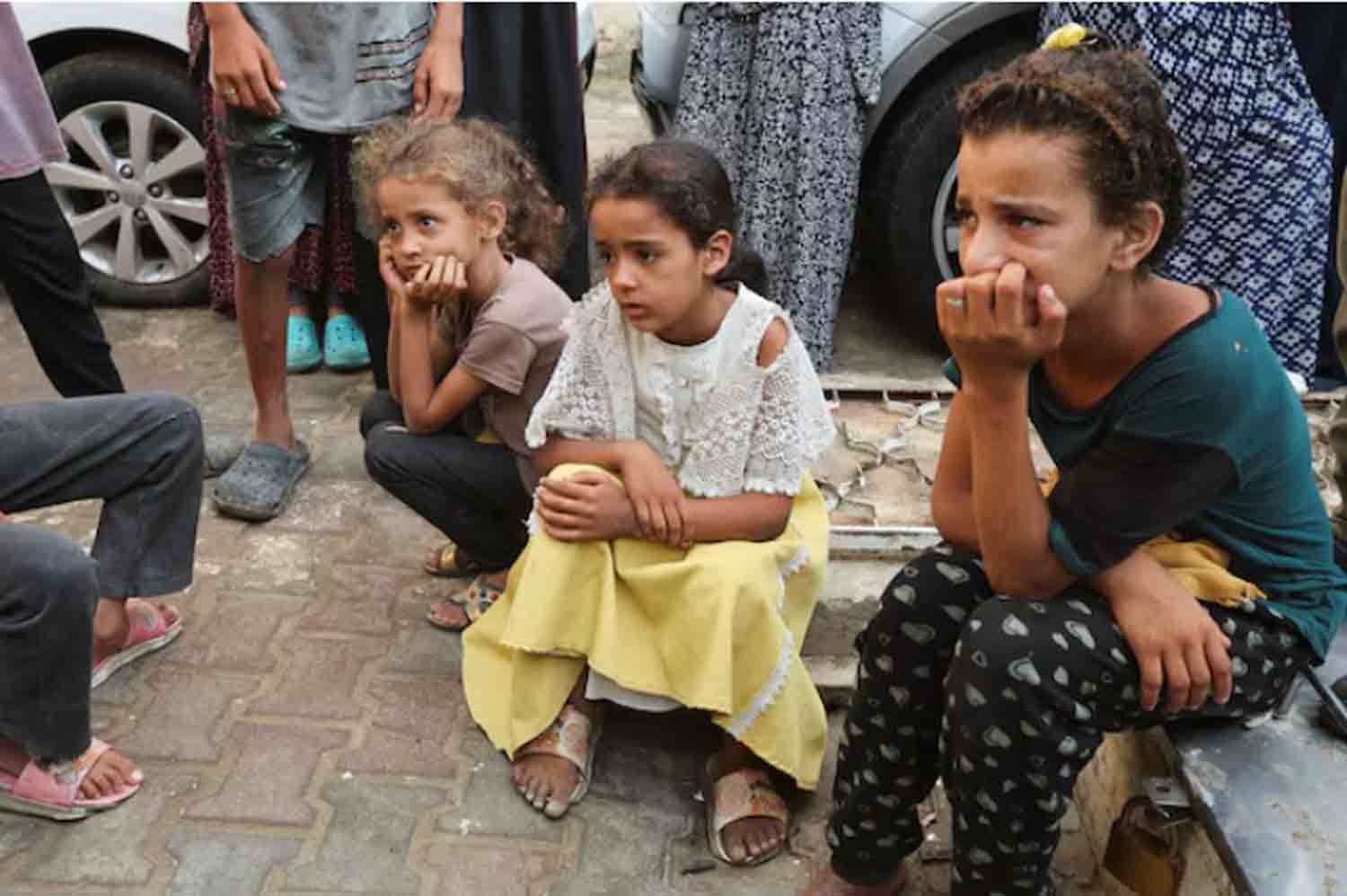
Children at tent camp for displaced people in Gaza

In February, while holding an ice cream cone, President Joe Biden of the United States stated that a ceasefire in Gaza was imminent, potentially occurring within days.

However, over seven months later, Israel’s military actions in Gaza have not only persisted but have intensified, with Israeli forces conducting invasions and airstrikes in Lebanon as tensions and violence escalate throughout the Middle East.

The Biden administration has consistently called for de-escalation while simultaneously offering political backing to Israel and maintaining a steady flow of munitions to support its military operations.

Washington has largely endorsed Israel’s aggressive actions this year, including the targeted killings of Hamas leaders in Beirut and Tehran, the assassination of Hezbollah leader Hassan Nasrallah, and the incursion into southern Lebanon.

More than a year into the conflict in Gaza, Israel continues its relentless offensive in the besieged territory, resulting in nearly 42,000 fatalities, while also conducting daily bombings in Beirut and gearing up for potential military action against Iran.

As the situation in Gaza escalates and extends throughout the region, the disparity between US rhetoric and its actual policies is becoming more pronounced.

Is the Biden administration merely unable to restrain Israel, as many liberal commentators argue? Or is it actively contributing to the escalation, using the turmoil to further a more aggressive stance towards Iran, Hamas, and Hezbollah?

The concise answer is that through its ongoing military and diplomatic backing of Israel, the US continues to play a significant role in the violence in the region, despite its public statements advocating for restraint and a ceasefire, according to analysts. While it is challenging to ascertain the administration’s true motives or intentions, there is an increasing amount of evidence indicating that the Biden administration is closely aligned with Israel, rather than being a passive ally facing defiance.

What actions and statements have been made by the US thus far?

Following an extensive public campaign advocating for a ceasefire in Gaza, the US has redirected its attention towards backing the Israeli military operations in Lebanon.

Last week, US Secretary of Defense Lloyd Austin expressed support for an Israeli ground offensive in southern Lebanon, which has the potential to escalate into a comprehensive invasion of the nation.

“I have made it clear that the United States stands behind Israel’s right to defend itself,” Austin stated on September 30 after a discussion with his Israeli counterpart, Yoav Gallant.

“We concurred on the importance of dismantling the attack infrastructure along the border to prevent Lebanese Hezbollah from executing attacks similar to those on October 7 against Israel’s northern communities,” Austin remarked, referencing the assault by Hamas on southern Israel that resulted in the deaths of at least 1,139 individuals.

The Lebanese group initiated attacks on Israeli military targets in October of the previous year, claiming it was a strategy to compel the Israeli government to cease its military actions in Gaza, which were launched in response to the Hamas assault.

For several months, the frequent clashes were primarily confined to the border region. This violence has caused tens of thousands of individuals from both sides to flee. Hezbollah contended that residents of northern Israel could only return once the country halts its military operations in Gaza.

In response to a targeted assassination campaign against Hezbollah’s senior military leaders, Israel commenced a significant bombing campaign across Lebanon, resulting in the destruction of civilian homes in numerous villages and towns starting on September 23.

Since that time, Israeli military actions have forced over 1 million individuals to flee their homes in Lebanon.

Prior to this escalation, the White House had been asserting for several months its commitment to finding a diplomatic resolution to the tensions at the Lebanon-Israel border. US envoy Amos Hochstein made numerous trips to the area, primarily to caution against further escalation.

As the ongoing low-level conflicts escalated into full-scale warfare in Lebanon, the Biden administration sought support from Arab and European nations, proposing an “immediate” 21-day ceasefire on September 25 to halt the violence.

However, just two days later, Israel carried out an airstrike that killed Nasrallah, destroying multiple residential buildings in Beirut and effectively eliminating any chance for a swift ceasefire. The White House praised the operation as a “measure of justice.” This assassination was authorized by Israeli Prime Minister Benjamin Netanyahu while he was in the United States for the United Nations General Assembly in New York.

Osamah Khalil, a history professor at Syracuse University, expressed skepticism regarding the authenticity of President Biden’s diplomatic initiatives, casting doubt on media claims that Hochstein had advised Israel to exercise restraint.

Khalil emphasized that the United States has been an active participant and supporter of Israel’s actions in Gaza and the broader region. He argued that the Biden administration utilized ceasefire discussions as a strategy to deflect domestic criticism.

“These negotiations were merely for appearances, especially as public sentiment towards the war grew increasingly negative,” Khalil remarked in an interview with Al Jazeera last month.

Transforming the Middle East

Recent reports from US media lend credence to Khalil’s claims.

On September 30, Politico cited unnamed sources indicating that high-ranking US officials, including Hochstein and Brett McGurk, the National Security Council coordinator for the Middle East, have discreetly endorsed an Israeli military initiative against Hezbollah.

The publication noted, “Behind the scenes, Hochstein, McGurk, and other senior U.S. national security officials are framing Israel’s operations in Lebanon as a pivotal moment—one that will positively reshape the Middle East for years to come.”

In a separate report, Axios highlighted that the US is seeking to capitalize on the recent setbacks Israel has inflicted on Hezbollah by advocating for the election of a Lebanese president aligned with Washington’s interests.

The Lebanese presidency has remained unfilled for nearly two years, as the parliament struggles to reach a consensus on a new leader.

On Tuesday, US State Department spokesperson Matthew Miller characterized the conflict in Lebanon as an “opportunity” for political transformation. He expressed that Washington aims for the Lebanese populace to have “the ability to elect a new president [and] the ability to break the stalemate that Hezbollah has maintained over the country.”

Hezbollah and its allies hold numerous seats in the Lebanese parliament due to the outcomes of free elections.

The ambition to reshape the region has long been a cornerstone of the US neoconservative agenda, which advocates for support of Israel and the promotion of US-aligned governments through assertive foreign policy and military actions. This strategy was particularly evident during the administration of former US President George W. Bush.

Eighteen years ago, during the Bush administration, Israel engaged in its last significant conflict with Hezbollah, prompting then-Secretary of State Condoleezza Rice to describe it as the “birth pangs of a new Middle East.”

Khalil pointed out that many neoconservatives from the Bush era have since aligned themselves with the Democratic Party, now supporting Vice President Kamala Harris in her presidential campaign for the upcoming November election.

Harris has received the endorsement of former Vice President Dick Cheney, a prominent figure behind the “war on terror” and the 2003 invasion of Iraq led by the United States.

As chair of the Senate Foreign Relations Committee, President Biden also supported the Iraq war, a stance shared by Secretary of State Antony Blinken, who was a Democratic staff member on the committee at that time. McGurk, who was an adviser in the Bush White House, played a significant role in the U.S. occupation of Iraq, while Hochstein has a background in the Israeli military.

Khalil remarked, “There is a neoconservative agenda within the Democratic administration.”

Gaza Failures

As the conflict intensifies in Lebanon and global attention shifts to a potential confrontation between Iran and Israel, numerous analysts argue that President Biden’s inability to resolve the situation in Gaza has contributed significantly to the current instability in the region.

Khalil Jahshan, executive director of the Arab Center Washington DC, emphasized that the Biden administration’s unwavering support for the Netanyahu government is leading the entire region into uncertain territory.

In an interview with Al Jazeera, Jahshan remarked that over the past year since the onset of the Gaza war, the US has demonstrated “total blind support” not only for Israeli policies but also for “Israeli excesses.”

“This outcome stems from a one-sided approach that has dismissed any rational considerations from the outset of this conflict,” he stated.

Following Hamas’s attack on Israel on October 7, 2023, Biden quickly expressed steadfast support for the US ally.

He supported a “swift, decisive, and overwhelming” military response from Israel against Hamas. The White House also quickly sought additional funding from Congress to bolster military aid to Israel in order to support the ongoing conflict.

Despite increasing calls for a ceasefire amid a worsening humanitarian crisis, Washington maintained that Israel had a “right” to pursue Hamas.

Recent investigations by ProPublica and Reuters revealed that the Biden administration received and disregarded internal alerts regarding potential Israeli war crimes in Gaza while continuing arms transfers to Israel.

As both domestic and international criticism mounted following Israel’s extensive destruction in Gaza, which displaced nearly all of the 2.3 million residents and pushed them to the brink of famine, Biden began to adjust his rhetoric.

In recent months, the U.S. has started using the term “ceasefire” to advocate for an agreement that would halt the fighting in Gaza and facilitate the release of Israeli captives held by Palestinian factions in the besieged area.

However, there has been minimal pressure on Netanyahu to agree to such a deal.

Whether Biden and his team genuinely sought a ceasefire but were unsuccessful, or if they employed the diplomatic initiative as a diversion from the grim realities of the U.S.-backed conflict, the outcome remains the same—an escalating war resulting in the deaths of tens of thousands of innocent individuals.

The evidence indicates that it is politically beneficial for them to publicly advocate for a ceasefire while failing to take any meaningful steps to achieve it, stated Ryan Costello, a policy director at the National Iranian American Council (NIAC), an organization in the United States that encourages diplomatic relations with Tehran.

Jahshan further remarked that the Biden administration has not presented equitable ceasefire proposals while simultaneously supplying arms to Israel.

“What is the purpose of a ceasefire if those proposing it are still providing military support to one of the involved parties?” he questioned. “That does not constitute a ceasefire; it merely serves as an invitation to prolong the conflict.”

Iran’s diplomatic efforts for mitigating the extent of Israel’s retaliation

0

Iran’s government is exhibiting considerable anxiety and has been actively pursuing urgent diplomatic discussions with various Middle Eastern nations. The aim is to explore possibilities for mitigating the extent of Israel‘s retaliation following its missile strike earlier this month. Should these efforts prove unsuccessful, Iran seeks assistance in safeguarding its interests, as reported by US media.

This apprehension is largely due to doubts regarding the US’s ability to persuade Israel against targeting Iranian nuclear facilities and oil infrastructure. Additionally, Iran’s primary proxy militia in the region, Hezbollah, has suffered significant setbacks due to recent Israeli military actions, further heightening Tehran’s concerns.

The US has been in dialogue with Israel regarding its intended response to Iran’s attack on October 1. US officials have expressed a clear preference for Israel to refrain from striking Iranian nuclear sites or oil facilities. President Joe Biden recently communicated with Israeli Prime Minister Benjamin Netanyahu, marking their first discussion in nearly two months, during which he emphasized that Israel’s response should be “proportional.”

The Gulf allies of the United States, including the United Arab Emirates, Bahrain, and Qatar, have conveyed their apprehensions to the US regarding a possible assault on Iranian oil facilities. Such an attack could lead to significant economic and environmental repercussions for the entire region, according to an Arab diplomat speaking to CNN.

The Biden administration is increasingly alarmed that the ongoing cycle of retaliatory strikes between Iran and Israel, which escalated earlier this year following Israel’s attack on what Iran claimed was its consulate in Damascus, could escalate into a broader regional conflict that might involve the US.

A significant aspect of these concerns is the perceived decline in US influence over Israel over the past year. In a manner similar to its actions in Gaza, Israel has shown a growing tendency to ignore US calls for restraint in Lebanon, where its extensive bombing campaign and ground operations have resulted in over 1,400 casualties since late last month.

Moreover, Israel did not seek US consultation prior to launching a large-scale attack that targeted thousands of communication devices used by Hezbollah operatives last month, nor before the assassination of Hezbollah leader Hassan Nasrallah in Beirut, which disrupted a fragile ceasefire proposal put forth by the US and France just 48 hours prior.

As of Friday, Israel’s security cabinet has yet to make a decision on the next steps, as reported by an Israeli official to CNN. While the divergence between US and Israeli positions appears to be narrowing, a US official cautioned that this alignment may not be sustained.

A senior administration official commented on the discussions within the Israeli cabinet, stating, “We cannot definitively ascertain whether they voted or not,” and expressed doubts regarding the transparency of the information Israel is providing to the United States. The official indicated that it may be unwise to place too much confidence in the actions of the Israeli government.

Israel has not provided any guarantees against targeting Iran’s nuclear installations.

For many years, Israel has been strategizing potential strikes on Iran’s nuclear capabilities, with a military exercise conducted two years ago simulating such an attack. Additionally, Israel is believed to have been involved in the assassination of Iranian nuclear scientists in recent years, and Iranian nuclear facilities have faced cyberattacks, likely attributed to Israel, including the notable Stuxnet virus that successfully infiltrated Iran’s Natanz nuclear site.

” Our response will be formidable”

Israel’s Defense Minister Yoav Gallant delivered a stern message to Iran regarding his country’s potential actions on Wednesday.

“Our response will be formidable, accurate, and most importantly – unexpected. They will be left bewildered by the events that unfold,” Gallant stated.

According to an Arab diplomat, the Gulf states generally prefer to remain neutral in the ongoing conflict. Although Iran has publicly declared that any entities perceived as supporting Israel will be regarded as aggressors, it is improbable that Iran’s neighboring countries would overtly defend Tehran in the event of an Israeli offensive.

However, Saudi Arabia, the United Arab Emirates, and Qatar have communicated to both the United States and Iran that they will not permit Israel to utilize their airspace for strikes against Iran, as reported by the Arab diplomat and another source familiar with the situation. Additionally, a Jordanian official confirmed that Jordan will safeguard its airspace from any unauthorized incursions, irrespective of their source.

The United States does not perceive that Iran seeks to engage in a full-scale conflict with Israel. Iran’s Foreign Minister, Abbas Araghchi, stated in an interview with Al Jazeera this week that Netanyahu is “the only one who wants a war and to set the region on fire to stay in power.”

Nevertheless, the US has communicated through backchannels to Tehran, advising them to carefully consider their response in the event of an Israeli strike, according to an official.

Qatar frequently engages in dialogue with Iranian officials and conveys their responses back to the US. However, the US official noted that ultimately, “we just do not know what [Iran] will do.” Various influential figures within Iran may have differing perspectives on how to react to Israel, which will largely depend on the magnitude and nature of the anticipated Israeli action, another US official indicated.

This official also mentioned that Iran’s messaging has remained consistent, both publicly and privately, since the country launched its missile attacks on Israel earlier this month, with no significant shifts in their communication.

Iran has shown a keen interest in seeking assistance from Saudi Arabia to deter an Israeli assault and in leveraging their influence with Washington to help resolve the ongoing crisis, as reported by an Arab diplomat to CNN.

Officials from various nations have convened three times within a month, and Araghchi visited Saudi Arabia on Wednesday to discuss regional issues and to address the actions of the Zionist regime in Lebanon and Gaza, as reported by local media.

The international community is closely monitoring Israel’s actions as it considers its response. However, until Saturday evening, Israel will observe a period of inactivity in recognition of Yom Kippur, the Jewish Day of Atonement, which is regarded as the most sacred day in Judaism. While it is not entirely out of the question for Israel to initiate military action, all businesses, restaurants, and services will be closed, public transportation will be suspended, and the main airport, Ben Gurion in Tel Aviv, will also be closed.

Nicaragua severs diplomatic ties with Israel

0
Nicaraguan Vice-President Rosario Murillo sings revolutionary songs during a march called "We walk for peace and life. Justice" in Managua, Nicaragua.

Nicaragua announced on Friday that it is severing diplomatic ties with Israel, labeling the Israeli government as “fascist” and “genocidal.” The Nicaraguan government attributed this decision to Israel’s military actions against Palestinian territories. Earlier that day, the country’s congress had adopted a resolution urging the government to take measures in alignment with the one-year anniversary of the Gaza conflict.

According to the Nicaraguan administration, the ongoing conflict has now expanded to include Lebanon and poses serious threats to Syria, Yemen, and Iran. The situation in the Middle East remains tense following Iran’s missile strikes on Israel on October 1. Iran supports the militant group Hezbollah, which has been the target of recent Israeli attacks. Additionally, Iran is an ally of President Daniel Ortega’s government. Nicaragua has faced increasing isolation in recent years, particularly after Ortega’s crackdown on anti-government protests in 2018, which resulted in approximately 300 fatalities, according to human rights organizations.

Israel employing strategies in southern Lebanon similar to Gaza

0

Israel‘s education minister, Yoav Kisch, stated in early July that “Lebanon, as we know it, will not exist.”

This remark echoed the sentiments of far-right Israeli officials who have called for the dismantling of the Lebanese militant group Hezbollah.

A year prior, Israeli ministers had backed Prime Minister Benjamin Netanyahu’s declared objective to “eradicate” Hamas in Gaza, following a deadly attack by the group on southern Israel that resulted in the deaths of 1,139 individuals and the abduction of approximately 250 on October 7, 2023.

In the name of this objective, Israel has reportedly killed over 42,000 Palestinians in Gaza, displaced nearly the entire population of 2.3 million, obliterated civilian infrastructure, and created conditions conducive to widespread famine.

Since intensifying its military actions against Lebanon in late September, Israel has been employing similar strategies in southern Lebanon, as reported by civilians, analysts, and human rights organizations.

Amal Saad, a Hezbollah expert originally from south Lebanon, stated, “The situation in south Lebanon cannot be compared to that of Gaza, as Gaza is experiencing a historically unprecedented crisis that amounts to genocide.”

She further remarked to Al Jazeera, “While Israel appears to be employing tactics similar to those used in Gaza, the current situation in Lebanon is not yet characterized by ethnic cleansing or genocide.”

However, she cautioned, “It has the potential to escalate in that direction.”

kill zones

On September 23, Israel’s military chief, Daniel Hagari, urged residents of south Lebanon to evacuate areas associated with Hezbollah’s military activities, including locations used for weapon storage.

According to Ramzi Kaiss, a Lebanon researcher for Human Rights Watch, the lack of specific guidance on which villages to evacuate and which areas might be safe rendered these warnings largely ineffective.

Furthermore, he noted that the warnings imply that Israel is categorizing anyone who remains in their villages, whether by choice or necessity, as a military target—similar to its approach in Gaza, where the Israeli military deemed areas designated for evacuation by Palestinians as “kill zones.”

Individuals who remain in these areas frequently face gunfire or aerial bombardment.

“Providing a warning does not grant permission to regard everyone as a combatant,” Kaiss stated.

Al Jazeera interviewed four residents from southern Lebanon who reported that most villages and towns beyond Sidon—located approximately 44 km (27 miles) south of Beirut—are nearly deserted.

Since September 23, Israel has reportedly killed nearly 2,000 individuals before they could evacuate their homes, including over 100 children, along with numerous medical personnel and rescue workers.

Ahmed, a young man from a small village near Nabatiya in southern Lebanon, chose not to evacuate due to his commitment to caring for his grandmother, who suffers from Alzheimer’s.

In a conversation with Al Jazeera, he recounted an Israeli bomb striking a location near his residence.

“There’s a 50-50 chance that someone still here will survive,” he conveyed in a voice message.

“The Israelis disregard civilian status,” he continued. “They assume everyone is a combatant, and many homes around me have been destroyed by Israel, despite the fact that there were no weapons in them.

“I knew all the residents of those homes.”

Israel blurred the lines between civilian and military targets

According to the latest data from the United Nations Satellite Centre (UNOSAT), Israel has damaged or destroyed approximately 66 percent of all structures in Gaza.

This widespread destruction suggests that Israel has deliberately blurred the lines between civilian infrastructure, such as homes, medical facilities, and aid warehouses, and legitimate military targets.

Analysts and civilians have indicated to Al Jazeera that this strategy appears to be mirrored in Lebanon.

An elderly resident from a predominantly Christian village in southern Lebanon reported that Israeli forces bombed both his home and that of his neighbor on September 30.

This attack resulted in the deaths of his wife and children, including a newborn less than a week old.

He mentioned fleeing to Beirut but did not specify the timing of his departure, emphasizing that Israel is targeting everything and sometimes provides civilians with delayed warnings.

“They did not provide us with any warning before commencing airstrikes on our village,” he stated to Al Jazeera. “This is unjust. The warning from them arrived only afterwards.”

A recent video shared on social media depicts the border town of Yaroun, a largely Shia community, devastated by Israeli bombings over the past year.

The visuals are reminiscent of those from Gaza and heighten concerns that many more civilians may lose their lives, according to Kaiss from HRW.

“Based on our observations on the ground, there is a considerable risk that civilians in the region will encounter atrocities or be subjected to them,” he informed Al Jazeera.

Prolonged Displacement

As Israel conducts extensive bombings across Lebanon, residents are left anxious about the duration of their displacement—similar to the situation in Gaza, where Israel has largely evacuated the northern areas and continues to instruct those remaining to move south.

No one in Gaza is certain when or if they will be able to return to the north to rebuild their lives.

The prospect of prolonged, possibly permanent, displacement also troubles Jad Dilati, whose family fled from Nabatieh to Beirut as Israel intensified its military actions in Lebanon two weeks ago.

Structures and businesses that were integral to his daily life and childhood now lie in ruins, including the local vegetable market and barber shop.

He worries that his home could be next.

“They might target our house simply on a whim,” Dilati, 23, expressed to Al Jazeera. “I feel as though I will return to a town that is unrecognizable.”

Dilati considered the likelihood that he might not return to Nabatieh for an extended period, given the potential for the war to continue or for Israel to attempt to occupy southern regions again, similar to its actions from 1982 to 2000.

On October 8, a video shared on social media depicted Israeli soldiers hoisting their flag on Lebanese territory.

“This is the cost of living adjacent to an expansionist ethno-state,” Dilati remarked to Al Jazeera.

In spite of Israel’s invasion and the widespread devastation in southern Lebanon, Dilati remains hopeful about returning to Nabatieh to assist his community in rebuilding the homes and livelihoods that have been shattered by renewed Israeli aggression.

“We will reconstruct [Nabatieh] to make it even better than it was before. My parents work in Nabatieh. My sister attends school there. Everything I know, I learned in Nabatieh,” he expressed.

“I cannot fathom not being able to return. I understand what Palestinians have endured, and while it may be a possibility, I find it hard to imagine.

“I have faith that we will prevail [in the war], even if it requires time.”


Hezbollah says focus is on achieving a military victory over Israel

0

Hezbollah‘s current focus is on achieving a military victory over Israel; however, it remains receptive to any initiatives aimed at halting what it describes as “aggression,” according to Mohammad Afif, the head of the group’s media office, who spoke on Friday.

The hostilities between Israel and Hezbollah have escalated in recent weeks, with Israel conducting airstrikes in southern Lebanon, targeting Beirut’s southern suburbs and the Bekaa Valley, resulting in the deaths of several prominent Hezbollah leaders, alongside the deployment of ground forces into southern Lebanon.

Hezbollah has escalated its attacks by launching rockets further into Israeli territory.

“Tel Aviv is merely the beginning; Israel has experienced only a fraction of what is to come,” Afif stated during a televised press conference held in the southern suburbs of Beirut, with the backdrop of destroyed buildings.

“Our primary objective at this moment is to overcome the enemy and compel them to cease their aggression. Nonetheless, we welcome any political initiatives, whether internal or external, aimed at achieving a halt to hostilities, provided they align with our comprehensive strategy regarding the conflict, its context, and its outcomes.”

He refuted claims that weapons were stored in the southern suburbs of Beirut, asserting that Israel employed timed explosives to create that impression. He assured residents of the area, as well as those displaced from southern Lebanon and Bekaa, that they would soon be able to return home.


Putin and Pezeshkian emphasized the strengthening economic relationship between their nations

0
Russian President Vladimir Putin meets Iranian counterpart Masoud Pezeshkian on the sidelines of a cultural forum dedicated to the 300th anniversary of the birth of the Turkmen poet and philosopher Magtymguly Fragi, in Ashgabat, Turkmenistan.

Russian President Vladimir Putin engaged in discussions with Iranian President Masoud Pezeshkian on Friday in Turkmenistan, where both leaders emphasized the strengthening economic relationship between their nations and their aligned perspectives on global issues, a development that raises concerns in the United States.

In opposition to Washington and the European Union regarding Russia’s military actions in Ukraine, which Putin frames as part of a broader existential battle against a self-serving West, he is eager to enhance connections with what he refers to as the Global East and Global South.

As Russia prepares to host a BRICS summit in Kazan from October 22-24, Putin extended an invitation to Pezeshkian for an official visit to Russia, a proposal that the Iranian president accepted, as reported by Russia’s state RIA news agency.

Pezeshkian reportedly stated, according to Iran’s official IRNA news agency, “Our economic and cultural exchanges are being fortified daily and are becoming increasingly resilient.”

The increasing collaboration between Iran and Russia, driven by the intentions of their respective leaders, should be expedited to enhance their relationship, he stated. Last month, Pezeshkian pledged to strengthen his nation’s ties with Russia as a means to mitigate the impact of Western sanctions. Both nations are reportedly on the verge of finalizing a strategic partnership agreement, which Pezeshkian expressed hope could be completed during the upcoming BRICS summit in Russia later this month.

The United States views the deepening connection between Moscow and Tehran with apprehension, having accused Iran of providing ballistic missiles to Russia for use in the Ukraine conflict, a claim that Tehran has refuted.

NEW WORLD ORDER ON THE HORIZON, PUTIN STATES

Russia has announced that its collaboration with Iran is deepening across various sectors. According to the TASS news agency, Putin remarked to Pezeshkian during a conference in Ashgabat, Turkmenistan, that both nations are actively engaging in the international arena and share similar perspectives on global events.

Pezeshkian, as reported by IRNA, emphasized the significant complementary strengths of Iran and Russia, suggesting that their positions in the world align more closely with each other than with other nations. He previously criticized Israel for its actions in the Middle East, urging it to “stop killing innocent people,” and pointed out that these actions are supported by the U.S. and EU. Russia has also condemned Israel’s military operations, which it claims are aimed at ensuring its own security, particularly when they target civilian areas.

Putin further noted that economic relations between Moscow and Tehran are on the rise. In statements released by the Kremlin earlier on Friday, he indicated that a new world order is taking shape, with emerging centers of economic growth and political influence. He expressed Russia’s support for extensive international dialogue regarding this evolving multipolar world and its willingness to engage in discussions through various platforms, including the Commonwealth of Independent States, the Eurasian Economic Union, the Shanghai Cooperation Organisation, and BRICS.

Hezbollah is gearing up for a prolonged war following the significant loss of senior leadership

0
Hezbollah members parade during a rally marking al-Quds Day,

Hezbollah is gearing up for a prolonged war of attrition in southern Lebanon following the significant loss of its senior leadership due to Israeli military actions. A new military command has been established to oversee rocket launches and ground operations, according to two sources familiar with the group’s activities.

The organization has suffered greatly from three weeks of intense Israeli assaults, particularly the assassination of its leader, Sayyed Hassan Nasrallah. Observers, both allies and adversaries, are closely monitoring Hezbollah’s ability to withstand the Israeli forces that have entered Lebanon with the objective of pushing the group away from the border.

Despite the challenges, the Iran-backed organization retains a substantial arsenal of weapons, including advanced precision missiles that have not yet been deployed, as reported by four sources familiar with its operations. This comes in the wake of numerous airstrikes that Israel claims have significantly reduced Hezbollah’s military capabilities.

Following Nasrallah’s assassination on September 27, Hezbollah’s command structure faced disruption for several days until Shi’ite militants successfully established a new “operations room” within 72 hours, as confirmed by a Hezbollah field commander and a source close to the group.

Nasrallah, along with several other Hezbollah leaders and an Iranian commander, was killed when Israel successfully identified and targeted his fortified bunker beneath Beirut.

Despite ongoing Israeli assaults, the new command center has remained operational, allowing fighters in the southern region to launch rockets and engage in combat based on centrally issued directives, according to unnamed sources familiar with the situation.

A senior official affiliated with Hezbollah indicated that the organization is currently engaged in a war of attrition. Avraham Levine, an analyst at the Israeli think tank Alma, noted that Hezbollah is likely “well prepared and waiting” for Israeli forces, making them a formidable adversary. He emphasized that while the command structure has been compromised, Hezbollah retains the capability to target Israeli communities and confront Israeli troops, characterizing the group as “the same powerful terror army we all know.”

Fighters are empowered to execute orders “based on the capabilities of the front,” according to a Hezbollah field commander, who characterized the new command as “a narrow circle” maintaining direct contact with the field. It is uncommon for a Hezbollah field commander to engage with international media.

The commander noted that this new command functions under complete secrecy and refrained from providing additional information regarding its communication methods or organizational structure. Following the death of Nasrallah, Hezbollah has not appointed a new leader, and the most likely successor has also been killed. Sheikh Naim Qassem, the deputy leader of the Shi’ite group, expressed support for ceasefire initiatives this week while asserting that the group’s operational capabilities remain intact.

A source familiar with Hezbollah’s operations indicated that the group’s dedicated fixed-line phone network is “essential” for current communications. Reports suggest that this network withstood attacks on the group’s communication systems in September.

A statement released this week by the “operations room of the Islamic Resistance” claimed that fighters were actively resisting incursions and “watching and listening” to Israeli forces in unexpected locations, likely referring to concealed Hezbollah positions. This statement marked the first public acknowledgment of the new command’s existence, though it did not disclose the identities of its members or the circumstances of its establishment.

Hezbollah’s media office did not respond to a request for comment prior to publication, which included a comprehensive summary of the information shared by the field commander and other sources. Following the publication of this story, Hezbollah’s media office issued a written statement declaring that the portion of Reuters’ report “attributed to a Hezbollah field commander is completely false” and that there are “no sources in Hezbollah.”

When inquired about the situation in Lebanon, the Israel Defence Forces (IDF) directed Reuters to previous public statements.

TUNNEL WARFARE

On October 1, Israel announced that its ground forces had commenced operations in southern Lebanon, initially deploying commando units, followed by regular armored and infantry units. The military confirmed on Tuesday that reservists from the 146th Division are now actively engaged, increasing the total number of divisions operating on Lebanese territory to four.

While Israel has not disclosed the exact number of soldiers involved, a typical division comprises over 1,000 personnel. The troops are reportedly engaged in close-quarters combat with Hezbollah fighters, with Israel stating that twelve of its soldiers have lost their lives in southern Lebanon or northern Israel since the operation began.
Both Hezbollah and Israel acknowledge the existence of a vast tunnel network in southern Lebanon, which has expanded since the 2006 conflict between the two. A 2021 report from the think tank Alma suggests that these tunnels may stretch for hundreds of kilometers.

A Hezbollah field commander emphasized that the tunnels are “the foundation of the battle,” noting that the group has invested years in their construction. “Their time has come,” he remarked.
The Israeli military has released video evidence purportedly showing deep tunnels seized by its forces. One video, shared on October 5, appears to depict an underground room equipped with landline telephones, although Reuters has not been able to verify the video’s date or location.

A source affiliated with Hezbollah indicated that the tunnels identified by Israel were specifically constructed for the Radwan special forces units, intended for future operations in the Galilee region of northern Israel. This source claimed that Israel remains unaware of the full extent of the tunnel network.

HEAVILY IMPACTED BUT STILL RESILIENT

Andreas Krieg, a senior lecturer at the School of Security Studies at King’s College London, noted that while Hezbollah’s capabilities have been significantly diminished, the group continues to launch rockets at Israel with considerable intensity, reserving its ballistic missiles for critical situations.
Hezbollah has reported an increase in its firepower in recent days.

According to the World Factbook from the U.S. Central Intelligence Agency, prior to the current conflict, Hezbollah was estimated to have over 150,000 missiles and rockets in its arsenal.

Two sources indicated that Hezbollah has opted not to deploy its most advanced rockets, including precision-guided missiles, in order to conserve resources for a prolonged conflict and to prevent Israel from justifying broader attacks on Lebanese infrastructure, such as the airport in Beirut, as well as roads and bridges.

A third source mentioned that the group has refrained from targeting major Israeli cities like Tel Aviv with its most powerful weapons, as such actions would provide Israel with a rationale to intensify its military response against Lebanon.

It is clear that Israel has caused significant damage to Hezbollah. In September, thousands of booby-trapped communication devices utilized by Hezbollah operatives were detonated, an incident that Israel has neither confirmed nor denied involvement in.

Starting on September 23, Israel markedly increased its airstrikes, claiming to have destroyed tens of thousands of Hezbollah rockets, primarily located in southern Lebanon, the Bekaa Valley, and the southern suburbs of Beirut.

Israeli officials have indicated that Hezbollah’s average daily launch of 100-200 missiles and rockets, rather than the anticipated thousands, signifies a notable decline in their capabilities. Estimates regarding Hezbollah’s losses have varied, with one Western diplomat noting that prior to Nasrallah’s death, as much as 25% of their missile capacity may have been compromised. Reports from Reuters have previously highlighted that Iran had proposed to replenish its ally’s arsenal but encountered difficulties with supply routes.

The Israeli military claims to have eliminated hundreds of Hezbollah fighters, including a significant portion of the senior leadership within the Radwan special forces. The United States, which classifies Hezbollah as a terrorist organization, remarked that deputy leader Qassem’s recent call for a ceasefire indicates that the group is under pressure.

GUERRILLA TACTICS

In a recent and lethal confrontation, hidden Hezbollah operatives launched an assault on Israeli troops advancing near Odaisseh, a southern village, shortly after Israel had bombarded the area with artillery and airstrikes, according to a source affiliated with Hezbollah.

The ambush involved the use of mines and Russian-made Kornet anti-tank missiles, weaponry reminiscent of that employed against Israeli forces during the 2006 conflict in southern Lebanon.

This incident appears to correlate with the Israeli military’s report of five soldiers from a commando unit being killed and five others suffering serious injuries during a gunfight on October 2.

The Israeli military has refrained from providing further details beyond its previously released statements. On the same day, two additional soldiers were reported killed in a separate event, as confirmed by the Israeli army.

Israel’s objective is to facilitate the return of tens of thousands of individuals who fled northern Israel following Hezbollah’s rocket attacks a year ago, which were launched in solidarity with Hamas in Gaza.

According to Lebanese officials, Israel’s military actions have displaced over 1 million people in Lebanon, primarily from the Shi’ite community that supports Hezbollah.

Mohanad Hage Ali from the Carnegie Middle East Center in Beirut anticipates an advance by Israeli forces, questioning the extent of the costs Hezbollah will impose on them.

The southern region holds significant symbolic value for Hezbollah, which was established by Iran’s Revolutionary Guards in the early 1980s partly to counter an Israeli invasion and subsequently fought against Israel’s prolonged occupation.

“Engaging Israel on the battlefield is fundamental to Hezbollah’s operations,” noted Krieg.
“This is their area of expertise, and most of their ground defenses have been specifically designed for this purpose,” he added.

Hezbollah aims to convey a strong message to Israel, as well as to its supporters in Lebanon and allies within the Iran-backed Axis of Resistance, demonstrating that it remains resilient and capable of inflicting substantial damage on Israeli forces.

Russian hypersonic missile hit the vicinity of Ukraine’s significant airbase

0

A Russian hypersonic missile hit the vicinity of Ukraine‘s significant Starokostiantyniv airbase on Monday morning, according to a rare admission from Kyiv, following a drone and missile assault that also affected the capital.

This latest attack on the Starokostiantyniv airfield, located in the western Khmelnytskyi region and frequently targeted by Russia, occurred just a day after the Dutch defense minister announced that the Netherlands would be providing additional F-16 jets to Ukraine in the upcoming months.

Ukraine received a shipment of F-16s this summer after extensive lobbying efforts directed at Western nations, and it maintains strict confidentiality regarding the locations of its warplanes to safeguard them from Russia’s long-range strikes throughout the conflict. The air force, which typically refrains from disclosing damage to military installations, did not confirm whether the strike inflicted any damage on the airbase, making the acknowledgment of a missile hitting the area particularly noteworthy.

Governor Serhiy Tyurin reported that there were no civilian casualties or damage to essential infrastructure. The air force confirmed that two Kinzhal missiles were intercepted in the Kyiv region. Although debris fell in three districts of Kyiv, city officials stated that there were no significant damages or injuries following the engagement of air defenses against incoming threats.

However, debris did cause damage to the roof of a multi-storey residential building and a supermarket in the Solomianskyi district, located in the western part of the city. Additionally, one piece of debris landed on school grounds, as noted by Serhiy Popko, the head of the city’s military administration.

In the central Shevchenkivskyi district, missile debris also fell in an open area, damaging a car in the southern Holosiivskyi district. Ukrainian air defenses successfully shot down 32 Russian drones, with an additional 37 drones detected as lost on military radars, indicating they may have been neutralized by electronic warfare systems, according to the air force. Since the onset of the war in February 2022, Russia has consistently conducted long-range missile strikes on Ukraine, with drone attacks occurring almost nightly.

India disregards international regulations, sanctions, and even diplomatic ties to bolster its domestic defense industry

0

India has historically been the largest importer of military equipment, but it is now actively working to bolster its domestic defense industry. In pursuing this goal, the country appears to disregard international regulations, sanctions, and even diplomatic ties. Notably, a state-run defense public sector unit continued to engage in arms sales with a controversial German firm that has faced a business ban.

Recent reports from Indian media indicate that concerns arose when Munitions India Limited (MIL), a government-owned entity, supplied approximately 500 tonnes of explosives to Rheinmetall, a German company that has been inactive since 2012 due to corruption allegations. The final shipment is believed to have been suspended after the issue was escalated to government authorities.

Over the past two years, MIL has experienced a surge in international orders, driven by increased global demand for explosives in the wake of the Russia-Ukraine conflict. The company has reached full production capacity, with numerous countries eager to place orders. Documentation reveals that the explosives were sold through an intermediary, with the initial shipment of 144 tonnes dispatched in October 2023 to a Spanish firm, Expal, which is now owned by Rheinmetall. Two additional shipments followed, with the last one occurring in March 2024.

Sources indicate that the initial delivery contract was established with Expel, which subsequently underwent a change in ownership to Rhine Metal. This transition was not communicated to the relevant higher authorities. Additionally, a comprehensive questionnaire submitted to the Ministry of Interior and the Ministry of Defense has not received a response.

Earlier it was revealed that artillery shells from Indian arms firms were being shipped to Ukraine by European customers and New Delhi had not intervened to stop the trade despite Moscow’s protests, Reuters news agency told Indian and European governments. A report was published in this regard after discussions with eleven sources and commercial analysis of the defense industry.