The 2026 Iran war may have reached another strategic turning point.
A report by The Wall Street Journal claiming that Bahrain and Kuwait secretly carried out direct airstrikes inside Iranian territory has introduced a new layer of uncertainty into an already expanding regional conflict. If accurate, the operation would represent the first publicly reported instance of the two Gulf monarchies conducting offensive military operations against Iran itself—a dramatic departure from decades of reliance on defensive postures and proxy conflict.
The report alleges that the strikes targeted Iranian missile and drone storage facilities responsible for supporting attacks against Gulf states and US military installations across the region. While neither satellite imagery nor official military evidence has independently verified the claims, the strategic implications are significant enough that defence planners throughout the Middle East are taking notice.
More importantly, the story highlights a broader transformation already underway: the gradual shift of Gulf Arab states from passive hosts of Western military forces into increasingly active participants in regional military operations.
Whether the reported strikes ultimately prove accurate or not, they illustrate how rapidly the strategic balance in the Persian Gulf is evolving.
A Story Built on Anonymous Sources
Before examining the military implications, it is essential to distinguish verified facts from unconfirmed reporting.
The Wall Street Journal based its report entirely on unnamed officials familiar with the alleged operation. According to those sources:
- Bahrain and Kuwait conducted covert airstrikes inside Iran.
- Iranian missile and drone depots were the primary targets.
- The UAE supplied intelligence and defensive air cover.
- The operation occurred earlier this month.
However, several critical pieces of evidence remain absent.
There are currently no publicly released:
- satellite images confirming damage;
- battle damage assessments;
- official acknowledgements from Bahrain;
- Iranian military statements confirming the attacks;
- independent visual evidence showing the strikes occurred.
Kuwait has gone further than remaining silent.
Its ambassador in Washington publicly rejected reports that Kuwait participated in attacks against Iran or allowed its territory to be used for offensive operations.
That denial creates a direct contradiction with the newspaper’s reporting.
For analysts, this means the alleged operation should currently be treated as plausible but unverified, rather than established fact.
Responsible defence analysis requires distinguishing military possibility from confirmed operational history.
Why the Story Still Matters
Even if portions of the report ultimately prove inaccurate, it reveals an important strategic reality.
Until recently, Gulf states largely preferred to fight Iran indirectly.
Their approach relied on:
- missile defence,
- intelligence sharing,
- hosting American forces,
- supporting coalition operations,
- economic pressure,
- diplomatic balancing.
Direct attacks inside Iranian territory represented an escalation most Gulf capitals sought to avoid.
That calculation has changed dramatically during the current conflict.
Iran has repeatedly launched missiles and drones toward Bahrain, Kuwait and other Gulf states hosting American forces.
US bases, desalination plants, airports and energy infrastructure have all become potential targets.
As Iranian attacks intensified, Gulf governments faced a strategic dilemma.
Should they continue relying solely on defensive interception?
Or should they begin destroying launch capabilities before missiles leave Iranian territory?
The reported strikes suggest some Gulf leaders may now favour pre-emptive action over passive defence.
That represents a fundamental change in Gulf security doctrine.
Why Missile Depots Are Logical Targets
From a military perspective, the reported target selection makes operational sense.
Modern missile warfare depends less on launch vehicles than on logistics.
Missile storage sites.
Drone assembly facilities.
Command centres.
Communication hubs.
Fuel depots.
These facilities collectively sustain Iran’s long-range strike capability.
Destroying launch infrastructure reduces the number of missiles that can be fired in future salvos.
Rather than attempting to intercept every incoming drone or ballistic missile, attacking logistics forces Iran to rebuild its strike inventory.
This strategy mirrors operations conducted elsewhere.
Ukraine has increasingly targeted Russian ammunition depots instead of only intercepting missiles.
Israel routinely strikes missile production and storage sites throughout Syria and Lebanon.
The United States has repeatedly attacked Houthi drone storage facilities in Yemen.
In military terms, degrading logistics often produces greater long-term effects than destroying individual launchers.
If Bahrain and Kuwait indeed participated, selecting missile depots would represent the most militarily rational objective.
Could Bahrain and Kuwait Actually Carry Out Such Missions?
The question is less about political willingness than military capability.
Individually, neither Bahrain nor Kuwait possesses the full spectrum of assets required for sustained independent operations against Iran.
Both maintain capable but relatively small air forces.
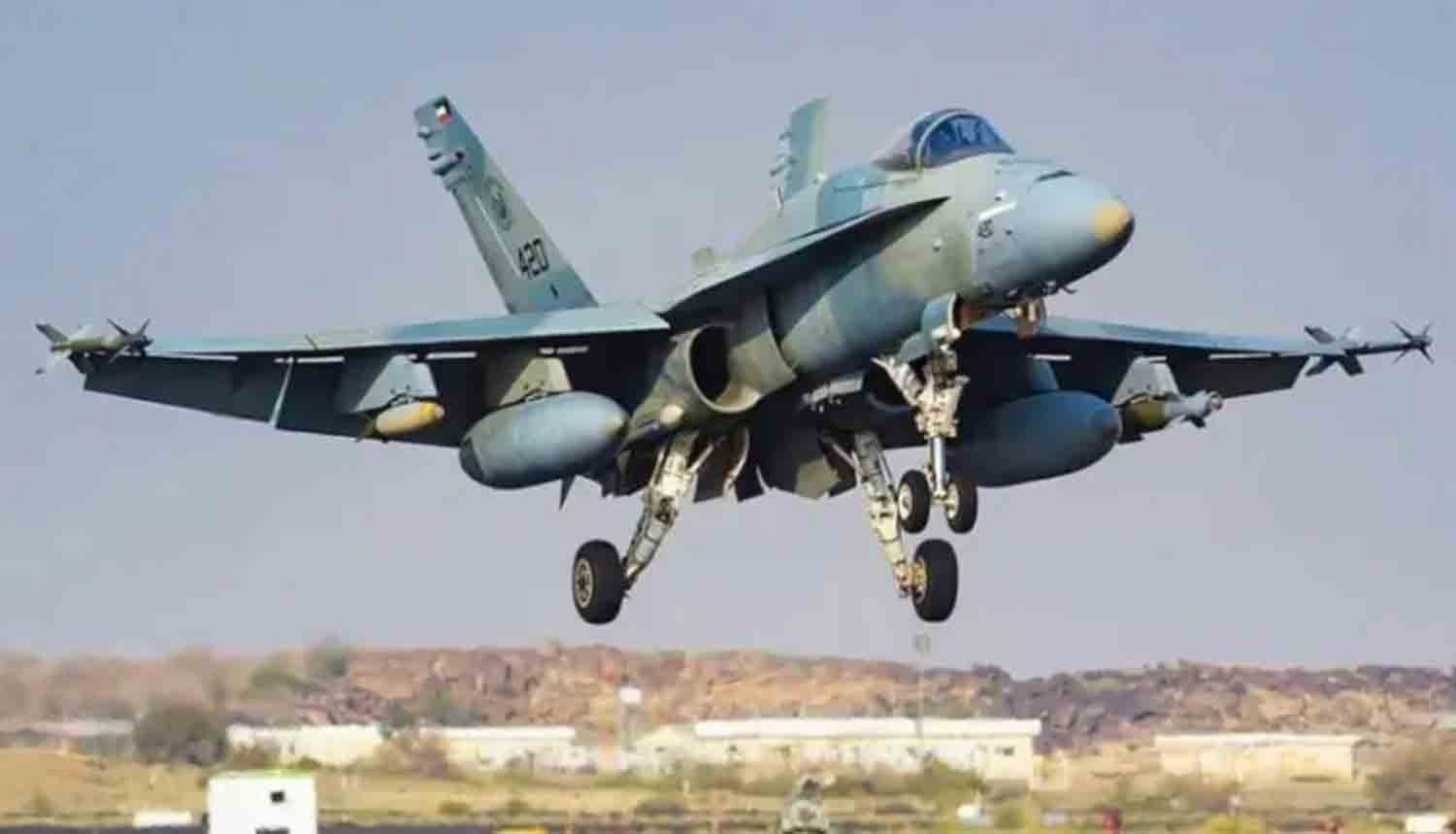
Kuwait Air Force
Kuwait operates:
- F/A-18C Hornets
- F/A-18D Hornets
- Eurofighter Typhoons
- incoming F/A-18 Super Hornets
These aircraft are fully capable of employing precision-guided weapons.
However, deep strikes into Iranian airspace require much more than modern fighters.
Successful operations demand:
- intelligence,
- electronic warfare,
- suppression of enemy air defences (SEAD),
- aerial refuelling,
- satellite surveillance,
- airborne early warning,
- secure command-and-control.
Kuwait has only limited indigenous capability in several of these areas.
Bahrain’s Air Force
Although much smaller, Bahrain fields one of the Gulf’s most modern fighter fleets.
Its upgraded F-16V Block 70 aircraft feature:
- AESA radar,
- advanced electronic warfare suites,
- Link-16 datalinks,
- modern precision strike capability.
These aircraft have already participated in intercepting Iranian drones during the current conflict.
Nevertheless, Bahrain’s limited fleet size means sustained offensive operations would quickly stretch available resources.
The Royal Bahraini Air Force was designed primarily for homeland defence—not prolonged campaigns against a country the size of Iran.
Coalition Warfare Changes Everything
Where the reported story becomes strategically credible is in its description of coalition support.
According to the report, the UAE supplied:
- intelligence,
- surveillance,
- targeting information,
- defensive air cover.
That changes the equation entirely.
Modern coalition warfare allows smaller air forces to generate combat power far beyond what they could achieve independently.
Instead of each country possessing every capability, coalition members contribute specialised assets.
One nation provides intelligence.
Another conducts electronic warfare.
Another performs aerial refuelling.
Others execute the strike itself.
The result is a single integrated kill chain.
This model closely resembles the operational architecture long employed by the United States and NATO.
If Gulf states are beginning to replicate that approach independently, regional military integration has entered a new phase.
The UAE’s Quiet Transformation into the Gulf’s Most Capable Military Power
Whether or not the reported Bahraini and Kuwaiti strikes actually occurred, one aspect of the story aligns closely with the military realities emerging across the Gulf: the United Arab Emirates has become one of the region’s most capable expeditionary air powers.
Over the past decade, Abu Dhabi has invested heavily in capabilities that extend well beyond territorial defence. Modern intelligence, surveillance and reconnaissance (ISR) assets, advanced command-and-control networks, electronic warfare systems and precision-guided munitions have transformed the UAE Air Force into a force capable of supporting complex coalition operations.
This evolution has been visible in multiple theatres, including Libya, Yemen and maritime security operations in the Gulf. The reported provision of intelligence and defensive air cover to Bahrain and Kuwait therefore fits an operational model that the UAE has been steadily developing for years.
If the report is accurate, the Emirates were likely not leading the mission but enabling it—providing the intelligence, targeting and airspace management that smaller Gulf air forces would struggle to generate independently.
That distinction matters because modern warfare is increasingly won not by the number of fighter aircraft a country possesses, but by the quality of its sensor network and its ability to fuse intelligence into real-time combat operations.
Saudi Arabia’s Strategic Calculation Is Becoming More Complex
Saudi Arabia occupies a unique position in the Gulf security architecture.
Unlike Bahrain or Kuwait, Riyadh possesses the region’s largest military and the financial resources to sustain prolonged operations. Yet military capability does not automatically translate into political willingness.
Earlier reports suggested Saudi aircraft may have participated in limited operations against Iranian targets alongside coalition partners. However, Riyadh has remained deliberately cautious throughout the current conflict.
That caution reflects several strategic realities.
Saudi Arabia has spent years attempting to reduce tensions with Tehran after the Chinese-brokered restoration of diplomatic relations in 2023. At the same time, the Kingdom remains deeply concerned about the vulnerability of its oil infrastructure, particularly after the 2019 attacks on Abqaiq and Khurais demonstrated how precision drone and missile strikes could temporarily disrupt global energy markets.
The Kingdom therefore faces a delicate balancing act.
It cannot appear weak in the face of repeated Iranian attacks, yet it also seeks to avoid becoming the centre of a full-scale regional war.
This explains why Saudi policy increasingly appears to combine military preparedness with diplomatic restraint.
Why Oman and Qatar Continue to Follow a Different Strategy
Not every Gulf state shares the same threat perception.
Oman has long positioned itself as the Gulf’s principal mediator, maintaining working relations with both Iran and Western powers. Muscat has frequently facilitated indirect negotiations that would have been politically impossible through more confrontational regional actors.
Qatar follows a similarly balanced approach.
While hosting one of America’s largest military bases in the region, Doha has simultaneously preserved communication channels with Tehran and has repeatedly acted as an intermediary during regional crises.
Neither country has shown any appetite for direct military confrontation with Iran.
This divergence highlights a broader reality often overlooked in discussions of Gulf security.
The Gulf Cooperation Council is not a unified military alliance comparable to NATO. Instead, each member state calculates risk through its own geography, economic exposure and domestic political priorities.
The current conflict is exposing these differences more clearly than at any point in recent decades.
The Strait of Hormuz Remains the Conflict’s Strategic Centre of Gravity
Regardless of where individual airstrikes occur, the true strategic prize remains the Strait of Hormuz.
Roughly one-fifth of the world’s seaborne oil trade passes through this narrow waterway connecting the Persian Gulf with international markets. Any disruption would immediately reverberate across global energy prices, shipping costs and insurance markets.
Iran has repeatedly threatened to interfere with commercial shipping if confronted militarily.
Although a complete closure of the Strait would also damage Iran’s own economy, Tehran possesses numerous options short of outright blockade.
These include:
- anti-ship missiles,
- naval mines,
- fast attack craft,
- one-way attack drones,
- harassment of commercial vessels,
- electronic warfare,
- maritime sabotage.
Each option allows Iran to increase pressure without necessarily crossing the threshold into a conventional naval war.
This “grey-zone” approach has become a defining feature of Iranian maritime strategy.
Gulf Infrastructure Remains Iran’s Most Powerful Pressure Point
Iran does not need to defeat Gulf militaries conventionally to impose significant costs.
Instead, Tehran can exploit the concentration of critical infrastructure along the Gulf coastline.
Unlike many larger countries, Gulf states possess relatively limited strategic depth.
Airbases, desalination plants, ports, oil export terminals, airports and electricity generation facilities are frequently located within missile range of Iranian territory.
This creates an asymmetric advantage.
A relatively inexpensive drone costing tens of thousands of dollars can threaten infrastructure worth billions.
Desalination facilities represent perhaps the most vulnerable targets.
Unlike oil installations, which can often resume operations after repairs, damage to large desalination plants could rapidly affect drinking water supplies for millions of people across the Gulf.
Military planners therefore view infrastructure protection as equally important as defending military bases.
Iran’s Escalation Ladder Is Still Climbing
Iranian officials have consistently rejected external pressure while signalling their readiness to continue military operations.
Statements from senior Iranian leaders emphasise resilience rather than compromise, suggesting Tehran believes prolonged confrontation may ultimately weaken coalition cohesion.
This reflects a long-standing feature of Iranian strategic culture.
Rather than seeking rapid military victory, Tehran often attempts to exhaust opponents politically, economically and psychologically.
Repeated missile attacks, drone strikes and calibrated escalation seek to increase the costs of continued confrontation while avoiding actions that would guarantee overwhelming retaliation.
The challenge for Gulf states is that every retaliatory strike risks climbing another rung on the escalation ladder.
If Bahrain and Kuwait have indeed crossed the threshold into direct offensive operations, Iran may increasingly view them not merely as hosts for American forces but as active belligerents.
That distinction could influence future Iranian targeting decisions.
What This Means for the United States
Although Washington may not publicly acknowledge involvement in every reported operation, the United States remains deeply embedded in Gulf military architecture.
American early-warning systems, Patriot missile batteries, intelligence-sharing arrangements, command-and-control networks and logistics infrastructure underpin much of the region’s collective defence capability.
Even when Gulf partners conduct independent operations, many rely on systems designed to operate within a US-led security framework.
This creates a strategic dilemma for Washington.
The United States seeks to reassure regional allies while avoiding uncontrolled escalation into a broader regional war.
However, as Gulf states assume increasingly active military roles, distinguishing between American operations and partner-led missions becomes progressively more difficult from Tehran’s perspective.
Iranian planners may interpret any Gulf military action as part of a wider coalition campaign, regardless of Washington’s actual level of involvement.
That perception alone increases escalation risks.
The Bigger Strategic Picture
Whether the reported strikes are eventually confirmed or disproved, the broader trajectory of Gulf security is becoming unmistakable.
The era in which Gulf monarchies relied almost exclusively on defensive interception is gradually giving way to a doctrine that places greater emphasis on pre-emptive disruption of enemy capabilities.
The conflict is also accelerating military integration among regional partners.
Shared intelligence networks, interoperable aircraft, integrated missile defence systems and coalition planning are transforming relatively small national air forces into components of a much larger regional security architecture.
At the same time, this transformation carries significant risks.
Greater military coordination enhances deterrence, but it also increases the possibility that localised incidents could rapidly expand into wider regional confrontations involving multiple states.
For global energy markets, the consequences extend well beyond the Middle East.
Every escalation around the Strait of Hormuz immediately influences oil prices, shipping costs, insurance premiums and supply-chain stability across Asia, Europe and beyond.
That is why even an unverified report about covert Gulf airstrikes deserves serious analytical attention.
Defence Talks Assessment
The alleged Bahraini and Kuwaiti strikes should not yet be regarded as established historical fact. The available evidence remains incomplete, official accounts are contradictory and independent verification is lacking.
However, dismissing the report outright would overlook the deeper strategic trends reshaping the Gulf.
Military capabilities across the GCC are becoming increasingly integrated. Smaller air forces are acquiring advanced platforms, precision-guided weapons and network-centric warfare capabilities that enable them to participate in operations once reserved for major powers.
At the same time, Iran continues to expand its missile and drone arsenal while demonstrating a willingness to strike regional infrastructure in response to perceived threats.
These parallel developments are changing the strategic balance.
The Gulf is no longer simply a theatre where regional states host foreign forces while avoiding direct confrontation. It is evolving into an environment in which local militaries are increasingly willing—and increasingly capable—of undertaking offensive operations as part of broader coalition campaigns.
Whether this particular operation occurred exactly as reported remains uncertain.
What is becoming increasingly certain is that the strategic landscape of the Middle East is changing faster than at any time since the 1991 Gulf War.