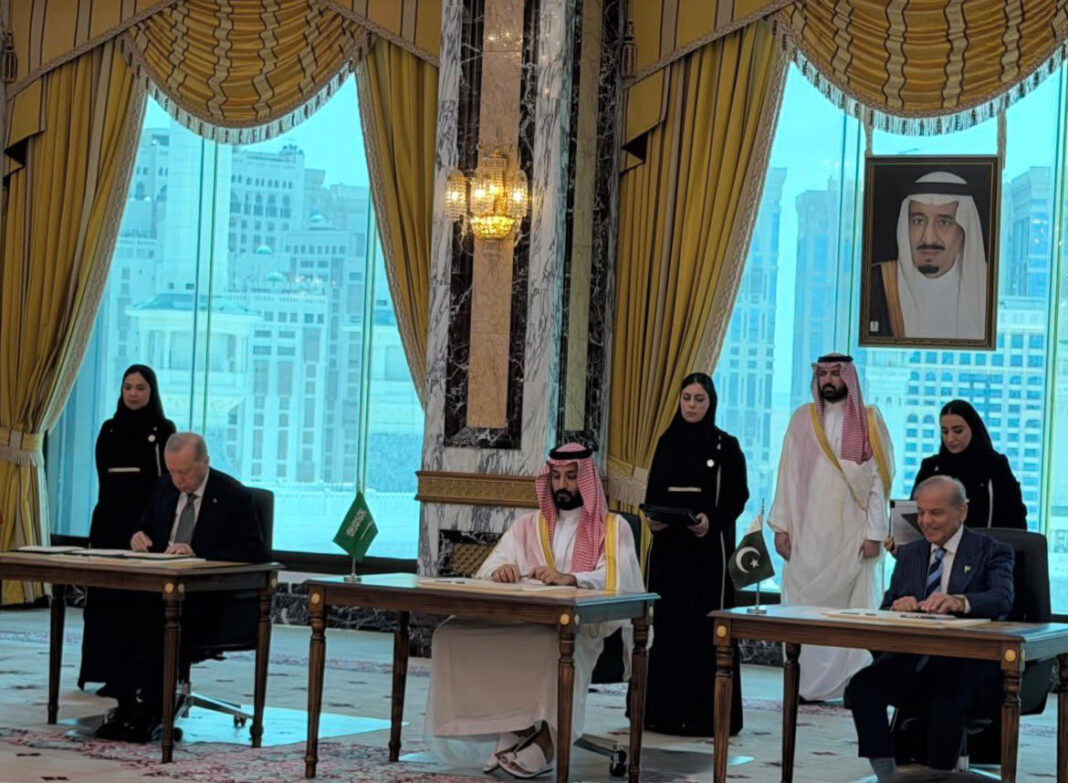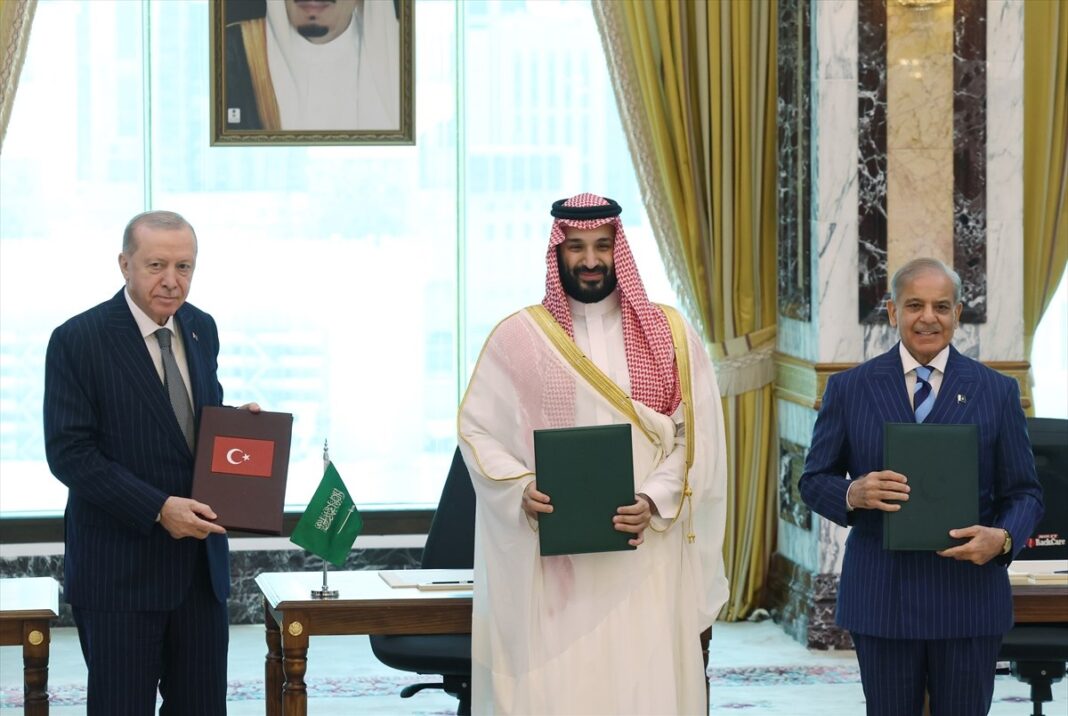
The Makkah Joint Defence Agreement, signed by Saudi Arabia, Türkiye and Pakistan, has triggered intense debate within India’s strategic community, with many defence analysts describing it as one of the most consequential regional security developments in recent years.
While India’s Ministry of External Affairs (MEA) has adopted a measured public stance, Indian media outlets and security experts have been far more vocal, questioning the agreement’s long-term implications for South Asia and the broader Middle East.
The agreement was signed during the Makkah Al-Mukarramah Summit for Joint Defence, attended by Saudi Crown Prince Mohammed bin Salman, Turkish President Recep Tayyip Erdoğan, and Pakistani Prime Minister Shehbaz Sharif.
Although the publicly released declaration emphasizes collective security, defence cooperation and regional stability, many Indian analysts believe its strategic significance extends well beyond its carefully worded diplomatic language.
India’s Official Response Remains Restrained
Unlike some previous regional security developments, New Delhi has not publicly criticized the agreement.
Indian officials have instead emphasized the importance of maintaining strong relations with Saudi Arabia while carefully monitoring developments.
This measured diplomatic response reflects India’s growing strategic and economic partnership with Riyadh.
Saudi Arabia today is:
- One of India’s largest crude oil suppliers.
- A major investor under Vision 2030.
- An important strategic partner in energy security.
- A participant in the proposed India-Middle East-Europe Economic Corridor (IMEC).
Because of these expanding interests, New Delhi appears reluctant to publicly challenge Saudi Arabia’s evolving defence relationships.
Indian Strategic Circles See a Bigger Geopolitical Shift
Outside official channels, however, the tone has been considerably different.
Leading Indian media outlets—including CNN-News18, WION, Times of India, India Today, Firstpost, and Republic—have described the agreement as a major geopolitical development rather than a routine diplomatic declaration.
Several retired military officers and strategic commentators argue that the agreement institutionalizes closer cooperation among three influential regional powers.
Their concern is not simply Pakistan’s participation but the combination of:
- Saudi Arabia’s economic and diplomatic influence.
- Türkiye’s rapidly expanding defence industry.
- Pakistan’s experienced military and nuclear deterrent.
From this perspective, some Indian analysts believe the agreement creates a more coordinated strategic partnership stretching from the Eastern Mediterranean to the Arabian Sea.
The Collective Security Clause Has Drawn Particular Attention
The clause attracting the greatest scrutiny states that an armed attack against one participating country would be regarded as an attack against all three.
Although the declaration provides no operational details explaining how such a commitment would be implemented, Indian defence commentators argue that its political significance should not be underestimated.
Questions frequently raised in Indian strategic discussions include:
- Would Saudi Arabia politically support Pakistan during a future India-Pakistan crisis?
- Could Türkiye increase military assistance to Pakistan?
- Will intelligence-sharing mechanisms emerge?
- Could future joint military exercises improve interoperability among the three armed forces?
At present, the declaration does not answer these questions.
Nevertheless, many analysts believe the clause represents a notable political signal regarding future security cooperation.
Pakistan-Türkiye Defence Cooperation Already Concerns India
For several years, Indian security analysts have closely followed expanding military cooperation between Pakistan and Türkiye.
Major areas of collaboration include:
- MILGEM-class corvettes
- Drone technologies
- Aerospace cooperation
- Electronic warfare
- Naval modernization
- Defence industrial collaboration
The addition of Saudi Arabia is viewed by some Indian commentators as adding both financial resources and greater diplomatic influence to an already expanding defence partnership.
Saudi Arabia’s Strategic Balancing Raises New Questions
One of the biggest surprises highlighted in Indian commentary is Saudi Arabia’s ability to simultaneously deepen defence cooperation with Pakistan while strengthening economic ties with India.
Rather than viewing the two relationships as contradictory, many analysts now argue that Riyadh has adopted a policy of strategic multi-alignment.
Under this approach:
Pakistan contributes:
- Military cooperation
- Defence expertise
- Regional security partnership
India contributes:
- Large-scale trade
- Energy markets
- Investment opportunities
- Technology cooperation
- Long-term economic growth
Several Indian think tanks argue that Saudi Arabia increasingly treats both relationships independently rather than viewing them through the traditional India-Pakistan rivalry.
Changing Security Calculations for India
Some Indian defence commentators argue that the agreement reflects broader changes in Asia’s security architecture.
India already faces growing strategic competition along its northern frontier with China.
Now, some analysts believe New Delhi must also account for increasing strategic coordination involving Pakistan, Türkiye and Saudi Arabia.
While few analysts describe the declaration as creating an immediate military threat, many argue it warrants close observation as future defence cooperation develops.
What Remains Unknown
Despite widespread debate, important questions remain unanswered.
The publicly released declaration does not establish:
- A permanent military alliance.
- Integrated command structures.
- Joint operational headquarters.
- Common force deployments.
- Defence procurement arrangements.
- Intelligence-sharing mechanisms.
- Mutual military assistance procedures.
Whether such frameworks emerge will likely determine the agreement’s long-term strategic significance.
Broader Regional Context
The agreement was signed against the backdrop of significant geopolitical changes across the Middle East.
Recent tensions involving Iran, Israel and the United States, combined with concerns over maritime security in the Strait of Hormuz and the Red Sea, have encouraged several regional powers to strengthen security cooperation.
For Saudi Arabia, the declaration reflects efforts to diversify security partnerships.
For Türkiye, it aligns with Ankara’s ambition to expand its regional influence.
For Pakistan, it reinforces longstanding defence ties with Riyadh while deepening strategic engagement with Türkiye.
Strategic Assessment
The reaction in India illustrates a clear distinction between official diplomacy and strategic debate.
While the Indian government has responded cautiously, much of India’s strategic community views the Makkah Joint Defence Agreement as a significant geopolitical development with the potential to reshape regional security calculations over time.
At the same time, it is important not to overstate what has been announced. The publicly available declaration provides broad political commitments but does not yet establish the detailed institutional or operational mechanisms typically associated with a formal military alliance.
The agreement’s long-term impact will therefore depend less on its symbolic language and more on the practical defence cooperation, military coordination and follow-on agreements that emerge in the months and years ahead. For India, the declaration serves as a reminder that the Middle East’s evolving security architecture is increasingly interconnected with South Asia’s strategic environment.